
Business payment processing fees: A UK guide for 2026
What if the headline rate on a payment proposal tells you less than you think? Business payment processing fees can include several charges, and a percentage alone may not show what accepting payments really costs across your sales channels. When fee terminology differs between providers and statements, comparing options or planning a budget becomes harder.
Look beyond the advertised rate. The full cost may include interchange, card-scheme and processor charges, alongside terminal or software subscriptions and transaction-specific fees. The mix can vary by payment type and channel, so a rate that looks simple on paper may not reflect your actual payment activity.
This guide explains the main components of processing fees and how to assess them using your transaction records and statements. You’ll also learn how to compare pricing models and manage costs without making payments less convenient for customers. The aim is a clearer view of what you’re paying, what those charges support and where informed decisions can improve your payment operations.
Table of Contents
Business payment processing fees explained: what can you be charged for?
How business payment processing fees build up across a transaction
How to assess business payment processing fees using your own figures
How to manage payment processing fees without harming the customer experience
How Dojo supports business payment processing and clearer payment operations
Business payment processing fees explained: what can you be charged for?
Payment processing fees are charges associated with accepting and processing a business payment. Their amount and structure depend on the provider, payment type and agreement. They can include costs linked to individual transactions and recurring charges for equipment, software or an account. There’s no single rate or standard list for every business, so compare your agreement with the charges shown on your statements.
Some charges apply only when a payment is made, refunded or handled in a particular way. Others may continue during quieter trading periods, even if transaction volume falls. Focus on the charges that apply to your arrangement rather than assuming every fee mentioned elsewhere is universal.
Which payment fee terms should a business recognise?
Three terms help explain how card transaction costs are built up:
Interchange: a component associated with a card transaction and linked to the card issuer, usually the customer’s bank. The Interchange fees reference gives more background on the term and its regulation.
Card-scheme fees: charges associated with the card network, such as Visa or Mastercard, which provides the rules and infrastructure that support card payments.
Acquirer or processor margin: the provider’s charge for services involved in handling the payment, such as processing the transaction and enabling acceptance.
These components may be shown separately or combined into a single rate, depending on the pricing model. A blended price can be easier to read, while itemised pricing can show how different costs contribute. Statement labels vary, so match unfamiliar terms to the descriptions in your agreement.
Which charges are separate from transaction processing?
A transaction charge is linked to payment activity. A terminal rental or software subscription is a recurring charge for equipment or services, usually billed on a regular schedule. For example, a business with fewer sales in a quiet month may pay less in transaction charges while its agreed terminal or software subscription continues.
Other charges depend on the contract and services used. An agreement may specify charges related to refunds, authorisations, account services or particular payment types. These aren’t automatic features of every arrangement. Check the pricing schedule and statement together to see whether a charge is occasional, transaction-linked or recurring.
For a clear picture of business payment processing fees, separate variable transaction costs from fixed or periodic service charges. This makes it easier to understand why the total changes between statement periods and gives you a sound basis for assessing the full cost.
How business payment processing fees build up across a transaction
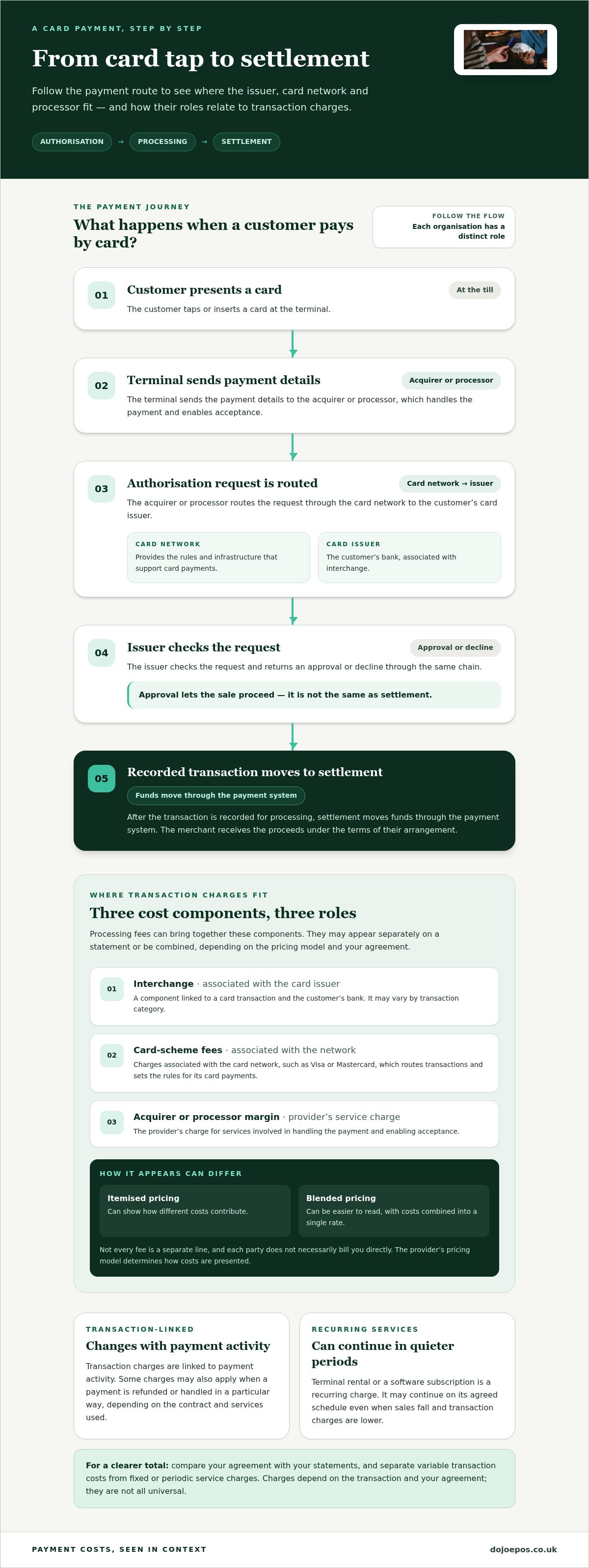
A card payment moves through several organisations before the sale proceeds reach your business. Each has a distinct role, and transaction charges may be combined or itemised according to your merchant agreement.
Processing fees can bring together interchange, card-scheme charges and an acquirer or processor’s service margin. The applicable components depend on the transaction and your agreement. That doesn’t mean every fee is charged as a separate line or that each party bills you directly. Your provider’s pricing model determines how the costs are presented.
What happens when a customer pays by card?
When a customer taps or inserts a card at the till, the terminal sends the payment details to the acquirer or processor. It routes an authorisation request through the card network to the customer’s card issuer. The issuer checks the request and returns an approval or decline through the same chain. Approval lets the sale proceed, but it isn’t the same as settlement.
After the transaction is recorded for processing, settlement moves funds through the payment system and the merchant receives the proceeds under the terms of their arrangement. The issuer, card network and acquirer or processor each play a role. The issuer is associated with interchange, the network with scheme charges, and the acquirer or processor with the service that enables the business to accept and process the payment.
Payment service providers operate within a wider UK regulatory framework. The Financial Conduct Authority (FCA) regulations on payment services explains the FCA’s approach to payment institutions and electronic money institutions. This is useful background, but it doesn’t tell you how a particular provider will itemise transaction charges.
How do interchange and card-scheme charges fit together?
Interchange relates to the card issuer and may vary by transaction category. Card-scheme charges are associated with the network that routes transactions and sets the rules for its card payments. They’re separate from the acquirer or processor’s service margin, which covers the provider’s part in enabling acceptance and handling the payment. Your statement may show these components individually or group them into a broader charge.
Why can payment type and channel affect the fee breakdown?
A card-present transaction at a terminal and an online payment follow different acceptance processes. Their fee treatment can differ, but there’s no universal rule that one channel always costs more. Card type, transaction details and the terms in your agreement may all influence how charges apply. Check how your agreement categorises each payment type, then compare like with like across channels.
For example, if an in-person sale and an online order appear under different labels, don’t assume the difference is an extra provider margin. First identify whether the statement separates interchange and scheme charges or bundles them into a rate. A connected setup can help bring channels into a wider payment operation. Explore Dojo’s payment solutions for card-present and online acceptance.
How to assess business payment processing fees using your own figures
Your statements show what accepting card payments costs, rather than what a headline rate suggests. Use a consistent period and the same definitions each time you compare costs. This helps you distinguish transaction charges from the wider cost of your payment setup.
What should you look for on a merchant statement?
Start with the statement period, card sales volume and number of transactions. Then work through these four steps:
Collect statements: Gather statements and matching sales figures for the periods you want to assess. Use complete periods so the totals align.
Group charges: Separate transaction-processing charges from terminal rental, software subscriptions and any other itemised charges.
Calculate totals: Add the relevant processing charges for each period. Keep recurring costs as separate lines so they remain visible in your overall cost picture.
Review patterns: Compare equivalent periods and note changes in transaction count, average sale, payment channel or card mix. These can help explain why costs have shifted.
Check that the card sales figure covers the same dates and payment activity as the charges. If a statement includes adjustments or charges relating to a different period, record them separately rather than letting them distort the comparison.
How can you calculate an effective processing rate?
Add the transaction-processing charges for your chosen period, then divide that total by card sales for the same period. Multiply by 100 to express the result as a percentage.
Hypothetical formula: (relevant transaction-processing charges ÷ card sales for the same period) × 100 = effective processing rate.
This calculation gives you a useful view of processing costs against sales. It doesn’t replace your agreement’s pricing details, and it shouldn’t hide other costs. Keep terminal, software and other recurring charges visible as separate total-cost lines. To assess the full setup, include those lines in your review rather than folding them into the transaction rate.
Two arrangements with the same headline percentage may still produce different overall costs. One may include charges that another lists separately, or the transaction mix may differ. A fixed charge per transaction can also affect the overall result differently for businesses with different transaction sizes or volumes. Compare the same period, payment channels and charge categories before drawing conclusions.
Repeat the calculation across several comparable periods. A single statement can be affected by an unusual sales mix or one-off item, while a consistent review can reveal whether changes in volume, channel or recurring services are influencing your costs. For rate-specific context alongside your own figures, refer to the existing Dojo Card Machine Rates guide.
How to manage payment processing fees without harming the customer experience
Managing costs starts with understanding what your agreement and statements say. Don’t change how customers pay simply because one charge looks high. First identify what it covers, how it relates to your payment activity and whether the service still supports the way your business operates. A change that lowers one cost but adds friction at checkout may not be the right trade-off.
There’s no single tactic that will reduce payment costs for every business. Make informed choices that balance charges with dependable acceptance and the payment options customers expect.
Which payment operations should merchants review regularly?
Set a regular review schedule and use your statements and reporting to check:
Services and hardware: Confirm that the terminals, software and account services you pay for still fit your day-to-day operations. Flag recurring services that no longer support how you take payments.
Channels and transaction patterns: Compare in-person and online activity, transaction counts and payment mix across equivalent periods. Look for meaningful changes, not just a different total.
Charges against activity: Match statement periods to sales and investigate unfamiliar or unexpected changes. A shift in transaction mix or channel may help explain a difference, but check the itemised charges before drawing a conclusion.
Keep customer choice and reliable payment acceptance in view as you review costs. Removing a payment option or changing a checkout process can affect convenience, so weigh any potential saving against how customers shop and pay.
How can integrated payments support clearer cost management?
Connected payment and business systems can help align transaction records with sales information, making it easier to reconcile activity and compare channels. Clearer reporting may help you spot differences between payment records and sales totals, or understand how transaction patterns relate to charges. It doesn’t guarantee lower fees; its value is in supporting a more informed review.
For a deeper systems overview, consult the existing Integrated Payment Solutions guide. As you consider how payment tools fit together, explore Dojo’s integrated payment solutions for card-present and online operations.
Use what you learn to review the agreement, charges and payment workflow together. That keeps fee decisions grounded in your own activity while helping protect the smooth, dependable checkout experience customers need.
How Dojo supports business payment processing and clearer payment operations
Once you’ve assessed your transactions and separated processing charges from recurring costs, consider how a payment setup fits your business. Dojo offers card-present and online payment solutions, with transaction-based processing charges alongside terminal and software subscriptions. Reviewing these together gives you a clearer view of the payment services involved and the costs set out in your agreement.
How can a payment setup fit your business operations?
Start with how customers pay and how your team handles each sale. Card terminals support in-person acceptance, while online payment solutions serve digital sales. Integrated payments can connect payment acceptance with wider business systems, and Blinq POS software can form part of a point-of-sale setup. The right mix depends on your channels and workflows, not simply on a headline rate.
Dojo’s offering includes payment terminals such as Dojo Go and Dojo Pocket, integrated payments and Blinq POS. Consider these alongside the way you record sales, reconcile transactions and manage checkout. Dojo also offers next-day transfers. Transfer timing and applicable terms are part of the arrangement to understand when reviewing how funds fit into your cash-flow processes.
For a broader overview of provider services, the Merchant Services UK guide can help put payment acceptance in context. As you compare options, focus on how each part supports your operation: the channel it serves, the workflow it fits and the charges associated with it.
What should you understand before moving forward?
Use your transaction data to assess payment volumes, channels and patterns. Then review the agreement and separate transaction-based processing charges from terminal or software subscriptions. This makes it easier to understand both variable costs and recurring commitments, without assuming that one pricing structure or setup will suit every business.
Consider the complete payment journey as well as the statement. A solution needs to fit how customers pay and how your team manages sales and records. Clear reporting and connected systems may support reconciliation, while the service terms explain how charges and transfers apply. Keep those operational needs in view alongside cost when deciding what to use.
Dojo’s card-present and online payment solutions bring these considerations into one payment operation. Explore Dojo’s payment solutions to see how terminals, integrated payments and Blinq POS can fit your business, then review the relevant transaction charges and recurring subscriptions against your requirements. This gives you a practical basis for assessing business payment processing fees without losing sight of the experience you want customers to have.
Turn your next payment review into a growth decision
Make your next review a useful baseline, not just a check that the latest statement looks familiar. As your business changes, your payment needs may change too. A new sales channel, different customer habits or a shift in how your team handles transactions can all be reasons to revisit whether your setup still fits.
Keep business payment processing fees in view alongside the role each payment service plays in your day-to-day operation. That perspective helps you make considered choices as the business evolves, rather than reacting to one charge in isolation or changing a process customers rely on.
When you’re ready to explore a setup built around your payment needs, take the next step with Dojo. Explore Dojo payment solutions for your business and find a confident way forward for your payments.
Frequently Asked Questions
What are business payment processing fees?
Business payment processing fees are charges for handling payments a business accepts, most commonly card transactions. Your statement may show one combined processing charge or several line items, depending on your pricing arrangement. For example, a transaction charge could be listed separately from a terminal subscription. Read the statement alongside your agreement to identify which charges relate to accepting payments and which cover other services.
What is included in a card processing fee?
A card processing fee may include costs associated with interchange, the card scheme and the processor or acquirer’s service margin. Depending on the pricing arrangement, it may appear as one blended charge or as separate components. Some agreements may also specify charges for particular transaction events, such as a refund. Check the fee schedule for the terms that apply to your account rather than assuming every possible charge is included.
How are business payment processing fees calculated?
They’re calculated according to the pricing terms in your agreement. A charge might be a percentage of the transaction value, a fixed amount per transaction or a combination of both. To check a statement, compare the charges with card sales for the same period and account for any per-transaction charges separately. Use matching dates and sales figures so the calculation isn’t skewed by timing differences.
Why do payment processing fees vary between transactions?
Charges can vary because transactions may use different card types, payment channels or processing terms. For example, an online payment and a card-present payment may be treated differently under an agreement. The card used and transaction details can also affect how charges apply. Compare transactions with similar characteristics and check the relevant pricing terms before interpreting a difference as a change to your overall rate.
Are interchange fees the same as payment processing fees?
No. Interchange is one component associated with a card transaction and the card issuer; payment processing fees can cover a wider set of costs. Depending on the pricing model, interchange may be passed through as a separate item or incorporated into a combined charge. When reading an itemised statement, remember that interchange alone doesn’t necessarily show the total amount charged for processing the payment.
Can a business negotiate payment processing fees?
Businesses may be able to discuss or negotiate terms, though any change depends on the agreement and provider. Transaction volume, average sale value and the mix of payment channels can help you explain your requirements. Review the complete arrangement, including transaction charges and recurring services, rather than focusing only on one percentage. A negotiated rate doesn’t automatically mean lower overall costs if other charges or service needs differ.
Do payment processing fees include card machine rental?
Not necessarily. Card processing charges are generally linked to transactions, while card machine rental is a recurring cost for the hardware and may be listed separately in the agreement or statement. Rental can remain payable during a quieter trading period, depending on your terms. Check whether your statement separates equipment charges from transaction costs, then include both when assessing the total cost of accepting payments.


Comments