
Merchant account with fast payout: what UK businesses need to know
A fast payout isn’t decided by the moment a customer taps their card. If you’re looking for a merchant account with fast payout, focus on when the money becomes available in your business bank account, not simply when the payment is approved.
It’s easy to see a successful card payment and assume the funds are ready to spend. In practice, authorisation, processing, settlement and payout are separate steps, and each affects when money reaches your account. That gap matters when bills, stock orders or supplier payments are due.
This guide explains the journey from customer payment to payout, what settlement speed means and which terms can affect the timing. You’ll learn what to compare beyond a headline promise, including payout schedules, timing definitions and conditions. Dojo’s Next-Day Transfers can form part of a payment setup that helps you plan around expected takings.
Table of Contents
What does a merchant account with fast payout actually mean?
A merchant account with fast payout is a payment arrangement designed to move card takings into a business’s nominated bank account promptly after transactions are completed. Faster access can help you plan for routine outgoings, but “fast” depends on the full journey from customer payment to usable funds, not how quickly an account is approved.
Payout speed is the time between a completed customer payment and the point when the resulting funds are available to use in your business bank account.
A merchant account helps a business accept and manage card payments. For a useful grounding in the terminology, see What is a merchant account? Keep account setup separate from transaction timing: a quick application decision does not tell you when that day’s takings will reach your bank.
Authorisation, settlement and payout: what happens at each stage?
These terms describe different events. Knowing which one a provider means by “fast” makes it easier to compare payout claims:
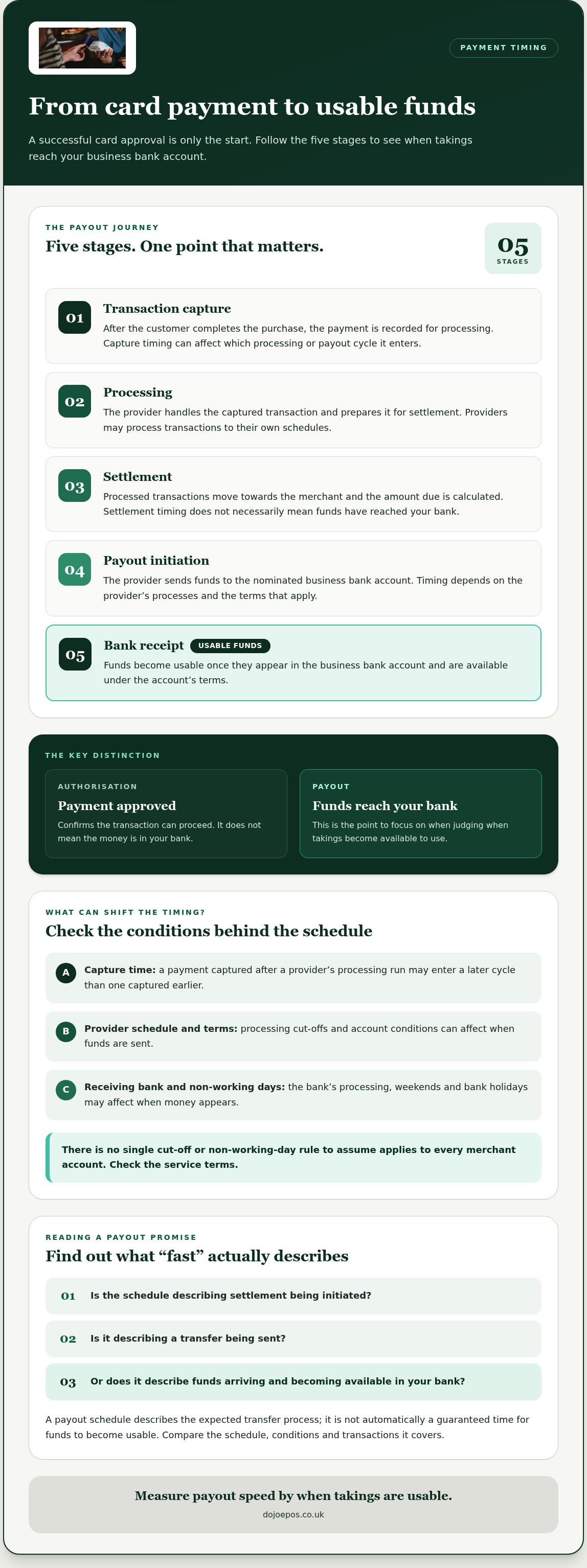
Authorisation: When a customer pays, the payment request is checked and approved or declined. Approval confirms the transaction can proceed, but it doesn’t mean the money is in your bank account.
Processing: The approved transaction is captured and handled through the payment system so it can be included in settlement.
Settlement: Processed transactions move through the payment system towards the merchant, and the amounts due are worked out.
Payout: Funds are sent to the nominated business bank account. They’re usable once they appear there and are available under the account’s terms.
Each stage contributes to the overall wait. A quick authorisation only describes the payment decision at the till or online checkout. It doesn’t show how soon settlement and bank payout will follow.
Why does payout speed matter to a UK business?
Predictable access to takings helps you coordinate card sales with outgoing commitments. A retailer may need to replenish stock, whilst a business with regular payroll needs to plan for wage payments. Knowing when funds are expected makes those decisions easier to organise.
Timing matters when working capital moves through the business quickly. If you take sales today but receive the funds later, there may be a gap between serving customers and having those takings available for planned outgoings. Faster payout won’t automatically improve profitability, but a clear schedule can help you manage cash flow with greater confidence. Focus on when completed transactions become usable funds, not just the approval message.
How does the merchant payout timeline work from payment to bank account?
A card payment passes through several steps before the takings are available in your business bank account. Mapping the journey helps you understand what a provider’s payout timetable covers and where timing can vary.
Transaction capture: The payment is recorded for processing after the customer completes the purchase. When it’s captured can affect which processing or payout cycle it enters.
Processing: The payment provider handles the captured transaction and prepares it for settlement. Providers may process transactions according to their own schedules.
Settlement: Processed transactions move towards the merchant, and the amount due is calculated under the payment arrangement. A settlement schedule may describe when this stage happens, rather than when money reaches your bank.
Payout initiation: The provider sends funds to the nominated business bank account. The timing may depend on the provider’s processes and the terms that apply to the account.
Bank receipt: The receiving bank processes the incoming payment. The funds become usable once they appear in the account and are available for business use.
The FCA outlines the UK framework for payment institutions in its guidance on FCA regulation of payment institutions. Regulatory information and payout timings answer different questions: the former concerns the provider’s regulatory framework, whilst the latter concerns the operational journey for your takings.
What can affect when card takings arrive?
Transaction timing, a provider’s processing schedule and the receiving bank can all influence when funds appear. For example, a payment captured after a provider’s processing run may enter a later cycle than one captured earlier. Any relevant cut-off depends on the service terms, so don’t assume there’s one universal time.
Weekends and bank holidays may also affect timing, depending on the provider’s service and how the receiving bank processes payments. Check the terms for the payout arrangement rather than assuming the same rule applies to every merchant account with fast payout.
How should a business read a payout schedule?
Check what the stated schedule measures: settlement being initiated, a transfer being sent, or funds arriving in your bank. Look for conditions that affect timing, including any processing cut-offs and how non-working days are treated.
A payout schedule describes the expected transfer process; it isn’t automatically a guaranteed time for funds to become usable. Once you know what the schedule means, you can set more realistic expectations for incoming takings. To see how payment services can fit into your business setup, explore Dojo payment solutions.
How to compare fast-payout merchant accounts without overlooking the conditions
A fast-payout headline is a starting point, not enough to judge how a payment arrangement will work for your business. Compare what the schedule means, which transactions it covers and what conditions apply. Keep application approval separate: a quick decision doesn’t indicate how soon card takings will reach your bank.
Use this comparison to organise the details:
Which payout details deserve a clear explanation?
Record both when a payout is initiated and when funds are expected to reach the business bank account. Read the service terms for conditions and exceptions rather than assuming a headline applies to every payment. Then map each payment channel to your workflow. For example, if your business takes payments in person and online, establish whether both types follow the same payout schedule.
For a broader look at payment costs and transparency, read Dojo’s guide to merchant account with no hidden fees.
How do payout schedules fit different cash-flow needs?
Match the schedule to the rhythm of your outgoings. A business that replenishes stock frequently may value predictable access to card takings. Payroll, supplier payments and seasonal changes can also affect how closely incoming funds need to align with planned costs. The aim is to understand timing, not assume faster payout alone resolves every cash-flow challenge.
Consider the full payment setup alongside payout timing. Dojo’s guide to merchant services in the UK offers further context on services that can support your payment workflow.
How can your business plan around faster merchant payouts?
A predictable payout schedule is most useful when it’s part of a regular cash-flow routine. Map expected card receipts against upcoming outgoings, then compare those expectations with what reaches your bank. Faster payouts can make funds available sooner, but they don’t replace forecasting or working-capital planning.
What should a simple payout-planning routine include?
Set a regular time to review payment records and bank activity. Use this checklist to keep the process consistent:
Map outgoings: Record recurring commitments such as stock orders, supplier payments and payroll, alongside their expected dates.
Group card sales by processing date: Keep transactions from different days separate so you can compare like with like.
Note expected payouts: Use the applicable payout schedule to estimate when each group of transactions should reach the business account.
Reconcile actual receipts: Compare transaction reports with bank statements. Account for adjustments shown in the records so you’re comparing the right amounts.
Log discrepancies: Record a delayed or unexpected receipt, its processing date and the amount shown in your records. Investigate before assuming what caused it.
This routine helps you spot timing patterns over time. If a payout arrives differently from your usual expectation, a clear record makes it easier to follow up and keep your cash-flow view current.
How can integrated payments support clearer reconciliation?
When payment and sales records are connected, it may be easier to match a transaction to the sale it relates to. That can make daily checks more manageable, especially if your business accepts payments through more than one channel. Keep a consistent process for comparing transaction reports, sales records and bank statements, whether the records are connected or reviewed separately.
For example, a retailer can compare card transactions recorded on a trading day with the payout entries expected for those sales, then note any differences for review. Reports show what was processed; the bank statement shows what arrived. Neither replaces a broader cash-flow forecast, which should also account for planned costs and changing demand.
Review your routine when trading patterns shift, such as during a seasonal increase in sales or a change in how customers pay. A Dojo payment setup can bring payment tools into the conversation as you organise records and plan around takings.
How Dojo Next-Day Transfers can support a more predictable cash flow
Dojo Next-Day Transfers is a payout offering for businesses that want to plan around next-day transfers. A clear schedule can help you organise routine operational outgoings, such as supplier payments or stock orders, alongside expected card takings. It provides a framework for planning, rather than removing the need to track what arrives and when.
As with any merchant account with fast payout, the useful detail is how the schedule works in practice. “Next day” describes the offering, but shouldn’t be read as a promise that every payment will arrive at a particular time. Keep the distinction clear: a transfer schedule helps set expectations, whilst funds are usable once they reach your business bank account and are available there.
What should merchants understand about next-day transfers?
Use the product terms to understand what the next-day schedule applies to and what conditions govern it. Don’t assume a particular cut-off, arrival time or treatment of weekends and bank holidays unless those details are stated for the service. This helps you plan realistically, then compare expected transfers with transaction records and bank activity.
For example, include expected payouts in your daily cash-flow view, then update it as receipts appear. This keeps the schedule useful without treating it as a guarantee or relying on an assumed arrival time to meet a commitment.
What is the next step towards a payment setup that suits your business?
Consider three practical points: when payouts are scheduled, which conditions apply, and how easily you can reconcile receipts against sales. Then look at how your customers pay. A business taking payments in person, online or through both channels needs a setup that supports its sales workflow as well as its cash-flow planning.
Dojo offers card-present and online payment solutions, alongside Next-Day Transfers. Together, these can form part of a payment setup built around how your business takes payments and manages takings. Explore Dojo payment solutions to see how they could fit your business.
Make payout timing part of your cash-flow plan
A merchant account with fast payout can support day-to-day planning, but headline speed is only one part of the decision. Understand the steps between a customer paying and funds reaching your bank, then compare payout schedules, conditions and payment channels with your business’s needs.
Build a routine for matching transaction reports with bank receipts, and track differences so you can investigate them without guessing at the cause. A predictable schedule can help you plan around regular outgoings, but it works best alongside cash-flow forecasting.
Dojo serves over 110,000 businesses worldwide and offers Next-Day Transfers as part of its payment offering. Explore Dojo payment solutions to see how payout timing can fit your operations and payment setup.
With clear expectations and consistent reconciliation, you can manage incoming takings with greater confidence and focus on moving your business forward.
Frequently Asked Questions
What is a merchant account with fast payout?
A merchant account with fast payout is a payment arrangement designed to transfer processed card takings to a business’s nominated bank account promptly. The key measure isn’t how quickly a customer’s payment is approved, but how soon the funds become available to use. Check what “fast” means, including whether the schedule refers to settlement, transfer initiation or money arriving in your bank.
How quickly can a merchant account pay out card transactions?
There’s no single payout speed for every merchant account. Providers set different schedules, and the time funds become usable can depend on when transactions are processed, the account’s terms and the receiving bank. Some payment arrangements offer next-day transfers, but that doesn’t necessarily mean funds will arrive at a particular time. Read the timing definition and conditions that apply to your account.
Is next-day payout guaranteed for every merchant?
No. A next-day payout description shouldn’t be treated as a guarantee that every merchant or transaction will receive funds the following day. Eligibility, service terms and processing conditions may affect how the schedule applies. Read the relevant product wording for the transactions covered, any applicable conditions and what “next day” means. Use the stated schedule to plan without assuming a specific arrival time.
Can a business receive card payments at weekends?
A business may be able to accept card payments at weekends if its payment setup and sales channel are available for use then. Taking a payment and receiving the resulting funds are separate events. A weekend transaction may follow the provider’s processing and payout arrangements, so don’t assume it will reach your bank that day. Check the relevant terms for the channel and schedule you use.
What is the difference between payment settlement and payout?
Settlement is the stage where processed transactions move through the payment system towards the merchant and the amount due is worked out. Payout is the transfer of funds to the nominated business bank account. The schedule may describe when settlement occurs or when a payout is initiated, rather than when the money is available to use. Compare both stages when reviewing a provider’s timing claims.
How do bank holidays affect merchant payouts?
The effect of a bank holiday depends on the provider’s payout service and the receiving bank’s processing arrangements. Some schedules may treat non-working days differently, but there isn’t one rule that applies to every account. Read the service terms for the relevant schedule and any stated exceptions. For cash-flow planning, don’t assume a transfer will arrive on a bank holiday unless that timing is explicitly covered.
Does faster payout mean a payment is approved faster?
No. Payment approval and payout speed describe different stages. Authorisation is the decision made when a customer pays, whilst payout is the transfer of funds to the business bank account after processing and settlement. A provider may approve a transaction promptly without sending the money to your bank at the same speed. Compare approval and payout as separate features when assessing a payment arrangement.


Comments