
Card Machine Contract Terms: A Merchant’s Guide to UK Transparency in 2026
If you believe your business is legally bound to a three-year terminal lease, you're likely paying for a contract that the regulator has already overhauled. Decoding card machine contract terms shouldn't feel like a full-time job, yet many UK merchants feel trapped by opaque notice periods and early termination fees. It's exhausting to manage the confusion between hardware rentals and processing agreements, especially when hidden clauses trigger automatic renewals without your consent. You've worked hard to build your brand; you shouldn't be held back by restrictive, outdated paperwork.
You deserve a payment partner that prioritises your cash flow over fine print. This guide shows you how to master complex deals and leverage the 18-month PSR rule to protect your bottom line. We'll explore the impact of the 2026 transparency directives and provide a clear checklist to help you switch providers without losing a single day of trading. By the end, you'll have the confidence to demand better terms and the agility to move your business forward with a solution that actually fits your needs.
Table of Contents
The Impact of the PSR 18-Month Rule on Card Machine Contracts
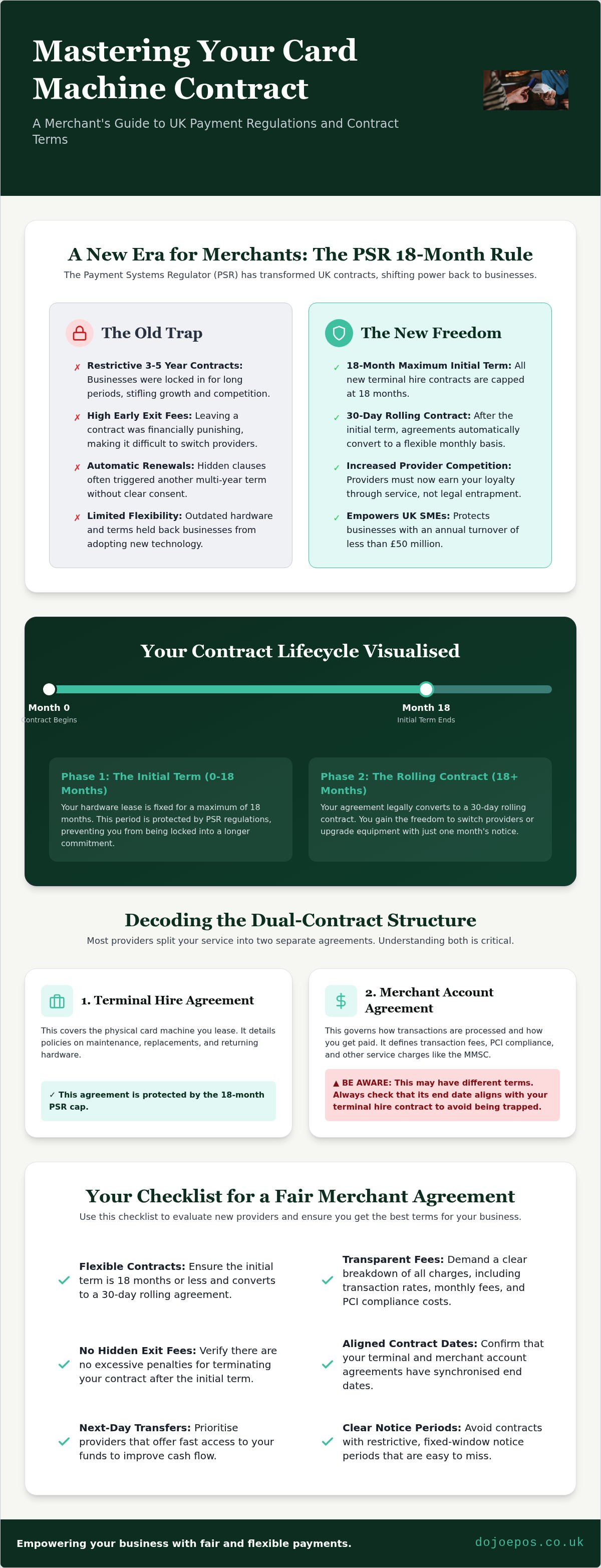
The Payment Systems Regulator (PSR) has transformed the landscape for UK businesses. Historically, traditional banks and legacy providers often locked merchants into restrictive, multi-year agreements that were difficult to escape. The PSR mandate now limits the initial term of card reader contracts for point-of-sale terminals to a maximum of 18 months. This regulation applies across the board, from high-street banks to modern fintech providers, ensuring that you aren't tethered to outdated hardware for half a decade. By standardising these card machine contract terms, the regulator has shifted the power back into your hands.
Why the 18-Month Cap Was Introduced
Before this intervention, it was common to find contracts stretching between three and five years. These long-term commitments stifled competition and made it nearly impossible for small businesses to switch to faster or more cost-effective technology. The PSR identified that a lack of transparency and high exit barriers were hurting the economy. This rule specifically protects businesses with an annual turnover of less than £50 million, covering the vast majority of UK SMEs. It encourages providers to earn your loyalty through service quality rather than legal entrapment. When providers know you can leave, they're incentivised to offer better support and more reliable hardware.
What Happens After the Initial Term Ends?
Once you complete your initial 18-month period, your contract doesn't just reset for another long term. Instead, it must legally convert into a 30-day rolling agreement. This means you can exit with just one month's notice, providing the ultimate flexibility to upgrade your hardware or move to a better deal. However, you must remain aware of the dual-contract structure. Whilst your terminal hire is capped, your merchant account for transaction processing may have different stipulations. Always verify that your card machine contract terms align across both agreements to avoid a "blindside" renewal on one half of your service. Understanding this transition is the first step toward maintaining a lean, agile business model that can adapt to new payment trends.
The PSR 18-month rule serves as a vital regulatory shield that prevents businesses from being trapped in indefinite, long-term lock-ins with payment providers.
Decoding the Dual-Contract Structure: Terminal Hire vs Merchant Accounts
Understanding card machine contract terms requires looking beyond a single signature. Most providers split the service into two distinct legal frameworks: the terminal hire agreement and the merchant account agreement. Misaligned end dates are a common trap in this structure. You might find your terminal lease ends months before your processing contract, leaving you stuck with a machine that doesn't work or an account with no way to take payments. Independent Sales Organisations (ISOs) often bundle these from different suppliers, adding layers of complexity. Dojo simplifies this through its relationship with Paymentsense Limited, ensuring a more cohesive experience, but you must still verify how these parts interact to maintain full control over your setup.
Hardware Rental Agreements
Your agreement for a Dojo Go or Dojo Pocket is essentially a lease for high-performance hardware. These terms specify maintenance and replacement policies, ensuring you aren't left stranded if a device fails. Most contracts include "fair wear and tear" clauses, but you'll be expected to return the hardware in good condition if you terminate the service. Clear terminal hire terms prevent unexpected bills for equipment you no longer use, allowing you to scale your fleet up or down as your business grows.
Merchant Account Processing Terms
The merchant account is the engine that moves funds from your customer's bank to yours. Terms here govern transaction fees, which typically follow a blended or interchange-plus structure. You can find a detailed breakdown of these costs in our guide to Dojo card machine rates. These terms also cover PCI DSS compliance and Minimum Monthly Service Charges (MMSC). An MMSC ensures the provider covers their costs even during your quietest trading months, so it's a critical figure to track for cash flow management.
Integrated Software Contracts (SaaS)
Modern commerce relies on integrated software like Blinq POS. Unlike traditional setups, this SaaS component often sits as an additional layer in your agreement. Having your software and hardware under one organised roof eliminates the friction between different tech support teams. Ensure your contract guarantees data ownership and portability, so your sales history remains yours even if you move your business model. If you're looking for a setup that works in harmony, consider exploring integrated payments that bridge the gap between hardware and software seamlessly.
Identifying Hidden Exit Fees and Notice Period Traps
Breaking free from a restrictive agreement requires a sharp eye for "poison pill" clauses. These are the subtle card machine contract terms designed to make leaving more expensive than staying. Many traditional acquirers rely on your oversight to trigger automatic renewals. If you don't act within a specific timeframe, you could find yourself committed for another year without intending to be. Understanding these traps is essential for any merchant looking to maintain business agility.
The Notice Period Window Trap
Some providers use an "anniversary" notice trap. This means you can only cancel your service during a narrow window, perhaps 30 days before the contract's annual renewal date. If you miss this window by a single day, the contract rolls over for another full term. To avoid this, always document your intent to cancel through a recorded delivery letter or a time-stamped email. Ensure you quote your Merchant ID (MID) in every piece of correspondence. This prevents the provider from claiming they couldn't identify your account, a common tactic used to delay the process.
Administrative and Hidden Exit Costs
Whilst the PSR 18-month rule offers protection, providers often find other ways to charge you on the way out. Look for de-installation fees or terminal refurbishment charges tucked away in the small print. These can add hundreds of pounds to your final bill. You might also see a "PCI non-compliance" fee appear on your last statement, even if you've been compliant for years. An exit fee should never exceed the remaining rental value under PSR guidelines.
Calculating your potential Early Termination Fee (ETF) is usually a matter of multiplying your monthly rental by the months left in your initial term. However, always check for "administration" or "de-programming" fees that can inflate the total. A vital rule for any merchant is to never give notice to your current provider until your new system is fully live and processing payments. Losing trading days during a transition is far more costly than paying for two systems for a short overlap. By staying organised, you ensure your card machine contract terms work for you, not against you.
How to Evaluate a New Merchant Agreement: A Practical Checklist
Evaluating card machine contract terms before you sign is your best defence against future frustration. Whilst many merchants focus purely on how to leave a provider, your priority should be finding a partner you actually want to stay with. Flexibility is the ultimate benchmark of a modern agreement. A rolling monthly contract or a short-term initial period indicates a provider's confidence in their own service. If a company doesn't feel the need to lock you in for years, it's because they know their technology delivers results. Demand a contract that honours your business agility rather than one that treats you like a captive audience.
Cash flow is the lifeblood of any SME, so your checklist must prioritise settlement speed. Does the contract guarantee Next-Day Transfers as standard? Waiting three to five working days for your own money is an outdated banking practice that modern commerce shouldn't tolerate. Additionally, insist on total transparency. Your monthly statement should clearly separate Blinq POS software subscriptions, terminal rental, and PCI compliance fees. If these costs are lumped together, auditing your expenses becomes an impossible task. Finally, check the support SLAs. Technology can fail, but the real test is the recovery time. Look for hardware replacement guarantees that ensure you aren't left without a terminal for more than 24 hours.
The "Total Cost of Ownership" Review
Don't get blinded by a low transaction rate. Providers often recoup these losses through high fixed monthly costs or hidden escalation clauses that allow them to raise rates without your explicit approval. Verify that your agreement contains no joining or set-up fees. These upfront costs are often unnecessary barriers to entry designed to pad a provider's margins. A transparent agreement focuses on a fair price for a premium service, avoiding the bait-and-switch tactics common amongst legacy banks. If you're ready for a contract that respects your need for speed and clarity, explore our payment solutions today to see the difference transparency makes.
Service and Support Commitments
There is a massive difference between basic email support and a genuine technical partnership. High-volume environments require more than a simple chatbot when things go wrong. The card machine contract terms for Dojo Go and Dojo Pocket are built to support 24/7 operations, ensuring expert help is available whenever your doors are open. For larger merchants, the inclusion of a dedicated account manager is essential. This single point of contact provides a level of accountability that traditional call centres can't match, turning your payment provider into a reliable extension of your own team.
Why Flexible Contract Terms are Essential for Business Agility
Business needs change at a rapid pace. Rigid card machine contract terms act as a handbrake on growth, preventing you from adapting to new market conditions. If you're opening a second site or running a seasonal pop-up, you need the ability to scale your terminal fleet instantly. Flexible agreements allow you to add a Dojo Go or Dojo Pocket without being shackled to a new multi-year commitment. This agility ensures your overheads mirror your revenue, keeping your operations lean and responsive. Transparency isn't just a legal requirement; it's a vital financial strategy. When you understand every line item on your statement, you can forecast cash flow with pinpoint accuracy, free from the fear of unexpected administrative surcharges.
Fueling Growth with Next-Day Transfers
Cash flow is the ultimate metric for business health. Traditional banking contracts often include a "weekend lag" where Friday's takings don't hit your account until the following Tuesday. This delay cripples your ability to restock inventory or pay staff on time. Next-Day Transfers should be a non-negotiable standard in your agreement. Getting paid seven days a week, even on bank holidays, transforms your inventory management. It allows you to reinvest your earnings immediately, turning your turnover into a tool for expansion. Settlement speed is the clearest indicator of a provider's technological strength. If they can't move money quickly, they're likely using legacy systems that will eventually fail your business.
The Dojo Advantage: Built for Modern Commerce
The era of clunky, analog cash registers and opaque bank agreements is over. Modern commerce demands integrated solutions like Blinq POS that work in perfect harmony with your hardware. We believe a payment partner should earn your business every single month through exceptional service and reliable technology, not through a restrictive lock-in. Our agreements are written in clear, accessible language, providing the peace of mind you need to focus on what matters: growing your brand. You've seen how the PSR 18-month rule and transparent card machine contract terms protect your interests. Now it's time to choose a partner that actually wants you to succeed.
Take Control of Your Payment Strategy
The landscape of UK payments has shifted in your favour. By mastering the 18-month PSR cap and decoding the dual-contract structure, you can finally escape the cycle of restrictive legacy agreements. Transparency is no longer an optional luxury; it's a fundamental requirement for maintaining business agility in a competitive market. You shouldn't have to navigate "poison pill" clauses or wait days for your own funds to arrive. Modern card machine contract terms must empower your growth rather than stifle your ambition.
Choosing a partner that prioritises your cash flow allows you to reinvest in your inventory and staff with total certainty. It's time to demand a service that respects your independence and provides the tools you need to thrive without the fear of hidden fees. We are here to ensure that your transition is seamless and your settlement is fast. You've worked hard to build your brand; your payment partner should help you protect it.
Join over 110, 000 businesses and switch to Dojo today to benefit from Next-Day Transfers as standard, UK-based expert support, and agreements with no hidden long-term traps. We're dedicated to helping you move forward with confidence and speed. Your business deserves a payment solution that works just as hard as you do.
Frequently Asked Questions
Can I end my card machine contract early without paying a fee?
Usually, you can only exit without a fee if you've completed your initial term or are on a rolling monthly agreement. If you're still within your first 18 months, you'll likely face an Early Termination Fee (ETF) based on the remaining rental value. The PSR 18-month rule ensures you aren't locked in forever, but it doesn't eliminate fees for breaking a valid contract early. Always check for contract buyout offers when switching providers.
What is the maximum length for a card machine contract in the UK?
Under the Payment Systems Regulator (PSR) mandate, the maximum initial term for a terminal lease is 18 months for most SMEs. Once this period ends, the agreement must convert into a 30-day rolling contract. This regulation prevents providers from using long-term renewals to trap businesses. Reviewing your card machine contract terms will confirm if your current deal adheres to these transparency standards, giving you the freedom to seek better rates elsewhere.
Is my terminal hire contract different from my merchant account?
Yes, they are separate agreements. The terminal hire contract relates to physical devices like the Dojo Go, whilst the merchant account agreement covers the processing of your transactions. It's a common trap to have these contracts end on different dates. When evaluating your card machine contract terms, ensure both parts of the service are aligned. This prevents a situation where you're paying for an account but have no hardware to process payments.
How much notice do I need to give to cancel my card machine?
Most modern providers require 30 days' notice once your initial term has concluded. However, some legacy contracts include "anniversary" clauses that only allow cancellation during a specific monthly window each year. Missing this window can trigger an automatic renewal for another full term. To protect your business, always send your notice via recorded delivery or time-stamped email. Don't forget to include your Merchant ID (MID) to ensure your request is processed without any administrative delays.
What happens if I cannot find my original contract paperwork?
You can request a digital copy of your agreement directly from your provider's customer service department. They are legally required to provide this information upon request. If your provider is an affiliate of a larger organisation, like Paymentsense Limited, they will maintain these records centrally. Having the paperwork allows you to verify your notice period and any potential exit fees. This step is essential before you begin the process of upgrading to more flexible payment technology.
Are there hidden fees when switching to a new payment provider?
Hidden costs often lurk in the fine print of traditional agreements. You might encounter de-installation fees, refurbishment charges for old terminals, or administrative "exit" costs that aren't clearly advertised. Some merchants also see a final PCI non-compliance fee if their certification has lapsed. Choosing a transparent partner ensures these "poison pill" clauses are eliminated. Always ask for a comprehensive closing statement from your current provider to see exactly what you'll be expected to pay.
How long does it take to switch card machine providers?
The technical setup of a new system is fast, often taking less than three days from order to delivery. However, the total time to switch depends on your existing notice period. We recommend keeping your current terminal active until your new Dojo Pocket or Dojo Go is fully operational. This strategy prevents any loss of trading days. Once you're successfully processing on the new network, you can safely complete the cancellation of your old service.
Does the 18-month PSR rule apply to all business sizes?
The 18-month cap applies to businesses with an annual turnover of less than £50 million. This threshold covers the vast majority of UK high-street shops, restaurants, and independent traders. If your turnover is higher, your contracts are treated as bespoke commercial agreements and may not have the same regulatory protections. For most SMEs, this rule is a powerful tool for maintaining business agility and ensuring that payment providers earn their loyalty through service rather than legal lock-ins.


Comments