
Card Reader with WiFi and 4G: The Complete 2026 Merchant Guide
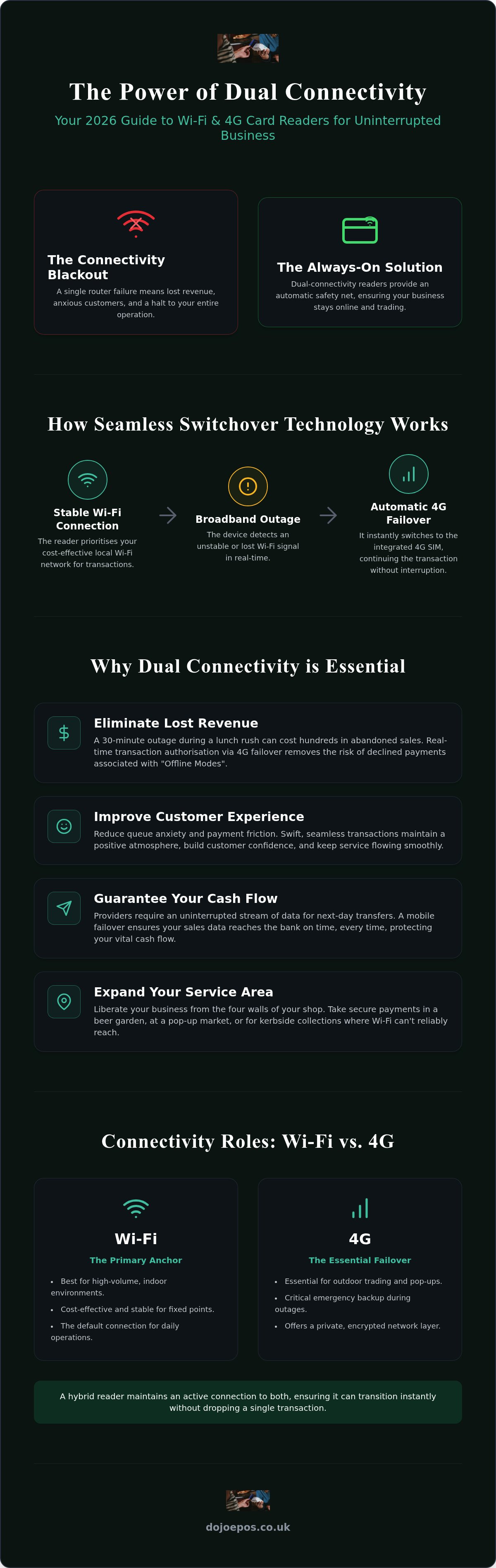
Imagine your busiest lunch rush. The queue is out the door, your team is flying, and then your router suddenly blinks red. For many merchants, this connectivity blackout means lost revenue and a room full of anxious customers. It's an avoidable crisis. Choosing a professional card reader with wifi and 4g ensures your business stays online, regardless of local internet hiccups or provider outages.
You understand that a reliable payment setup is the heartbeat of your operation. It's incredibly frustrating when complex tech requires manual switching or leaves you stranded whilst customers wait for a timed-out transaction. We're here to show you how dual-connectivity hardware provides the ultimate safety net by automatically switching to mobile data the moment your WiFi falters. This 2026 guide explores how to eliminate downtime, boost transaction speeds, and build a truly resilient payment environment that supports your growth.
Table of Contents
What is a WiFi and 4G Card Reader?
A card reader with wifi and 4g is a dual-connectivity device designed to eliminate the single point of failure that haunts traditional payment setups. Unlike older models that rely solely on a shop's router, these hybrid terminals house an integrated SIM card alongside standard wireless receivers. This architecture allows the machine to draw from two distinct data sources. If your local broadband stutters, the device immediately taps into the national mobile network to authorise the sale.
By 2026 standards, manual connection management is obsolete. Modern merchants require intelligent switching. This technology monitors signal strength in real time, shifting between networks without the staff ever needing to touch a settings menu. Whilst consumer-grade WiFi is excellent for internal stability, professional payment-grade 4G provides an encrypted, dedicated tunnel for sensitive data. This ensures that even in crowded areas where public WiFi is congested, your transaction remains secure and prioritised.
The Evolution of Payment Connectivity
The journey of the What is a Payment Terminal? has moved rapidly from fixed analogue phone lines to the agile, data-rich environment we see today. In the past, a cut cable or a local exchange fault could paralyse a business for days. Now, mobile data has transformed the landscape. 4G currently represents the sweet spot for UK merchants because it offers a perfect balance between widespread geographic coverage and low power consumption.
Modern readers like the Dojo Go and Dojo Pocket handle encrypted data packets with incredible efficiency. They don't just send a simple "yes" or "no" for a transaction; they transmit complex, multi-layered security tokens. 4G networks provide the necessary bandwidth to process these packets in seconds, keeping your queues moving whilst maintaining the highest levels of PCI compliance.
WiFi vs 4G: Which Does Your Reader Prefer?
In a standard indoor environment, WiFi is typically the primary connection. It's cost-effective and provides a stable anchor for fixed till points or restaurant tables. However, 4G is the essential failover that saves the day during "The Great British Broadband Outage." For mobile traders, market stallholders, or outdoor event caterers, 4G becomes the lead connection, providing a professional-grade link where traditional routers can't reach.
WiFi: Best for high-volume, indoor environments with a reliable local ISP.
4G: Essential for outdoor trading, pop-up events, and emergency backup.
Security: Both channels use advanced encryption, but 4G offers a private network layer away from public-facing WiFi.
A hybrid reader is a device that maintains an active heartbeat on both signals, ensuring it can transition between WiFi and 4G without dropping the transaction.
Why Dual Connectivity is Essential for UK Merchants
UK business infrastructure isn't infallible. In busy urban centres, local broadband networks often buckle under the weight of peak-time demand, leaving merchants vulnerable to sudden outages. A card reader with wifi and 4g acts as a vital insurance policy for your revenue. When your primary line fails, your terminal shouldn't skip a beat. This level of reliability is critical for maintaining customer confidence; lags in payment processing often trigger queue anxiety, making customers restless and suspicious of technology failures. A swift, seamless transaction keeps the atmosphere positive and your table turnover high.
Beyond the shop floor, your connectivity directly dictates your cash flow. To guarantee next-day transfers by 10am, your provider requires a consistent, uninterrupted stream of transaction data. If your reader stays offline during a broadband dip, your funds could be delayed. Using a reliable card machine with mobile failover ensures your data reaches the bank on time, every time, regardless of local internet hiccups.
The Cost of a Dropped Connection
A 30-minute WiFi failure during a Friday lunch rush can cost hundreds in abandoned sales. It's not just about the money; it destroys your service flow. Staff spend precious time rebooting routers or apologising to customers instead of serving them. Whilst some providers offer an "Offline Mode," this is a risky alternative. It allows payments to be stored and processed later, but you won't know if a card is declined until the device reconnects. An active 4G failover removes this gamble by ensuring every transaction is authorised in real time.
Expanding Your Service Area
Dual connectivity liberates your business from the physical constraints of a router. You can process payments in a beer garden, at a kerbside collection point, or even at a local pop-up market without relying on temperamental WiFi extenders. This mobility doesn't compromise your safety protocols. By adhering to the rigorous guidelines set by the PCI Security Standards Council, a professional terminal ensures that mobile data is just as secure as a wired connection. This allows you to take your service to the customer, whether they are seated at the back of a terrace or waiting for a delivery at their front door.
How Seamless Switchover Technology Works
Seamless switchover technology is the engine that keeps your business running when the local infrastructure fails. A professional card reader with wifi and 4g doesn't just wait for a connection to drop before reacting. Instead, it employs an always-on architecture that maintains a secondary link in a dormant yet ready state. This proactive approach is what separates premium hardware from entry-level alternatives that leave you staring at a "Connecting..." screen whilst a queue builds up.
The process relies on constant latency monitoring. Your terminal sends tiny data packets to check the speed and stability of the WiFi signal. If the reader detects a significant spike in latency or a series of dropped packets, it initiates a millisecond transition to the 4G network. This handoff happens so fast that the transaction isn't interrupted, and the customer never sees a change on the screen. Most importantly, the Point-to-Point Encryption (P2PE) remains locked. The security tunnel doesn't break just because the transport method changed.
Automatic Failover vs Manual Switching
Manual switching is the enemy of efficiency. During a busy lunch rush, your staff shouldn't have to navigate complex settings menus to find a new signal. It's a recipe for human error and frustrated diners. Professional devices like the Dojo Go manage this entire cycle in the background. By the time a staff member notices the router is struggling, the terminal has already secured the payment via mobile data. This automation allows your team to stay focused on service rather than troubleshooting tech issues.
Data Security on Mobile Networks
A common concern amongst merchants is whether mobile data is as secure as a private shop network. It's crucial to understand that a card reader with wifi and 4g uses a private Access Point Name (APN). This means your payment data isn't travelling over the public internet like a standard smartphone browser. It's a dedicated, encrypted tunnel between the device and the payment gateway. This architecture is vital for mitigating Compromised Mobile Payment Terminal threats which often target vulnerable or unencrypted connections.
The built-in SIM card plays a dual role here. It doesn't just provide data; it acts as a hardware-based authentication key. This ensures the network only accepts transactions from verified, authorised terminals. By keeping your PCI-DSS compliance intact whilst you're on the move, this technology provides the same level of protection in a beer garden as it does at the main counter.
Choosing the Right Hardware for Your Environment
Selecting the right hardware requires more than just checking a spec sheet. It's about how the device handles the pressure of your specific environment. A card reader with wifi and 4g must balance processing speed with physical durability. Power management is a primary concern; 4G connectivity naturally consumes more battery than WiFi because the terminal has to communicate with distant cell towers. If your business operates away from a charging base for long periods, prioritising a device with a high-capacity battery is essential to avoid mid-shift shutdowns.
Screen visibility is another critical factor for modern merchants. If you're taking payments in a bright beer garden or at an outdoor market stall, a standard screen can become unreadable. You need high-contrast, anti-glare displays to keep transactions moving without staff squinting at the terminal. Then there's the debate between pocket-sized portability and full-receipt functionality. Whilst digital receipts are growing in popularity, many UK hospitality businesses still rely on physical printouts for service speed and customer preference. Your hardware must match your workflow, not the other way around.
As we move through 2026, many merchants ask about the necessity of 5G. Whilst 5G offers incredible speeds for consumer tech, 4G remains the gold standard for payment terminals. Its architecture is more than sufficient for the small, encrypted data packets used in card processing, and it offers superior building penetration. Choosing a 4G-enabled device today ensures you have a stable, reliable connection that isn't prone to the signal drops sometimes associated with newer, higher-frequency networks. It's a future-proof choice that prioritises stability over unnecessary bandwidth.
The Handheld Powerhouse: Dojo Go
The Dojo Go is the workhorse of the UK hospitality industry. It's built for heavy-duty use in restaurants and busy retail shops where speed is the only metric that matters. With an integrated receipt printer and long-range WiFi and 4G antennas, it provides the robust feel that staff prefer during high-pressure shifts. Its ergonomic design and weighted balance make it a firm favourite for waitstaff who need to carry a terminal for several hours at a time without fatigue. It's the ideal solution for businesses that want a traditional, all-in-one terminal with modern, dual-connectivity brains.
The Ultra-Portable: Dojo Pocket
For mobile traders and those who value agility, the Dojo Pocket offers smartphone-sized technology without compromising on power. It's designed to manage 4G connectivity even in high-density crowd environments like music festivals or stadium concourses where bandwidth is often stretched thin. It provides a sleek, modern alternative to traditional, bulkier terminals. It fits easily into a pocket whilst still delivering the enterprise-grade security and speed your customers expect. It's perfect for queue-busting or taking payments on the move without being weighed down by extra kit.
Find the perfect fit for your team and order your Dojo card machine to start taking reliable payments today.
The Dojo Advantage: Reliable Payments Anywhere
Dojo doesn't just provide hardware; it delivers a complete ecosystem designed for high-performance commerce. By integrating a card reader with wifi and 4g as standard, Dojo ensures your business remains operational through almost any local network failure. This dual-connectivity approach is a cornerstone of the 99.9% uptime promise, supporting over 110,000 businesses across the UK. It removes the technical anxiety of connectivity, allowing you to focus on your customers whilst the machine handles the background logic of signal management.
Reliability extends beyond the connection to your actual bank account. Because your terminal stays online, your transaction data is batched and processed without delay. This consistency is what enables Dojo to offer next-day transfers as standard. Whether you've processed sales over the shop WiFi or via the 4G failover in a busy beer garden, your funds are ready and waiting by 10am the following day. It's a level of speed that traditional banks often struggle to match.
Connectivity That Drives Cash Flow
There's a direct link between the speed of your terminal and the health of your cash flow. Slow transactions lead to abandoned sales, but they also delay the settlement process. Dojo merchants cite next-day transfers as their favourite feature because it provides immediate access to working capital. This is particularly powerful when using integrated payments with Blinq POS Software. By synchronising your point-of-sale data with your card reader with wifi and 4g, you reduce manual entry errors and ensure every penny is accounted for and transferred on schedule.
Support is equally robust. If your connectivity ever falters, you aren't left to deal with an automated bot. Dojo provides human-centric, UK-based support to help you troubleshoot issues in real time. This ensures that even the most complex tech challenges are resolved quickly, keeping your business moving forward. It's a partnership that works behind the scenes to make your daily operations easier.
Ready to Organise Your Payments?
Switching to a modern payment setup shouldn't come with a list of hidden costs. Many providers charge extra for the data used by the terminal's SIM card, but Dojo takes a "no hidden fees" approach. Your 4G data is managed as part of the service, meaning you don't have to worry about roaming charges or data caps whilst trading away from your router. This transparency allows you to forecast your costs accurately whilst enjoying premium, dual-connectivity hardware.
The transition is designed to be as smooth as the transactions themselves. You can Upgrade to a reliable Dojo card machine today and join the thousands of UK merchants who have already secured their revenue against connectivity blackouts. It's time to move beyond basic card readers and embrace a solution that works as hard as you do.
Future-Proof Your Payments Today
The UK commerce landscape demands absolute resilience. You've seen how a card reader with wifi and 4g acts as a vital safeguard against broadband failure, ensuring your business never misses a sale during peak trading hours. By choosing hardware with seamless failover technology, you protect your revenue and provide a frictionless experience for every customer. It's about staying connected when others falter.
Reliability isn't just about signal strength; it's about the speed of your cash flow. With Dojo, you benefit from a 99.9% connectivity uptime promise and the security of UK-based technical support whenever you need it. Most importantly, your hard-earned funds reach your account through next-day transfers by 10am as standard, providing the working capital you need to scale.
Don't let a weak router or a local outage dictate your success. It's time to equip your team with the tools they need to thrive in any environment, from busy high streets to outdoor markets. Join over 110, 000 businesses and switch to Dojo today to secure your payments and accelerate your growth. Your future-proof payment setup is just a switch away.
Frequently Asked Questions
Do I need to pay for a separate SIM card for my 4G card reader?
No, you don't need to purchase or manage a separate SIM card. Dojo provides an integrated SIM card as standard within every device. This built-in connectivity is managed entirely by the provider, meaning there are no hidden data roaming charges or separate monthly mobile contracts to worry about. It's a plug-and-play solution designed to keep your business moving without the administrative burden of managing multiple network providers or data caps.
What happens if both WiFi and 4G signals are weak in my area?
Whilst dual connectivity significantly reduces the risk of downtime, extremely remote areas with poor infrastructure can still face challenges. If both signals are weak, your terminal will continue to attempt a connection using its high-gain internal antennas. In such cases, we recommend positioning the reader closer to a window or an external wall to improve the 4G link. Our UK-based technical support team can also help you optimise your local network settings to ensure signal stability.
Will my card reader automatically switch back to WiFi when the signal returns?
Yes, the terminal is designed to prioritise the most stable and cost-effective connection available. Once your local WiFi signal returns to a reliable strength, the device's intelligent switching technology will transition back from mobile data automatically. This happens seamlessly in the background. It ensures that your card reader with wifi and 4g always operates on the optimal network without requiring any manual intervention from your busy staff members during a shift, keeping your focus on the customer.
Is 4G fast enough for contactless and mobile wallet payments?
4G is more than capable of handling modern contactless and mobile wallet transactions in seconds. Since payment data packets are relatively small and highly encrypted, 4G provides more than enough bandwidth for rapid authorisation. This ensures that customers using Apple Pay, Google Pay, or physical contactless cards experience the same lightning-fast processing speeds they expect. It helps maintain a steady flow at the till and prevents queues from building up due to technical lag or slow signal response.
Can I use my phone’s hotspot instead of a 4G card reader?
Whilst you can technically connect a WiFi-only reader to a smartphone hotspot, it's not a professional or reliable long-term solution. Hotspots often suffer from high latency and can drop out during incoming calls, which can interrupt a live transaction. A dedicated card reader with wifi and 4g uses a private, encrypted network that is far more secure and stable. It removes the reliance on a secondary device and ensures you remain fully PCI-DSS compliant whilst trading on the move.
How much data does a typical card transaction use on 4G?
A single card transaction uses a very small amount of data, typically measured in kilobytes rather than megabytes. Even a high-volume merchant processing hundreds of sales a day will only consume a fraction of a standard data plan. Because the data is so lean, the network can process the authorisation request almost instantly. This efficiency is why 4G remains the industry standard for mobile payments, providing a perfect balance between network speed and minimal data consumption for merchants.
Are 4G card readers secure enough for PCI compliance?
Absolutely. Every transaction processed through a professional mobile terminal is protected by Point-to-Point Encryption (P2PE). This means the card data is encrypted the moment it touches the reader and stays that way until it reaches the secure payment gateway. Mobile data travels over a private Access Point Name (APN), which is much more secure than public WiFi. Using these devices helps your business meet strict PCI-DSS requirements whilst ensuring that customer sensitive information remains fully protected at all times.
Does the Dojo Go support 5G connectivity as well as 4G?
The Dojo Go is specifically engineered for WiFi and 4G connectivity as standard. Whilst 5G is expanding across the UK, 4G currently provides the most reliable and consistent coverage for payment processing. Its ability to penetrate buildings and maintain a stable link in crowded areas makes it the ideal choice for merchant hardware in 2026. You'll find that 4G speeds are already optimised to deliver near-instant authorisations, making higher-frequency 5G unnecessary for current payment data requirements and hardware stability.


Comments