
Cloud-based EPOS Software: The Complete UK Guide for 2026
What if your till did more than just process transactions, and instead acted as a 24/7 business consultant you could access from the palm of your hand? You've likely felt the frustration of being away from your shop and having no real-time visibility into your sales performance. It's a common headache for UK business owners who are tired of manual inventory updates taking up their evenings and the constant worry that a single hardware failure could delete years of vital data.
You deserve a system that works as hard as you do. This guide reveals how cloud based EPOS software transforms your operation from a simple point of sale into a powerful, remote-accessible management hub. By moving your data to the cloud, you can manage multiple sites from your phone and automate reporting without the technical friction of the past. We'll explore how next-generation platforms like Blinq deliver automatic updates and seamless synergy with Dojo card machines. You'll learn exactly how to reclaim your time, protect your data, and scale your business with total confidence as we head into 2026.
Table of Contents
What is Cloud Based EPOS Software?
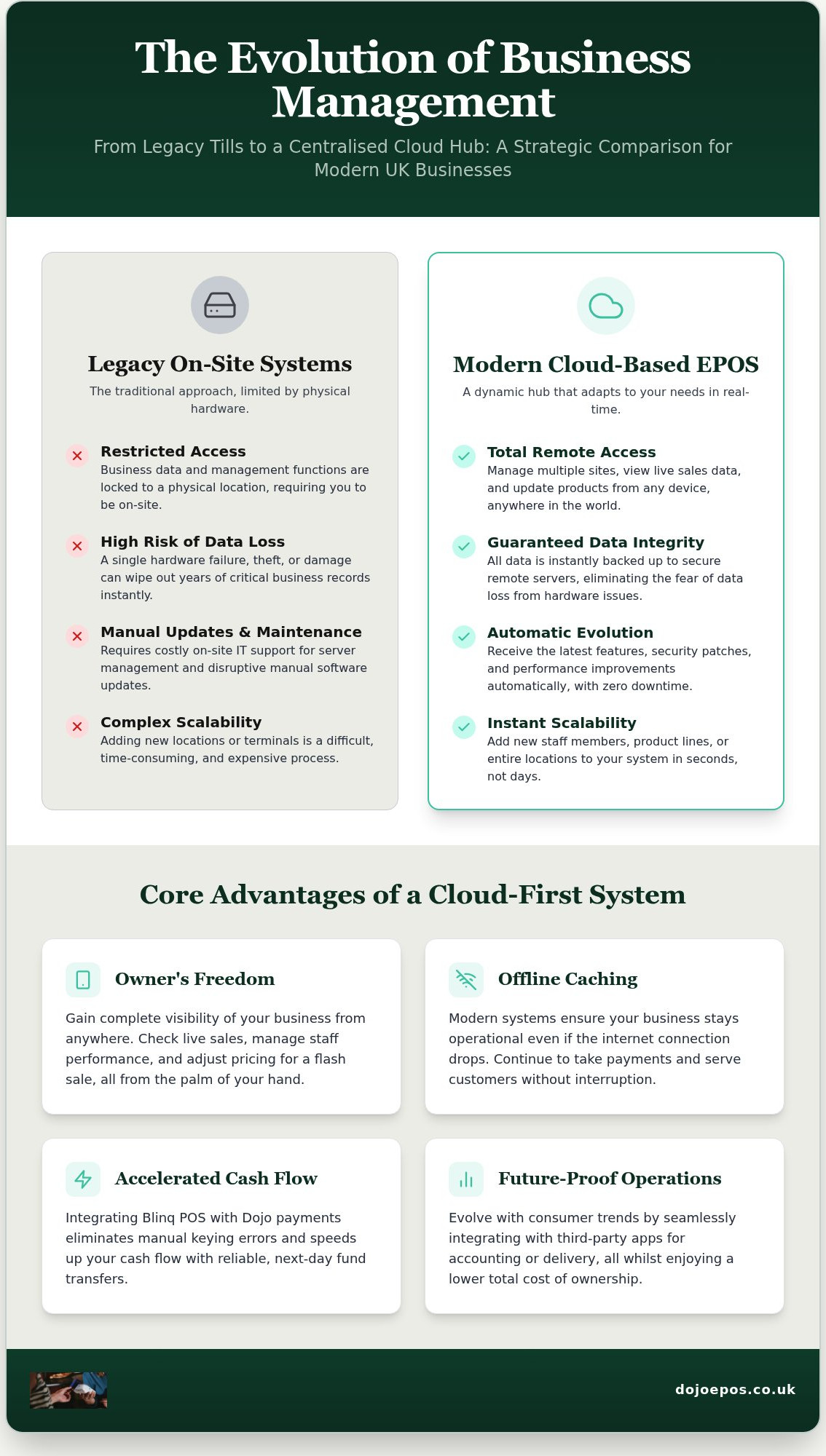
Cloud based epos software acts as the digital nervous system of your business. Unlike traditional systems that lock your data into a physical hard drive under the counter, cloud technology hosts your entire operation on secure, remote servers. This transition from legacy tills to agile digital platforms means your business is no longer a static location. It's a mobile, responsive entity that adapts to your needs in real-time, regardless of where you are.
When you adopt a cloud-first system, every transaction, stock change, and staff update is recorded instantly. This data is stored securely and updated across all your devices simultaneously. Whether you're standing at the counter or checking your phone from home, you see the exact same figures. It's about total visibility and the confidence to lead your team without being physically present 24/7.
The core components of a cloud ecosystem
Most modern systems operate on a Software-as-a-Service (SaaS) model. Instead of buying a one-off licence that quickly becomes obsolete, you subscribe to a service that constantly evolves. This software acts as the vital bridge between your electronic point of sale hardware and your broader business strategy. It ensures that your physical tools and digital data work in perfect harmony.
At the centre of this ecosystem is the back-office dashboard. Think of this as your mission control. It organises complex data into clear, actionable insights. From here, you can adjust prices, manage staff permissions, and track performance across every site you own with just a few clicks. It's a powerful tool that simplifies the day-to-day management of your commerce.
Why UK businesses are moving away from legacy tills
Maintaining on-site servers is a costly and risky endeavour. If a local server fails, your ability to trade often vanishes instantly. UK merchants are increasingly rejecting this fragility. They need real-time inventory management that spans multiple sites, ensuring they never overpromise stock to a customer or lose a sale due to data lag. It's about removing the technical barriers to growth.
Cloud systems also remove the technical friction that slows down service. During peak hours in a bustling high-street cafe or a busy retail store, every second counts. High-performance cloud based epos software ensures that your system stays fast and responsive, regardless of how many transactions you process. It's a strategic move from simply surviving the rush to mastering it with total confidence.
The Strategic Advantages of Cloud-First Systems
Embracing cloud based epos software isn't just about upgrading your hardware; it's about shifting your entire business model toward agility. Modern UK merchants need systems that act as a digital nervous system, reacting instantly to market shifts. By centralising your management, you gain the power to organise your entire operation from a single, secure login. Whether you run one boutique or a chain of twenty restaurants, the complexity of your backend remains simple and manageable.
Real-time reporting is perhaps the most transformative benefit. You stop making decisions based on what happened yesterday and start leading based on what's happening right now. You can spot a sudden surge in sales at one location and shift resources to meet the demand before it becomes a bottleneck. Because the system updates itself automatically, you always have access to the latest security patches and features without manual downloads or frustrating downtime.
Instant Scalability: Add new staff members, product lines, or entire locations in seconds rather than days.
Zero Maintenance: Eliminate the need for expensive on-site IT support for server management.
Data Integrity: Your records are backed up instantly, removing the fear of data loss from hardware failure.
Remote management and the 'Owner's Freedom'
The true power of cloud based epos software lies in the freedom it grants you. You can check sales figures from your sofa whilst your shop floor is buzzing. If you need to adjust prices for a flash sale or update a seasonal menu, you can do it remotely across all terminals simultaneously. Managing staff performance and rotas becomes a streamlined task through the central hub, allowing you to focus on growth rather than micro-management.
Future-proofing your business operations
Consumer payment behaviours change rapidly. A cloud system evolves alongside these trends, ensuring you're always ready for the next shift in how customers want to pay. Integrating third-party apps for accounting or delivery services is seamless, creating a unified tech stack that works for you. This results in a significantly lower Total Cost of Ownership (TCO), as you avoid the recurring costs of legacy hardware upgrades. If you're ready to see how this agility looks in practice, you can explore modern EPOS solutions designed for the UK market.
Cloud vs Legacy EPOS: Addressing the Reliability Myth
The most common objection to cloud based epos software usually starts with a single question: what happens if the internet fails? It's a valid concern for UK merchants dealing with patchy Wi-Fi or local outages. However, the idea that legacy, locally-hosted systems are more reliable is a persistent myth that ignores the physical risks of on-site hardware. If a traditional till's hard drive fails or the back-office PC is damaged, your data often vanishes with it. Modern cloud systems don't just solve this problem; they redefine what reliability looks like in a digital age.
Security is another area where the cloud outshines legacy setups. A physical till drawer or a server tucked under a counter is vulnerable to theft, fire, and simple human error. In contrast, cloud platforms utilise bank-grade encryption and tier-one data centres that are monitored around the clock. Recovering your business after a hardware disaster is as simple as logging in from a new device. You aren't just buying software; you're investing in a system that protects your livelihood against the unexpected.
Understanding 'Offline Mode' and hybrid systems
Modern cloud based epos software doesn't rely on a constant, perfect connection to function. When your internet drops, high-performance systems like Blinq transition seamlessly into 'Offline Mode'. Your terminals use local caching to store every transaction, order, and stock adjustment locally on the device hardware. Once your connection returns, the system automatically syncs this data back to the cloud without any manual intervention.
This hybrid approach ensures your integrated payments remain operational during outages. In the UK's fast-paced retail environment, having a 4G or 5G backup is a standard safety net, but local caching provides the primary layer of defence. It means your staff can keep serving customers and processing sales without even noticing a dip in connectivity. You maintain the speed of a local system with the intelligence and backup power of the cloud.
Data security and GDPR compliance in the cloud
Relying on a back-office PC to store customer information is a significant compliance risk. Professional data centres are far more secure than any local server, offering multiple layers of physical and digital protection. Cloud systems automate your backups, which eliminates the risk of manual data entry errors or forgotten save points. Every piece of information is recorded and protected the moment it's entered.
Cloud software also simplifies the complexities of GDPR. Because the provider handles the technical side of data storage, your system is built to meet the latest UK regulations by default. Features like encrypted customer databases and tiered staff permissions ensure that sensitive information is only accessible to those who need it. It removes the burden of data management from your shoulders, allowing you to focus on serving your customers with total peace of mind.
How to Choose the Right Cloud EPOS for Your Industry
Choosing cloud based epos software isn't a one-size-fits-all decision. Your choice must align with your daily operational friction. A Michelin-star restaurant and a boutique clothing store face entirely different challenges. Start by identifying your primary pain points. Do you need complex table management and kitchen display integration, or is real-time stock tracking across multiple sites your priority? Identifying these needs early prevents you from paying for features you'll never use.
Evaluate the user interface through the eyes of your front-of-house staff. An intuitive design reduces training time and minimises errors during the lunch rush. If the system is too complex, it creates technical friction that slows down service and frustrates your team. You want a platform that feels familiar and responsive from the first touch.
Check the integration list carefully. Your EPOS should talk to your accounting software and booking platforms seamlessly. Crucially, look for features like Next-Day Transfers. In the UK market, waiting days for your funds is no longer acceptable. Systems that offer next-day transfers as standard keep your cash flow healthy and your business agile. This synergy between software and payments is what separates a basic till from a growth-oriented hub.
Essential features for hospitality and retail
Hospitality owners should look for table mapping, split billing, and kitchen display synergy. These tools ensure that communication between the floor and the kitchen is instant and error-free. Retailers, on the other hand, need robust barcode scanning, multi-buy promotions, and ecommerce sync to bridge the gap between physical and online sales. A 'one size fits all' approach rarely works for specialist shops because it lacks the depth required for industry-specific workflows. Choosing a platform like Blinq ensures you have the specific tools needed for your sector.
Assessing support and implementation
Implementation is a critical phase. Look for UK-based support that understands your local market conditions and can respond quickly to time-critical issues. If your system has a hiccup on a busy Friday night, you don't want to be stuck in an international phone queue. Before committing, always book a demo. This allows you to test the software's responsiveness and see how easily new staff can be onboarded. A dedicated partner will work behind the scenes to make your transition as smooth as possible.
Ready to see how the right software can transform your operations? Get started with a Blinq POS demo today and experience the synergy of integrated payments and high-performance software.
Elevate Your Business with Blinq POS and Dojo
Blinq POS isn't just another software option. It's a next-generation cloud platform built to work in perfect synergy with Dojo's market-leading hardware. When you combine this high-performance cloud based epos software with Dojo's industry-leading payment technology, you eliminate the technical friction that often slows down growth. This synergy ensures that your front-of-house speed matches your back-office intelligence. You aren't just processing sales; you're capturing unified data that helps you understand your customers' habits, preferences, and peak visiting times with total clarity.
The speed of Dojo hardware combined with Blinq's cloud architecture creates a powerhouse for modern UK merchants. You get the dependability of a physical terminal with the agility of a remote-accessible hub. This means your data is always accurate, your reports are always live, and your business is always ready to scale. It's a move from simply managing a till to leading a sophisticated, data-driven operation.
Seamless payment integration as standard
Manual keying is a relic of the past that your business can't afford to keep. Integrated payments ensure that the amount on your Blinq terminal is exactly what appears on your Dojo card machine. This eliminates human error and saves your staff from the daily stress of end-of-day reconciliation discrepancies. Whether you're using a Dojo Go at the counter or a Dojo Pocket for tableside service, the integration is instantaneous and rock-solid.
Reducing queues becomes a reality when your transaction processing is this fast. One partner for both your software and payments means one point of contact and a system where every component is designed to talk to the other. It's about creating a frictionless experience for your staff and a premium service for your customers.
Next-day transfers: The Dojo difference
Cash flow is the lifeblood of any UK business. Waiting three to five working days for your takings is a burden you don't need to carry in a fast-moving market. Dojo provides next-day transfers as standard, ensuring your hard-earned money is in your bank account when you need it most. This allows you to reinvest in stock, pay staff, or manage overheads without the anxiety of a clearing delay.
Transparency is equally vital for your bottom line. Understanding your Dojo card machine rates is straightforward, with no hidden fees or complex jargon to decode. Switching to this smarter cloud based epos software is a decisive step toward a more profitable and efficient future. It's time to demand more from your technology and partner with a provider that works as hard as you do.
Future-Proof Your Business with Modern Cloud Technology
The shift toward cloud based epos software is no longer a trend; it's a strategic necessity for UK merchants aiming for growth in 2026. By centralising your management and embracing real-time reporting, you reclaim the freedom to lead your business from anywhere. You've seen how modern offline caching technology eliminates the fear of connectivity issues, whilst integrated payments remove the manual friction that slows down your service and impacts your bottom line.
Switching to a system that prioritises your cash flow and operational speed is the most decisive move you can make this year. With next-day transfers as standard and a platform trusted by over 110,000 businesses, you gain a partner dedicated to your long-term success. Our award-winning UK customer support works tirelessly behind the scenes, ensuring your transition is seamless and your hardware remains high-performing at all times.
Discover how Blinq POS and Dojo can transform your business today. It's time to step into a faster, smarter future with total confidence.
Frequently Asked Questions
What is the difference between cloud-based and traditional EPOS?
Cloud based epos software hosts your data on secure, remote servers, while traditional systems rely on local hard drives. This shift means you can access your sales figures and inventory from any location using a smartphone or tablet. Unlike legacy tills that require physical maintenance and manual backups, cloud systems update automatically. They offer a level of agility and remote visibility that static, on-site hardware simply cannot match for modern UK merchants.
Does cloud EPOS software work if my internet goes down?
Yes, your business stays operational even if your internet connection drops. High-performance platforms like Blinq use local caching technology to store every transaction on the device itself during an outage. Once your Wi-Fi or mobile data returns, the system automatically synchronises all data with the cloud. This hybrid approach ensures you never miss a sale or lose vital transaction records due to temporary connectivity issues in your shop.
Is cloud EPOS software secure for my customers' credit card data?
Cloud systems are significantly more secure than storing data on a back-office PC or a physical till. Professional data centres utilise bank-grade encryption and around-the-clock monitoring to protect sensitive information. When you use integrated payments through a provider like Dojo, your customers' card data is processed through secure, encrypted channels. This setup minimises the risk of data breaches and helps your business remain compliant with the latest UK security standards.
How much does cloud-based EPOS software cost in the UK?
The cost of cloud based epos software in the UK typically involves a combination of monthly software subscriptions and hardware rental fees. You also pay a commission on every card transaction processed through the system. While specific figures depend on your business size and sector, this model is often more cost-effective than legacy systems. It removes the need for expensive on-site server maintenance and provides a predictable monthly expense for your technology stack.
Can I use my existing hardware with new cloud EPOS software?
Most cloud systems perform best when paired with their own purpose-built hardware to ensure total reliability. Blinq POS is designed to work in perfect synergy with Dojo Go and Dojo Pocket terminals. While some software-only providers allow you to use tablets, a fully integrated solution eliminates technical friction. Investing in compatible hardware ensures that your software and payment machines communicate instantly, providing the fastest possible service for your customers during peak hours.
Do I need a separate merchant account for a cloud EPOS system?
You don't need a separate merchant account when you partner with an integrated provider like Dojo. We handle both your payment processing and your point-of-sale software, creating a unified experience for your business. This consolidation simplifies your admin and ensures that your hardware and software are perfectly aligned. It also enables features like next-day transfers, allowing your funds to reach your bank account much faster than traditional third-party merchant accounts.
How long does it take to set up a cloud EPOS system?
Setting up a modern cloud EPOS system is a rapid process that often takes just a few days. Once you've chosen your hardware, the onboarding team guides you through the digital configuration and menu setup. Because the hardware is designed to be plug-and-play, you can start trading almost immediately after it arrives. This speed is a major advantage over legacy systems, which often required complex on-site installations and lengthy staff training sessions.
Can I manage multiple business locations with one cloud EPOS login?
Managing multiple sites from a single login is one of the primary strategic advantages of this technology. You can view real-time sales data, adjust inventory levels, and update prices across every location simultaneously from your central dashboard. This centralised control removes the need to visit each shop physically to pull reports or change menu items. It provides a holistic view of your entire operation, making it much easier to scale your business.


Comments