
Compare Card Machine Rates UK: The 2026 Merchant Pricing Guide
The lowest headline transaction rate often ends up costing your business the most. When you compare card machine rates UK providers offer, it's tempting to focus purely on that single percentage. Yet headline savings disappear quickly when unexpected ancillary charges surface on confusing monthly statements, or rigid terminal leases lock you into multi-year commitments with punishing exit penalties.
Every merchant understands the frustration of cash-flow bottlenecks whilst waiting several business days for funds to clear. A fractional saving at the till means very little if settlement delays stall your daily operations and clunky hardware slows down customer throughput.
You can master UK card processing fee structures and uncover hidden charges before signing any agreement. In this guide, you will learn to dissect complex pricing models, spot deceptive contract traps, and pinpoint the most cost-effective payment solution for your actual turnover. Here is your roadmap to securing transparent pricing, accelerating fund transfers, and choosing a payment setup built to support your business growth.
Table of Contents
Understanding UK Card Machine Rate Structures: Flat-Rate vs Interchange
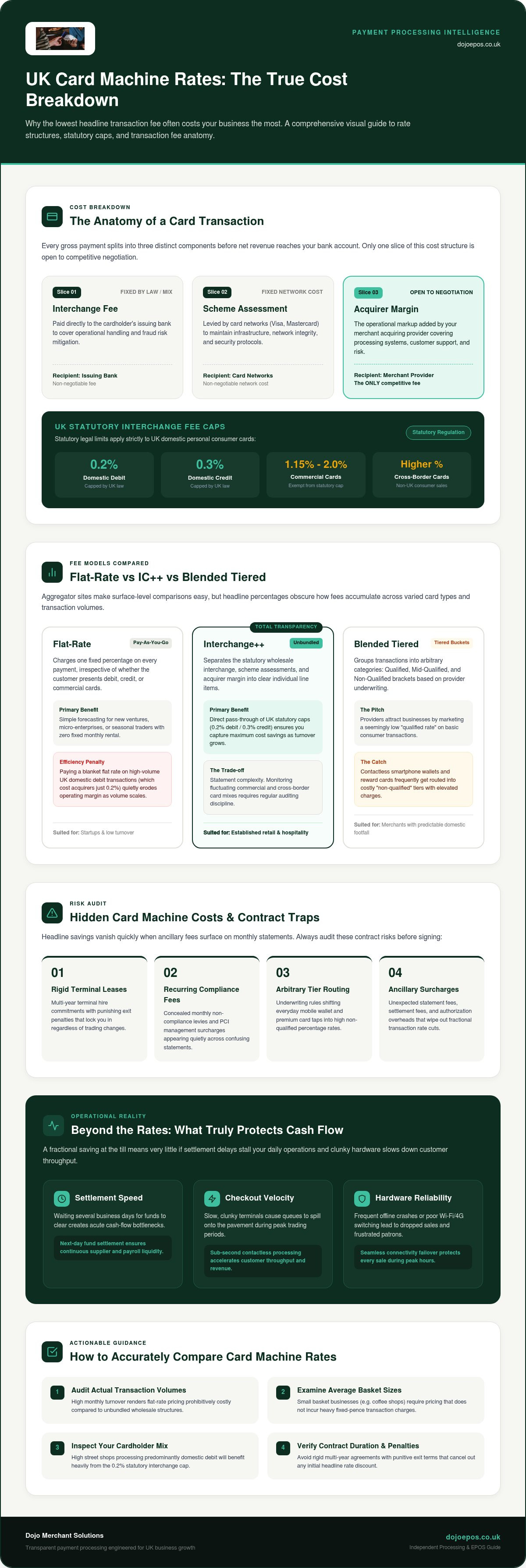
Headline percentages on card processing quotes rarely tell the entire story. Aggregator sites make it easy to compare headline numbers, but those headline figures often obscure how fees actually accumulate across different card types. When you evaluate how to compare card machine rates UK providers offer, looking past surface-level percentages reveals three distinct fee models: flat-rate, Interchange Plus Plus, and blended tiered billing.
Flat-Rate Pricing Models Explained
Flat-rate pricing charges one fixed percentage on every payment, irrespective of the card presented. Many providers pair this model with pay-as-you-go readers requiring no recurring terminal rental contracts. While this simplifies monthly forecasting for new ventures, micro-enterprises, or seasonal traders, it carries an efficiency penalty as turnover scales. Because UK consumer debit transactions cost acquirers very little to process behind the scenes, paying a blanket flat rate on high-volume, domestic debit card transactions quietly erodes your operating margin.
Interchange Plus Plus (IC++) Pricing Explained
Interchange Plus Plus unbundles the three structural components of every transaction: the wholesale interchange fee paid to the cardholder's bank, card scheme assessments from Visa or Mastercard, and the acquiring provider's markup margin. This structure offers total cost transparency. Under UK regulations, domestic consumer debit interchange is capped at 0.2% and consumer credit at 0.3%. An IC++ contract passes these statutory caps directly through to your business. The tradeoff is statement complexity. Because commercial and international cards bypass standard domestic caps, monitoring fluctuating card mixes requires ongoing auditing discipline.
Blended Tiered Rate Structures
Blended models group varied transaction types into arbitrary categories, typically designated as qualified, mid-qualified, and non-qualified tiers. Acquirers market an attractive qualified rate, but the provider's underwriting rules decide which payments fit that tier. In practice, modern contactless smartphone wallets and premium reward cards often get routed into expensive non-qualified brackets. Before committing to contracts built on shifting tier definitions, merchants should assess established merchant services UK frameworks to ensure their processing terms match their actual trading profile.
The Anatomy of a Card Transaction: Where Does Your Money Go?
Every time a customer taps a card or smartphone on your terminal, the gross transaction value splits into three distinct components before net revenue hits your bank account. These deductions flow to the cardholder's bank, the card brand network, and your merchant acquiring provider. Understanding this tripartite split is crucial when you compare card machine rates UK merchants encounter across quotes, as only one slice of this cost structure is open to competitive negotiation.
The merchant acquirer margin covers payment processing infrastructure, operational risk management, and ongoing customer support. Acquirers add this operational markup directly on top of base interchange and scheme charges. While regulatory intervention protects business owners in broader financial areas, such as previous FCA action on unfair fees, payment providers retain wide discretion over their own margins. A quality partner keeps this markup clear, predictable, and fair.
Interchange Fees and UK Statutory Regulations
Interchange is the statutory fee paid to card-issuing banks to facilitate transactions and manage fraud risk. For UK domestic personal debit and credit cards, interchange rates are capped by law at 0.2% and 0.3% respectively. These statutory caps ensure wholesale processing costs remain remarkably low for consumer-focused high street shops, cafes, and service businesses.
Corporate, business, and non-UK consumer cards fall outside domestic interchange caps. Commercial cards routinely carry interchange rates between 1.15% and 2.00%, whilst cross-border online sales to European cards also command higher wholesale percentages. If your firm processes substantial B2B invoices or caters heavily to overseas tourists, higher baseline interchange costs directly impact your final transaction settlement.
Card Scheme Assessments and Network Fees
Card schemes such as Visa and Mastercard levy assessment fees for routing payment data securely across their international clearing networks. These nominal access charges apply universally to all merchant service providers processing across respective card rails, leaving zero room for individual provider discounting.
Because underlying card scheme costs remain fixed across the payment sector, the difference between quotes comes down to acquirer margins, terminal capabilities, and settlement speed. To inspect clear transaction mechanics without hidden markups, examine detailed Dojo card machine rates. If you want to streamline front-of-house operations alongside transparent pricing, explore integrated merchant solutions tailored to your daily checkout volume.
Hidden Card Machine Costs and Contract Traps to Watch For
A competitive headline rate means very little if your monthly merchant statement arrives packed with ancillary overheads. Providers frequently use attractive processing rates to distract from complex back-end charges that inflate your overall processing bill. When you compare card machine rates UK suppliers promote, calculating the total cost of ownership across hardware, software, and administrative fees is the only reliable way to protect your margins.
Recurring Merchant Account Ancillary Fees
Ancillary charges quietly erode trading revenue. Watch out for these standard statement additions:
Monthly Minimum Service Charge (MMSC): A contractual floor fee billed whenever your monthly transaction volume falls below a set processing threshold.
Authorisation fees: Fixed charges, typically between 1p and 3p, levied against every single card communication attempt, including cancelled orders and customer card declines.
PCI DSS management and penalty fees: Regular administrative charges to verify data security standards, which can escalate into steep monthly non-compliance fees if self-assessment questionnaires lapse.
Chargeback handling fees: Dispute charges that range from zero up to £30 per customer contestation, regardless of whether the bank rules in your favour.
Hardware Rental vs Outright Purchase
Acquiring terminal hardware requires a clear-eyed look at commitments. Buying entry-level card readers outright removes recurring monthly rental fees, but leaves you vulnerable to technical obsolescence and lacks dedicated hardware replacement support. Traditional terminal leases present the opposite danger: they often lock merchants into separate third-party financing arrangements with severe termination penalties.
UK regulations limit POS equipment rental contracts to a maximum initial term of 18 months for businesses turning over up to £10 million annually, after which agreements must shift to a 30-day rolling basis. Modern subscription models offer an ideal alternative, pairing resilient terminal hardware with transparent rolling terms rather than multi-year leasing traps.
Cash-Flow Drag and Settlement Latency
Payment aggregators routinely ignore the operational expense of delayed payouts. Yet 48% of UK small and medium-sized enterprises rank faster fund settlement as a decisive factor when picking a card payment system. Legacy acquiring banks frequently hold card receipts for two to four business days, with weekend takings stalled until midweek.
This artificial latency chokes day-to-day liquidity, forcing merchants to lean on expensive business overdrafts simply to settle supplier invoices. Securing automated Next-Day Transfers keeps daily takings moving directly into your operational bank account seven days a week, turning trading volume into usable cash without delay.
How to Compare Card Machine Rates for Your Business Model
Generic online comparison tables fail because they ignore how your operational rhythm shapes your real costs. To accurately compare card machine rates UK providers offer, you must evaluate your specific trading metrics rather than theoretical averages. Follow this four-step audit on your recent merchant statements to find your true baseline:
Establish your Average Transaction Value (ATV): Divide your gross monthly card turnover by the total number of transactions processed.
Map your card split: Calculate the exact proportion of domestic personal debit cards against commercial, premium rewards, and international cards.
Tally total ancillary charges: Combine terminal rental subscriptions, PCI compliance costs, authorisation pence fees, and gateway charges.
Calculate your effective rate: Divide your total monthly processing deductions by your gross card revenue and multiply by 100. This single percentage reveals what you genuinely pay.
High-Volume, Low-Ticket vs Low-Volume, High-Ticket Retail
Your average ticket size dictates which pricing model protects your profit. For high-volume traders like quick-service cafes or newsagents, fixed per-transaction fees represent a serious hazard. A fixed 3p authorisation fee combined with a 5p acquirer cut takes almost 3% on a £3 coffee before percentage cuts even apply. High-volume businesses require low fixed-pence charges and transparent interchange pass-through. Conversely, luxury retail boutiques and trade counters handling £200 transactions care far less about 3p per tap; their priority is negotiating down the core percentage rate.
Contract Terms and Switching Flexibility
Never sign an agreement without examining termination terms, notice requirements, and equipment return conditions. Reject any provider attempting to enforce automatic multi-year rolling renewals without your explicit consent. Modern acquiring partners eliminate unnecessary friction by keeping agreements flexible and providing upfront support to offset legacy contract exit penalties.
If you're ready to leave predatory fees and confusing statement tiers behind, upgrade to Dojo's flexible merchant solutions to secure fast settlement and straightforward pricing built around your operational needs.
Beyond the Rates: Choosing a High-Performance Payment Partner
Card machine value extends far beyond raw percentages to front-of-house operational efficiency. Saving a fraction of a percent on card processing means nothing if slow hardware creates bottlenecks at your till. Payment latency is checkout processing delay that frustrates customers and causes queue abandonment. When you compare card machine rates UK providers offer, evaluating terminal responsiveness, network resilience, and software compatibility matters just as much as checking headline basis points.
Trusted by over 110,000 businesses across the UK, modern payment architecture links hardware directly to operational workflows. Explore Dojo's intelligent card payment solutions to see how high-speed processing and robust infrastructure keep counter queues moving and table turnover brisk.
Processing Speed, Connectivity, and Hardware Durability
Reliable connectivity ranks as the single most critical factor for UK small businesses choosing payment systems. A card terminal that drops connection during lunch rush costs you far more than processing fees ever could. Dual-connectivity devices prevent dropouts by automatically switching between cellular 4G data and local Wi-Fi networks.
Dedicated terminals like Dojo Go and Dojo Pocket complete transactions in seconds. Rapid customer turnaround keeps customer flow continuous, whether you run a bustling cafe or an active trade counter. High-grade hardware also withstands daily knocks, grease, and liquid spills across demanding hospitality and retail environments.
Point-of-Sale Integration and Intelligent Management
Treating card machines as isolated devices wastes precious staff hours. Integrated Payments connect card terminals directly to your till software, pushing bill totals instantly to the screen and eliminating human keying mistakes. Eliminating double entry stops cash discrepancies before they occur.
Pairing reliable payment hardware with Blinq POS software unifies sales tracking, floor management, and digital transaction receipts in one central platform. Automated end-of-day reporting syncs takings seamlessly, removing the headache of manual reconciliation so business owners can focus on revenue growth.
Take Control of Your Payment Processing Today
Unravelling merchant statements doesn't have to be an uphill battle. When you compare card machine rates UK providers offer, looking past promotional percentages protects your bottom line against ancillary penalties, rigid leases, and settlement bottlenecks. Aligning your actual transaction profile with transparent fee architecture ensures your business keeps more of what it earns every trading day.
True value pairs fair pricing with dependable performance. Empowering over 110,000 UK businesses with reliable, modern payments, Dojo delivers ultra-fast transaction hardware designed to eliminate checkout queues and keep service flowing smoothly. Rapid Next-Day Transfers ensure your trading capital lands in your bank account promptly, giving you the liquidity required to trade with complete confidence.
Take the next step towards friction-free commerce. Compare flexible payment plans and discover high-speed card machines with Dojo to equip your business with processing built for modern growth.
Frequently Asked Questions
How do I calculate the real effective rate on my merchant card machine statements?
Divide your total monthly card processing costs by your total monthly gross card revenue, then multiply by 100. This calculation combines base transaction percentages, terminal hire fees, monthly minimums, authorisation charges, and PCI compliance costs into a single representative figure. It gives you an accurate metric when you compare card machine rates UK providers market against what you actually pay out each billing cycle.
What is the difference between flat-rate pricing and Interchange Plus Plus in the UK?
Flat-rate pricing charges one fixed percentage across every card sale, making monthly accounting simple but more expensive for high-volume transactions. Interchange Plus Plus separates the transaction cost into three components: capped card-issuer fees, card scheme charges, and the provider's acquiring margin. This unbundled structure passes statutory UK consumer card caps directly to your business, delivering significant savings for merchants with higher turnover.
Can small businesses negotiate card machine rates with merchant service providers?
Small businesses can negotiate the merchant acquirer margin and hardware subscription costs, even though interchange and scheme fees remain fixed by law and card networks. If your card turnover consistently exceeds £5,000 monthly, providers usually offer custom pricing schedules rather than rigid public tariffs. Presenting three months of detailed merchant statements helps your business leverage transaction volume and secure lower acquirer margins.
How does transaction processing speed impact overall retail and hospitality revenue?
Rapid card processing directly speeds up counter throughput and table turnover during peak trading periods. Sluggish terminals create checkout queues that frustrate customers, occasionally leading to walkouts and lost revenue. High-speed terminals like Dojo Go complete card transactions in seconds. Eliminating latency keeps queues moving briskly, maximising capacity, and ensuring staff serve more paying patrons throughout busy weekend shifts.
Are next-day settlement transfers included as standard by all UK payment providers?
Next-day transfers are not standard across the UK payment industry. Many traditional acquiring banks hold card receipts for two to four business days, pausing weekend takings until the following week. This creates severe cash-flow lag. Modern providers like Dojo provide automated Next-Day Transfers every day of the week, ensuring daily turnover reaches your bank account promptly to fund ongoing operational expenses.
What hidden fees should I look for before signing a card machine contract?
Check contracts carefully for Monthly Minimum Service Charges, per-attempt authorisation fees, and recurring PCI DSS non-compliance penalties. You should also scrutinise early termination clauses and hardware leasing terms. Many providers advertise attractive headline percentages to compare card machine rates UK merchants see on marketing pages, while quietly burying steep monthly admin fees inside separate third-party equipment agreements.
Is it possible to switch card machine providers without disrupting daily business operations?
Switching providers can happen seamlessly without closing your till or missing customer transactions. Modern providers dispatch plug-and-play terminals like Dojo Go or Dojo Pocket directly to your door, fully pre-configured for your account. You simply power on the new device, connect to Wi-Fi or mobile data, and start taking payments immediately before serving notice or returning your old terminal hardware.


Comments