
Dojo vs Worldpay: Which UK Payment Provider is Best for Your Business in 2026?
Choosing the biggest name in UK payments used to be the safest way to protect your cash flow, but in 2026, legacy size often comes at the expense of modern agility. Whether you are weighing up Dojo vs Worldpay or simply looking to escape slow settlement times, you've likely felt the frustration of waiting days for your own hard-earned takings to hit your bank account. It's exhausting to manage a bustling business when your payment provider feels like a hurdle rather than a partner.
This definitive comparison cuts through the marketing noise to reveal which provider actually delivers on the promise of Next-Day Transfers and transparent pricing without the nasty surprises. We'll examine the hardware reliability of the Dojo Go against Worldpay's traditional infrastructure; helping you decide which tech stack supports your growth. We'll also break down the settlement speeds and integration capabilities that keep your EPOS running smoothly during your busiest shifts. By the end of this guide, you'll know exactly which platform will simplify your operations and put your money where it belongs: in your account, ready for the next trading day.
Table of Contents
Dojo vs Worldpay: The Battle of Payment Giants
The UK payment landscape has undergone a seismic shift. For decades, traditional banks and global giants held a monopoly on how businesses accepted card payments. Today, the rise of agile, tech-led payment service providers has redefined what merchants should expect from their partners. Worldpay remains the global incumbent, boasting a vast infrastructure as part of the FIS group. However, its sheer scale often brings a level of complexity that can stifle smaller, more ambitious businesses. Dojo emerged as a UK-born innovator specifically to counter this, focusing on speed, reliability, and the actual day-to-day merchant experience.
The Legacy vs Innovation Debate
Worldpay's history as a corporate giant influences its entire approach. Its systems are designed for massive scale, which often results in a corporate-first mentality where individual support can feel distant. For many SMEs, this "legacy lag" is a significant drawback. Dojo's mission is the polar opposite. They've built their platform to simplify payments for high-street shops and busy hospitality venues. Whilst Worldpay manages global complexities, Dojo focuses on local performance. Modern British business owners are increasingly prioritising this agility over brand heritage. They want tools that work instantly and a partner that responds at the speed of their business.
Who Are These Providers For?
Choosing between Dojo vs Worldpay usually depends on your specific operational needs. Worldpay is a powerhouse for large-scale enterprises and global chains that need to manage payments across multiple countries and currencies. If you're a multinational corporation, their complex infrastructure is a tool you might need. It's built for those who require a wide net of services rather than a specialised, local focus.
Dojo is the definitive choice for fast-paced UK retail, hospitality, and service businesses. These are merchants who cannot afford for their hardware to fail during a Saturday rush. They need the Dojo Go to process transactions in seconds and they want their money in their bank account the following morning. By focusing on the UK market, Dojo provides a level of tailored support and functional speed that global incumbents often struggle to match. When you're growing a British brand, you need a partner that lives in your time zone and understands your specific challenges. With over 110,000 businesses already on board, Dojo has proven that modern tech beats old-fashioned size every time.
Settlement Speed: Why Next-Day Transfers Change the Game
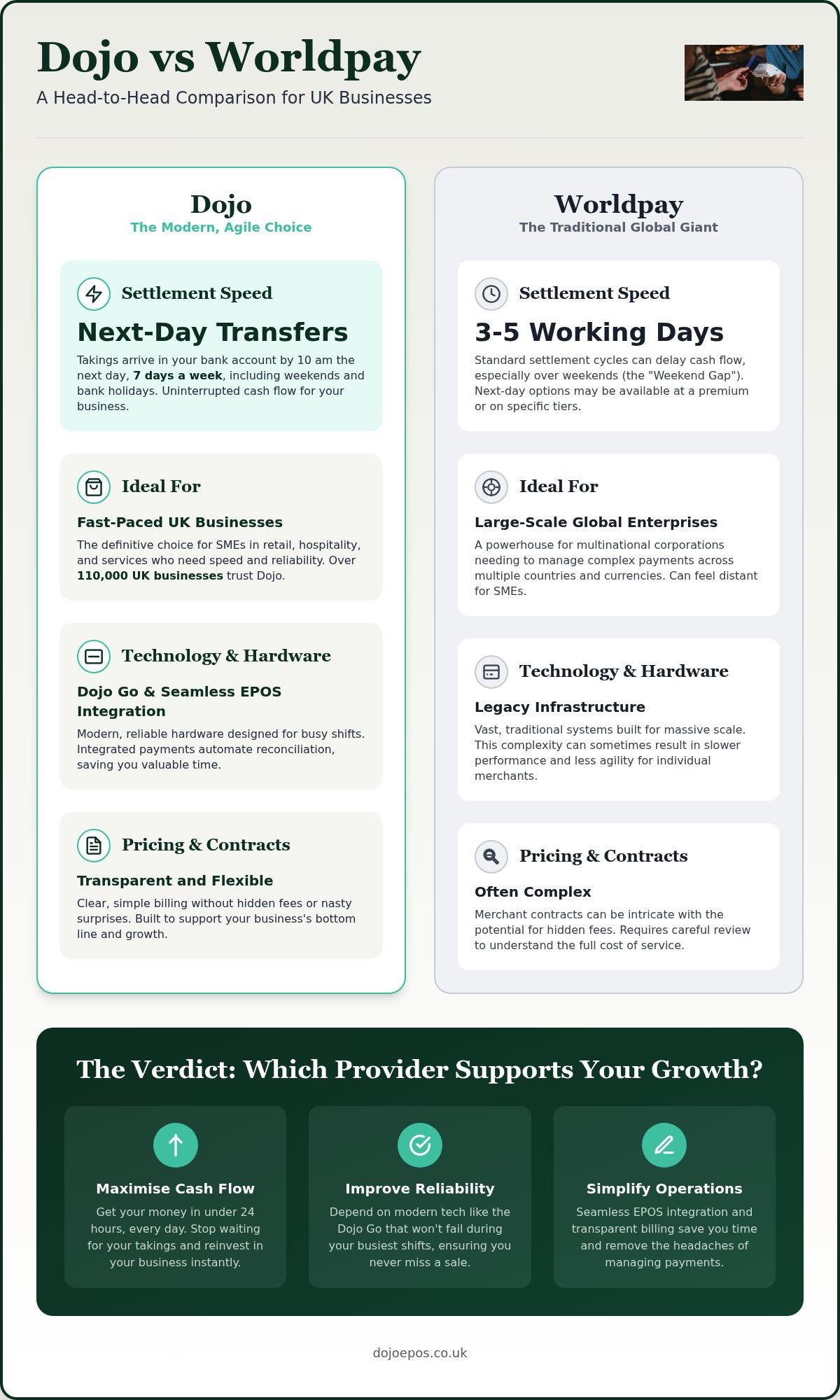
Cash flow is the lifeblood of any growing UK business. Whilst many merchants obsess over transaction percentages, the time it takes for funds to reach your bank account is often more critical. In the Dojo vs Worldpay debate, settlement speed is a primary differentiator that impacts your ability to pay suppliers, manage payroll, and reinvest in your growth. Waiting days for your own money creates unnecessary friction that modern businesses simply shouldn't have to tolerate.
Traditional payment models often leave businesses stuck in a "Weekend Gap." In this scenario, Friday's takings might not appear in your balance until the following Tuesday or Wednesday. This delay is increasingly incompatible with a modern economy that operates 24/7. Both providers must adhere to The Payment Services Regulations 2017, which govern the security and transparency of these transactions, but how they handle the actual movement of those funds varies significantly.
Dojo’s Next-Day Advantage
Dojo has set a new industry standard by offering next-day transfers as a core feature for over 110,000 businesses. Your takings arrive in your bank account the following morning, seven days a week. This includes weekends and bank holidays. It's a game-changer for hospitality and retail sectors that see their highest volumes on Saturdays and Sundays. Receiving funds in under 24 hours allows for precise stock management and immediate reinvestment. There is also a massive psychological benefit to seeing your hard-earned revenue reflected in your balance daily. If you want to see how this speed can transform your operations, you can explore integrated payments that sync directly with your POS.
Worldpay’s Settlement Structure
Worldpay has historically operated on a slower settlement cycle, often ranging from three to five working days for basic accounts. Whilst they have introduced next-business-day options, these are frequently subject to specific contract conditions or premium account tiers. This traditional model remains heavily reliant on standard banking hours. If a bank holiday falls on a Monday, a Worldpay merchant using a standard plan might wait even longer to access their weekend revenue. For an ambitious SME, this "cash flow friction" can be the difference between a smooth week and a financial headache. Legacy systems were built for a 9-to-5 world, but Dojo’s infrastructure is built for the reality of modern commerce.
Hardware and EPOS Integration: Dojo Go vs Worldpay Terminals
Modern card machines have evolved far beyond being "dumb" terminals that simply read chips. In 2026, your hardware is a sophisticated business tool that acts as a data hub for your entire operation. When comparing Dojo vs Worldpay, the physical hardware and how it talks to your software can be the deciding factor in your daily efficiency. Reliability is paramount; a terminal that drops its connection during a Friday night rush doesn't just cost you a sale; it damages your reputation. The Payment Systems Regulator (PSR) ensures a competitive landscape where such technical standards must remain high, but the user experience varies wildly between these two giants.
Dojo Go and Dojo Pocket: Built for Performance
The Dojo Go is engineered for speed and aesthetic appeal, fitting perfectly into modern retail and hospitality environments. Its user interface is a standout feature; it feels exactly like using a high-end smartphone rather than a clunky industrial tool. This reduces staff training time and speeds up the checkout process. For businesses that require mobility, the Dojo Pocket provides a smartphone-sized solution for table-side service without sacrificing power.
Connectivity is where Dojo truly shines. These devices come with 4G and WiFi connectivity as standard, switching between them instantly to ensure you never miss a payment. The battery life is designed to last through a double shift, and the rugged build quality means they can handle the inevitable drops and spills of a busy floor. It's hardware that works as hard as you do.
Seamless EPOS Integration with Blinq
Integration is no longer a luxury; it's a necessity for accurate accounting. Dojo integrates with over 600 EPOS systems, allowing for a level of automation that eliminates manual entry errors. This "Integrated Payments" ecosystem ensures that when you punch a total into your till, it appears instantly on the card machine. This doesn't just save seconds; it prevents costly mistakes and makes reconciliation a breeze at the end of the night.
Blinq POS Software further enhances this by organising your front-of-house and back-office operations into one cohesive unit. Whilst Worldpay offers a wide range of hardware from manufacturers like PAX and Ingenico, their integration process can sometimes feel fragmented. Worldpay's legacy systems often require more complex third-party setups to achieve the same level of fluid communication that Dojo provides natively. If you want a system that "just works" out of the box, the Dojo vs Worldpay hardware battle has a clear frontrunner for ambitious UK merchants.
Pricing Transparency and Contract Flexibility
Headline rates are often used as bait, but the true cost of a payment provider is found in the small print. In the Dojo vs Worldpay comparison, transparency is where the two models diverge most sharply. Many legacy providers rely on complex, jargon-heavy contracts that hide minimum service charges or PCI non-compliance fees until the first bill arrives. This "Hidden Fee" trap can inflate your monthly costs by 20% or more without warning. Dojo counters this with a commitment to simplicity, providing clear transaction breakdowns that even a busy business owner can digest in seconds.
Worldpay typically offers two main pricing structures: Interchange Plus and blended rates. Interchange Plus is technically transparent, but it requires you to understand the fluctuating base costs set by card schemes like Visa and Mastercard. Blended rates are simpler but often hide a larger margin for the provider. Contrast this with Dojo's approach, which focuses on straightforward monthly platform fees and clear transaction percentages that don't shift unexpectedly.
Switching Without the Stress
Exiting a restrictive legacy contract is often the biggest hurdle for UK merchants. Worldpay small-business plans frequently involve 18-month terminal-hire agreements, making it difficult to pivot when your business needs more agility. Dojo removes this barrier by helping merchants exit these restrictive contracts, often providing financial support to cover exit fees. Supported by expert consulting from Paymentsense, the transition is designed to be seamless. If you're tired of being locked into terms that no longer serve your growth, looking for a provider with monthly rolling terms should be your top priority.
Understanding Total Cost of Ownership
Your bottom line is affected by more than just a headline percentage. You must factor in terminal rental, gateway fees, and PCI compliance costs to find the true total cost of ownership. A slightly higher transaction rate can actually be more cost-effective if it comes with reliable hardware and superior customer support that prevents downtime during peak trading. You can learn more about Dojo card machine rates to see how they compare to your current statement.
Stop overpaying for legacy infrastructure and switch to a transparent payment partner that values your business growth and provides the clarity you deserve.
The Verdict: Which Provider Suits Your Business Growth?
Deciding between Dojo vs Worldpay comes down to your business's scale and your appetite for innovation. Worldpay is a legacy powerhouse. It remains a viable consideration for massive corporations and global chains that require complex multi-currency support across dozens of countries. If your operations span several continents and you need a provider with a global footprint, Worldpay's infrastructure is built for that specific scale. However, this global focus often results in a "one-size-fits-all" approach that can lack the personal touch and speed required by local high-street brands.
For the ambitious UK merchant, Dojo is the superior choice. Speed and agility are no longer optional extras; they are the foundations of a healthy business. Dojo has replaced the "legacy lag" of traditional providers with a high-performance tech stack that prioritises the merchant's daily reality. Whilst Worldpay offers a vast menu of services, Dojo offers a perfected, streamlined experience. You aren't just buying a card machine; you're investing in a system that eliminates manual errors and puts your money in your account when you need it most.
Before you sign your next payment contract, use this final checklist to ensure the partner you choose supports your growth:
Does the provider guarantee next-day transfers seven days a week, including bank holidays?
Is the hardware designed for high-performance, mobile environments with 4G and WiFi?
Will I have access to UK-based support during my busiest trading hours?
Are the contract terms flexible, or am I locked into a multi-year agreement?
Does the system offer native integration with my specific EPOS to automate reconciliation?
The Dojo Advantage for UK SMEs
Over 110,000 businesses have already transitioned to Dojo to escape the frustrations of slow settlements and clunky hardware. By focusing exclusively on the UK market, Dojo provides support that actually understands your specific trading environment. Integrated payments and next-day transfers aren't just features; they create a genuine competitive edge by freeing up your time and cash. You get a partner that works behind the scenes to make your life easier, allowing you to focus on what you do best: running your business.
Next Steps: How to Make the Switch
Upgrading your payment system is simpler than you might think. Start by gathering your current contract details and a recent merchant statement. This allows you to request a tailored quote that reflects your actual trading volume, rather than a generic estimate. If you're tired of being held back by legacy constraints, it's time to empower your business with better technology. To see the difference for yourself, get started with Dojo today. Modern commerce moves fast; ensure your payment provider can keep up.
Take Control of Your Business Cash Flow
Your decision in the Dojo vs Worldpay debate ultimately defines how quickly your business can move. Whilst legacy giants offer global scale, modern UK merchants need the agility of next-day transfers that arrive seven days a week, including weekends and bank holidays. You deserve a partner that eliminates manual reconciliation through seamless integration with over 600 EPOS systems, ensuring your team stays focused on service rather than spreadsheets.
Reliability shouldn't be a luxury. With UK-based expert support ready whenever you need it, you can trade with total confidence knowing your hardware won't let you down during a busy shift. It's time to leave behind complex contracts and slow settlement cycles in favour of a platform built specifically for your growth and success.
Join over 110, 000 businesses and switch to Dojo today and experience the speed your hard work deserves. Your future success starts with a payment partner that works as hard as you do.
Frequently Asked Questions
Is Dojo better than Worldpay for small businesses?
Dojo is often considered the better fit for fast-paced UK SMEs due to its speed and simplicity. Whilst Worldpay has a massive global infrastructure suited for enterprises, Dojo focuses on the daily needs of hospitality and retail. Its hardware, like the Dojo Go, is designed for immediate use, and the next-day transfer standard ensures smaller businesses maintain a healthy cash flow without waiting days for their takings.
How long does it take to switch from Worldpay to Dojo?
Switching is designed to be a rapid and efficient process. Most businesses can get set up with Dojo and receive their new card machines within a few working days. The transition is managed carefully to ensure you don't experience any downtime in your payment processing. By working with consulting experts from Paymentsense, you can navigate the technical setup and contract handover quickly, allowing you to start accepting payments almost immediately.
Does Dojo really offer next-day transfers on weekends?
Yes, Dojo provides next-day transfers as standard, seven days a week. This means that funds from transactions processed on a Friday, Saturday, or Sunday will arrive in your bank account the following morning. This service includes bank holidays, ensuring that your cash flow remains consistent regardless of the calendar. It is a significant advantage over legacy providers that often pause settlements until the next standard banking business day.
Can I use my existing EPOS system with a Dojo card machine?
Dojo offers integrated payments with over 600 different EPOS systems. This high level of compatibility means you can likely keep your current software whilst upgrading your hardware. By syncing your card machine with your till, you eliminate the need for manual data entry, which reduces human error and speeds up the reconciliation process. If you use Blinq POS software, the integration is even more seamless, creating a unified management dashboard.
What are the main differences in contract length between Dojo and Worldpay?
The primary difference lies in flexibility. When comparing Dojo vs Worldpay, Dojo is known for offering shorter, more flexible terms, including monthly rolling contracts for many merchants. In contrast, Worldpay small-business plans typically require a minimum 18-month terminal-hire agreement. This longer commitment can make it harder to pivot or upgrade your technology as your business grows. Dojo's model prioritises agility, allowing you to adapt your services without being locked into multi-year deals.
How does Dojo help with Worldpay exit fees?
Dojo provides financial support to help merchants cover the costs of leaving restrictive legacy contracts. If you are currently tied to an agreement with Worldpay and facing significant exit fees, Dojo can often assist with these costs to make the switch more affordable. This initiative is designed to remove the financial barriers that prevent ambitious UK businesses from upgrading to faster, more modern payment technology. You should discuss your specific contract details with their team.
Is Worldpay more secure than Dojo?
Both providers adhere to the highest industry security standards. Both Dojo and Worldpay ensure full PCI compliance and use advanced encryption to protect sensitive transaction data. There is no evidence to suggest one is inherently more secure than the other; they both operate within the strict regulatory framework of the UK payment industry. Dojo’s modern tech stack is built with security at its core, providing a dependable and safe environment for every transaction you process.
Do I need a separate merchant account for Dojo?
No, Dojo provides a complete payment solution that includes your merchant account functionality. When you sign up, they handle the processing of your transactions and the secure transfer of funds to your existing business bank account. This all-in-one approach simplifies your financial management, as you don't need to coordinate between multiple different service providers. You'll have one clear dashboard to monitor your takings, manage your hardware, and track your next-day transfers.


Comments