
Dojo vs Zettle for Restaurants: 2026 UK Hospitality Comparison
The cheapest card reader on paper often costs a busy dining room the most in lost covers and delayed service. When weighing up Dojo vs Zettle for restaurants, operators quickly realise that basic pay-as-you-go gadgets cannot handle the heat of a packed Friday night rush. You already know the sheer frustration of spotty Wi-Fi freezing a terminal mid-transaction, leaving guests stranded and risking walkouts. Equally painful is watching your floor managers waste hours manually reconciling crumpled receipts long after closing time.
Your team deserves a payment setup that accelerates service rather than stalling it. Discover whether Dojo or Zettle delivers the reliability, speed, and EPOS integration your restaurant needs to maximise table turnover and protect your margins. Below, we compare real-world processing times, two-way till synchronisation, and payout schedules to help you choose the right platform for your venue.
Table of Contents
Dojo vs Zettle: Core Differences for Busy Hospitality Venues
Selecting the right payment provider shapes how smoothly your dining room operates during peak trade. While retail shops often manage with simple card readers, full-service hospitality brings non-stop table turns, complex bill splitting, and relentless physical demands. The foundational distinction in the Dojo vs Zettle for restaurants comparison sits within their underlying commercial setup: payment facilitator aggregation versus direct merchant accounts.
Merchant Architecture: Payment Facilitator vs Direct Acquirer
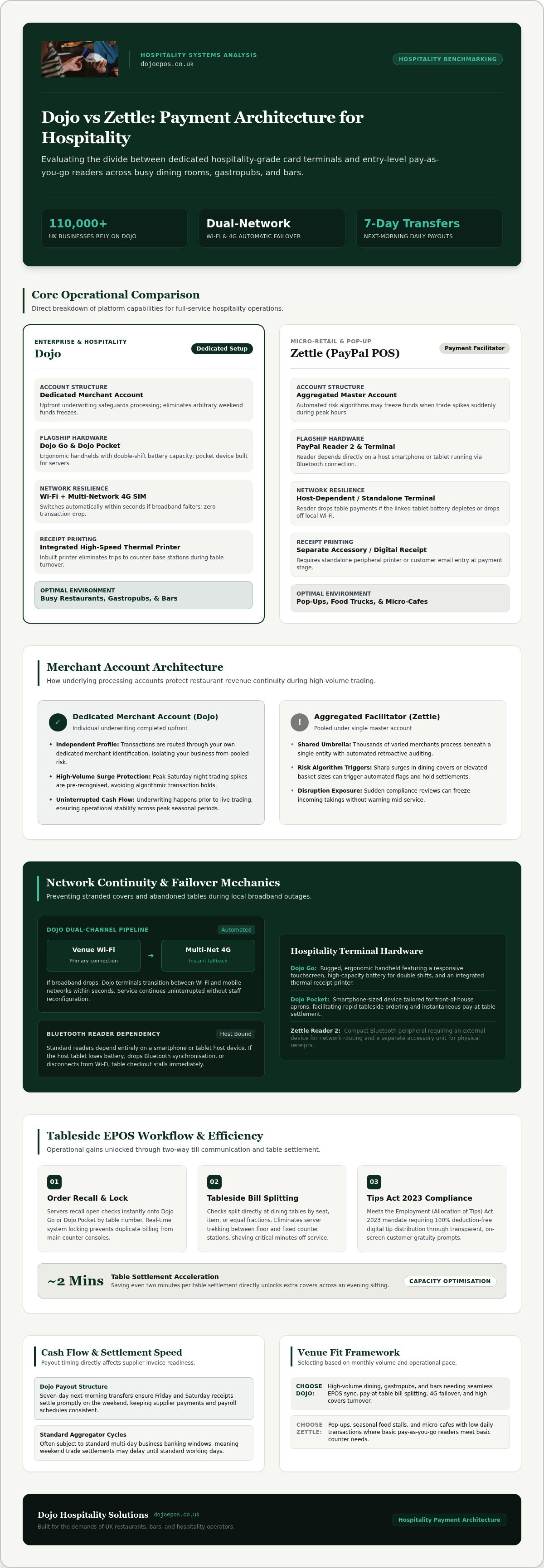
Zettle operates primarily as a payment facilitator, pooling businesses under an overarching master account. This allows rapid self-service onboarding, but automated risk algorithms can freeze funds or flag sudden transaction spikes during bumper weekend trading. For a restaurant turning tables rapidly on Saturday night, an unannounced freeze is catastrophic.
Dojo provisions dedicated merchant accounts backed by upfront underwriting. Over 110,000 businesses across the UK rely on this architecture to protect operational continuity. When trade surges, your processing remains stable, preventing cash flow disruption.
Hardware Durability: Handheld Terminals Built for Service
Hospitality hardware must withstand drops, kitchen steam, and long shifts. Entry-level setups like the Zettle Reader 2 depend on a continuous Bluetooth link to a smartphone or tablet. If that smart device runs low on charge, drops off local Wi-Fi, or leaves the dining floor, table payments grind to a halt.
Dojo builds standalone, commercial-grade hardware designed for fast-paced dining rooms:
Dojo Go: A rugged, ergonomic handheld terminal featuring a responsive touchscreen, high-capacity battery for double shifts, and a built-in thermal receipt printer.
Dojo Pocket: A smartphone-sized device built specifically for servers, enabling fast order-taking and pay-at-table convenience straight from an apron pocket.
Automatic Network Failover: Unlike Bluetooth readers tied to venue broadband, Dojo terminals combine Wi-Fi and multi-network 4G roaming. The device switches networks automatically within seconds if broadband drops, keeping service running smoothly.
Connecting modern hardware to electronic point of sale (EPOS) systems transforms floor workflow. The operational contrast between both solutions becomes clear when comparing core restaurant specifications:
Integrated EPOS and Pay-at-Table: Streamlining Restaurant Service
The speed of your payment phase directly determines dining room capacity. When examining Dojo vs Zettle for restaurants, the critical battleground is not merely processing cards, but how effectively the payment device communicates with your core till system. Shaving even two minutes off table settlement unlocks extra covers across an evening sitting, turning front-of-house efficiency straight into extra revenue.
Order Recall and Bill Splitting at the Dining Table
True hospitality requires effortless service at the guest's side. With Dojo, servers use the Dojo Go or Dojo Pocket to pull open checks straight onto the screen by entering the table number. The device locks the table in real time across the wider system, letting staff split checks by seat, item, or equal sums without trekking back to a stationary counter. Under the Employment (Allocation of Tips) Act 2023, UK operators must distribute 100% of digital tips without deductions, making Dojo's transparent on-screen gratuity prompts an essential compliance tool.
Zettle approaches pay-at-table differently. While its companion app handles basic ordering, using a standalone Zettle reader alongside a third-party restaurant POS often forces servers to calculate splits manually. Staff must print a paper bill at the central terminal, walk it to the diners, hand-key the total into the reader, and return to the main till to close the ticket.
Eliminating Costly Manual Re-Keying Errors
Mistyping amounts on a standalone keypad quietly drains profits. Entering £45.00 instead of £54.00 represents a write-off you rarely recover. Choosing robust integrated payment processing solutions links hardware directly with over 600 leading hospitality software platforms. Two-way synchronisation guarantees the exact balance on the bill transfers to the card machine instantly.
When the transaction succeeds, the tab closes automatically across your entire network. If you want to streamline operations further, combining proprietary hardware with Blinq POS software harmonises table ordering, kitchen printing, and card processing into one cohesive flow. Operators aiming to modernise front-of-house coordination can explore how an integrated card payment system completely removes manual end-of-night cashing up. If you are ready to upgrade your service speed, speak to our hospitality specialists about tailoring a setup for your venue.
Transaction Speeds, Connectivity, and Network Failover
Every second spent waiting at a card machine adds friction to the dining experience. When assessing Dojo vs Zettle for restaurants, network resilience and hardware latency separate commercial platforms from hobbyist equipment. A dropped connection during a frantic Saturday night service does not just stall the floor; it erodes guest goodwill and can trigger walkouts.
The Real-World Impact of Latency on Restaurant Turnover
Dojo processes payments in under two seconds on average. By contrast, entry-level readers like Zettle typically average between three and five seconds per tap. That discrepancy stems from Bluetooth latency, as the device must transmit card data to a paired smartphone before reaching the acquiring network.
Multiply that delay across a packed 120-cover service. A two-minute stall per bill split creates a bottleneck by the exit, leaves incoming bookings waiting at the bar, and slows kitchen ticket pacing. Diners ready to leave grow impatient quickly. Because the UK ban on card payment surcharges means restaurants must absorb transaction costs directly, extracting maximum efficiency from every terminal is vital for protecting operating margins.
Dual Connectivity: Automatic Wi-Fi and Cellular Switching
Broadband drops happen. Thick stone walls in historic buildings, crowded customer Wi-Fi networks, and basement dining spaces routinely disrupt local signals. If a venue depends on a basic card reader paired via Bluetooth to a central tablet, taking payment on an outdoor patio or pavement terrace often breaks the link entirely.
Dojo eliminates this risk with dual-connectivity architecture built straight into the Dojo Go and Dojo Pocket. The hardware connects to local broadband whilst maintaining an active multi-network 4G roaming SIM. If venue Wi-Fi stutters or drops, the terminal switches to mobile data automatically without cancelling the active transaction. All data travels across an encrypted payment gateway, ensuring bank-grade security without slowing down your team. Zettle users relying on standard readers must keep the host smartphone within immediate physical range, introducing a single point of failure that hospitality teams simply cannot afford during peak trading hours.
Cost Analysis: Transaction Rates, Hardware Subscriptions, and Cash Flow
Headline figures rarely tell the whole financial story. Comparing Dojo vs Zettle for restaurants requires looking beyond the initial hardware price tag to examine how processing fees eat into monthly turnover. While a pay-as-you-go reader seems affordable for a startup, flat-rate pricing becomes an expensive liability once your dining room reaches steady trading volume.
Step-by-Step Framework: Calculating Hospitality Card Costs
To establish your true cost of ownership, run your numbers through four straightforward checks:
Step 1: Audit card volume. Total your monthly card turnover and average ticket size. A pub taking £25,000 monthly faces very different processing mathematics than a seasonal coffee kiosk taking £2,000.
Step 2: Contrast pricing models. Zettle applies a flat 1.75% fee on all card transactions. Flat fees provide predictable simplicity for tiny volumes, but they penalise busy venues. Tailored merchant rates align costs directly with trading volume, significantly reducing the percentage paid per transaction.
Step 3: Evaluate hardware commitments. Zettle sells low-cost readers outright, avoiding monthly contracts. Dedicated platforms provide commercial terminals via manageable hardware agreements, bundling software updates and ongoing maintenance.
Step 4: Factor operational labour savings. Calculate the management hours saved when integrated systems automate end-of-day reconciliation. Removing manual till balancing easily returns several hours to your weekly rota.
Cash Flow Acceleration: Next-Day Transfers Seven Days a Week
Liquidity keeps commercial kitchens running smoothly. Independent venues rely on rapid cash access to settle with butcher, fish, and produce suppliers who demand prompt payment. Standard payment facilitators often hold weekend card receipts until Tuesday or Wednesday, creating unnecessary operational strain across bank holiday breaks.
Dojo solves this working capital squeeze with Next-Day Transfers processed seven days a week, including weekends and bank holidays. Sunday's bumper lunch service lands in your linked UK bank account by Monday morning. Conversely, moving money from a standard Zettle balance to your business bank account typically takes one to three business days unless you pay an additional 1.0% fee for instant withdrawals.
To see how bespoke merchant agreements compare against standard aggregator charges, consult our detailed breakdown of Dojo card machine rates. To stop overpaying on transaction percentages, request a tailored merchant quote and see what your restaurant can save.
The Final Verdict: Which Payment System Should Your Restaurant Choose?
Resolving the debate over Dojo vs Zettle for restaurants comes down to your operating model and covers. Both platforms serve distinct niches within the UK food and beverage sector. Choosing between them requires an honest assessment of your daily throughput, table turnover goals, and front-of-house workflow.
When Zettle Makes Sense: Pop-Ups and Low-Volume Counters
Zettle remains a practical, cost-effective option for micro-operators taking modest monthly revenues. If you operate a street-food van, a weekend market stall, or an occasional pop-up kiosk, you don't need complex table management or built-in thermal printing. Avoiding monthly hardware subscriptions keeps overheads low during seasonal closures. For simple counter transactions where guests order and pay in one step, its smartphone-paired reader delivers an accessible, pay-as-you-go entry point.
Why Dojo Wins for Full-Service and High-Volume Restaurants
Floor efficiency dictates profitability across multi-cover restaurants, gastropubs, and busy bars. Dojo wins decisively in full-service hospitality venues where terminal latency and dropped connections damage guest goodwill. Combining sub-two-second authorisations, automatic 4G network switching, and native two-way EPOS synchronisation keeps tables turning quickly during evening sittings. Whether pairing Blinq POS software with the Dojo Pocket for table ordering or stationing the rugged Dojo Go on the pass, your team gains tools built specifically for service pressure.
Migrating to a dedicated merchant setup does not have to disrupt your kitchen or bar trade. A structured switching protocol ensures smooth onboarding. You can test your integrated payments alongside existing hardware during a quiet midweek shift, train floor staff on pay-at-table workflows, and confirm EPOS tab closure before Friday evening bookings arrive. If your dining room has outgrown consumer gadgets and requires commercial reliability backed by next-day transfers, Upgrade your restaurant with Dojo today to give your floor staff the speed and stability they need.
Power Your Dining Room With Hospitality-Grade Payments
Deciding between Dojo vs Zettle for restaurants ultimately comes down to trading volume and service standards. Pay-as-you-go gadgets work well for weekend pop-ups, but bustling full-service dining rooms require dedicated, resilient infrastructure to handle peak dinner rushes. Eliminating manual bill keying through two-way EPOS synchronisation protects your hard-earned margins, keeps table turnover swift, and gives diners an effortless final impression.
Dojo equips your team with sub-2-second transaction processing speeds, seamless integration with over 600 leading EPOS systems, and next-day payment transfers 7 days a week as standard. You never have to worry about weekend banking delays stalling supplier orders or slow readers frustrating guests at the table. Join over 110,000 businesses supported nationally and put enterprise reliability onto your dining floor. Upgrade your restaurant payments with Dojo to unlock faster covers and effortless end-of-night reconciliations.
Frequently Asked Questions
Can I use Dojo and Zettle alongside my existing restaurant EPOS system?
Yes, but the integration depth differs substantially between both platforms. Dojo integrates directly with over 600 leading hospitality EPOS systems, providing two-way synchronisation that pulls live bills to the machine and closes tabs automatically. You can also pair terminals with Blinq POS software. Zettle integrates with its own app and select cloud partners, but running it alongside third-party restaurant systems often requires manual amount entry and separate reconciliation.
How fast do card payments settle into my business bank account with Dojo compared to Zettle?
Dojo transfers your card funds the next day, seven days a week, including weekends and UK bank holidays. Money lands directly in your linked bank account by the next morning without added transfer fees. Standard Zettle payouts take one to three business days to clear from your balance to your bank account, unless you pay an additional charge for instant transfers. Seven-day clearing prevents cash bottlenecks with fresh produce suppliers.
What happens to card transactions if the restaurant Wi-Fi goes down during service?
Dojo machines maintain continuous service by switching automatically to an integrated multi-network 4G roaming SIM within seconds. Your servers can continue taking payments at the table without dropping transactions or restarting the terminal. Standard Zettle readers do not have standalone cellular radios; they rely entirely on the host phone or tablet's connection. If your restaurant broadband drops and the paired device loses signal, card processing halts immediately.
Can servers split bills and add tips directly on the card machine at the table?
Yes, both Dojo Go and Dojo Pocket provide dedicated pay-at-table functionality directly on the handheld screen. Staff can recall open tables, split bills equally or by specific items, and let guests select digital tip options compliant with UK gratuity laws. Standard Zettle readers cannot manage live table orders on the device itself, meaning servers must calculate split amounts on a central counter tablet before presenting the reader.
Is Zettle cheaper than Dojo for a busy restaurant doing high monthly turnover?
No, Zettle becomes noticeably more expensive as your transaction volume increases. While Zettle's flat 1.75% fee suits low-volume micro-traders, it penalises busy hospitality spaces. When comparing Dojo vs Zettle for restaurants turning over steady monthly covers, bespoke merchant pricing on dedicated accounts significantly lowers the cost per transaction. Those margin savings comfortably offset terminal subscription agreements whilst eliminating costly manual keying errors across shifts.
How difficult is it to switch our restaurant payment provider to Dojo without downtime?
Switching is fast, structured, and causes zero downtime during dining trade. Over 110,000 businesses across the UK rely on Dojo hardware. Terminals arrive pre-configured to link with your local Wi-Fi and existing EPOS setup or Blinq POS software right out of the box. Most managers test the system during a quiet midweek lunch shift, letting floor staff master bill recall and table payments before busy weekend sittings begin.
Do Dojo card machines support Apple Pay, Google Pay, and contactless dining payments?
Yes, all Dojo devices accept Apple Pay, Google Pay, Samsung Pay, and major contactless cards with average processing speeds under two seconds. Diners can tap physical cards or smart devices without delay. In the comparison of Dojo vs Zettle for restaurants, rapid contactless authorisations on commercial hardware reduce exit congestion, keep floor staff moving briskly, and ensure guests leave on a seamless, positive note.


Comments