
EPOS Hardware: The Ultimate UK Buyer’s Guide for 2026
In 2026, your electronic point of sale hardware is no longer just a till; it's the high-performance engine that drives your entire business efficiency. If you've ever watched a queue grow while a sluggish card reader hangs, or spent your evenings manually fixing reconciliation errors between your till and terminal, you know that cheap kit is a false economy. You deserve a setup that works as hard as you do, turning every transaction into a seamless moment of service rather than a technical hurdle.
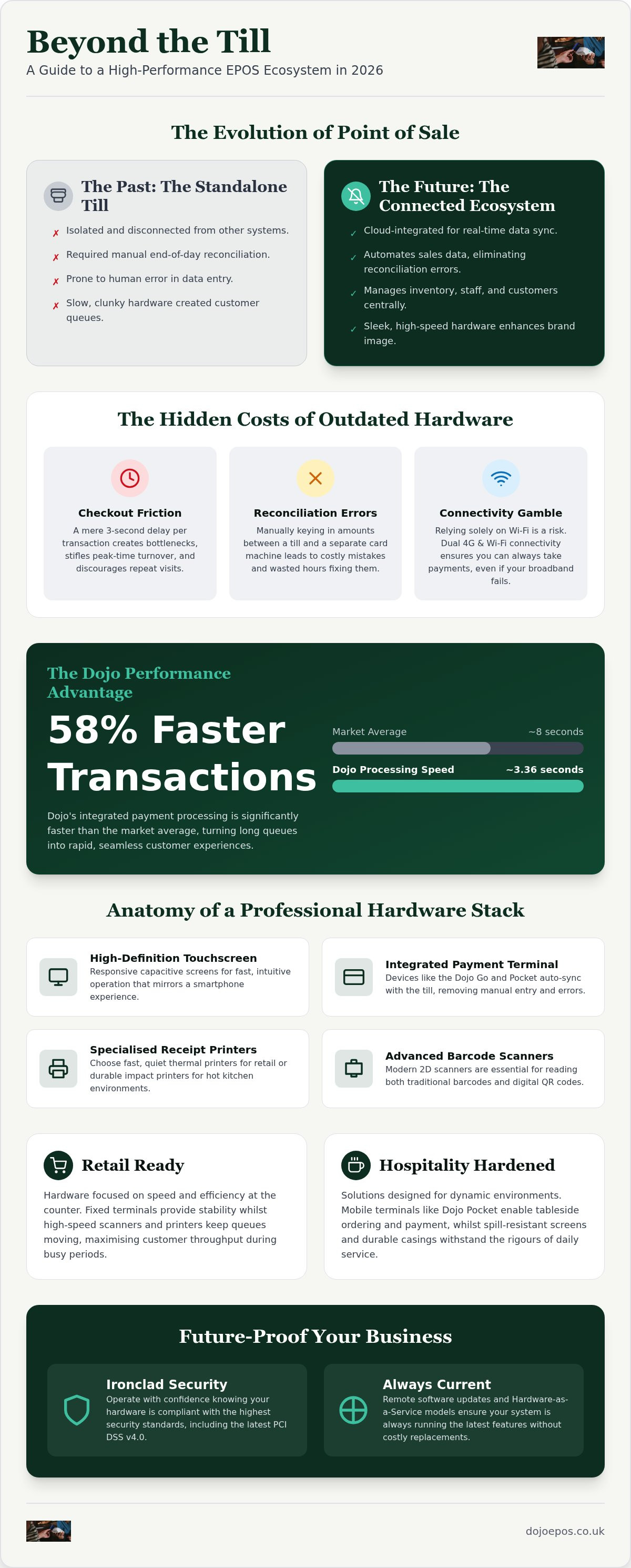
This guide reveals how the right hardware eliminates service latency, automates your admin, and future-proofs your UK operations against new standards like PCI DSS v4.0. We will look at how tools like the Dojo Go and Dojo Pocket, integrated with Blinq POS, create a professional environment that speeds up checkouts and syncs sales automatically. From leveraging processing speeds that are 58% faster than the market average to choosing durable kit that looks the part, you'll discover exactly how to upgrade your counter for a more profitable year.
Table of Contents
Beyond the Cash Register: Why Modern EPOS Hardware Matters in 2026
Essential Components of a Professional EPOS Hardware Ecosystem
Integrated vs Standalone Hardware: The Efficiency Comparison
Sector-Specific Hardware Requirements: Retail vs Hospitality
Future-Proofing Your Business with Dojo’s Hardware Solutions
Beyond the Cash Register: Why Modern EPOS Hardware Matters in 2026
The days of the clunky, standalone cash register are over. In 2026, your electronic point of sale hardware functions as a high-speed gateway to your business data. It's a connected ecosystem rather than a simple drawer for coins. Modern systems have transitioned from isolated analog units to cloud-integrated terminals that sync every transaction in real-time. This evolution means your hardware isn't just taking money; it's managing inventory, tracking staff performance, and securing customer data. A modern point of sale (POS) setup ensures that your physical storefront stays perfectly aligned with your digital records.
High-quality hardware builds immediate confidence. When a customer sees a sleek, responsive terminal, they feel their data is secure. This is why many UK businesses now prefer "Hardware-as-a-Service." This model allows for continuous tech updates, ensuring your business always operates on the latest, most secure version of the kit without the sting of a massive upfront cost every few years. Reliability is the foundation of customer trust; when your tech stays current, your brand stays professional.
The Cost of Latency: How Slow Hardware Bleeds Revenue
Speed is a currency in modern retail. A mere three-second delay per transaction might seem trivial, but across a hundred customers, it creates a bottleneck that stifles peak-time turnover. Slow electronic point of sale hardware causes "checkout friction," a psychological barrier that discourages repeat visits. Customers in 2026 expect instant gratification. By utilising terminals with high-speed processors, you eliminate these micro-delays. You move through the queue faster, keep the atmosphere energetic, and maximise your revenue during your most profitable hours.
Reliability in the UK Market: 4G and Wi-Fi Connectivity
Connectivity is the lifeblood of modern commerce. In the UK, relying solely on a shop's Wi-Fi is a gamble you can't afford to take. Dual-connectivity, featuring both Wi-Fi and 4G, is now a non-negotiable standard for professional merchants. Inferior hardware often forces an "offline mode" when the signal drops, which carries the risk of declined payments later on. Dojo focuses on "always-on" connectivity, ensuring your card machines switch seamlessly between networks. This redundancy provides peace of mind, knowing that your ability to take payments remains constant even if your local broadband fails.
Essential Components of a Professional EPOS Hardware Ecosystem
Building a professional electronic point of sale hardware ecosystem requires more than just picking individual components. It's about creating a synergy between the screen, the payment terminal, and the peripherals. In high-traffic environments, your electronic point of sale hardware acts as the face of your brand. A cluttered counter with tangled wires suggests chaos, whereas a sleek, minimalist setup projects authority and efficiency. The central terminal serves as the hub, managing everything from receipt printers to barcode scanners, ensuring that data flows without interruption.
You should prioritise materials that withstand the rigours of daily use. Spill-resistant screens and ruggedised casings are essential in busy hospitality settings where a single knocked coffee could otherwise halt your entire operation. Investing in durable kit reduces long-term costs by avoiding frequent repairs and replacements. If you are looking to streamline your counter, you can explore integrated hardware solutions that combine these components into one high-performance system.
High-Definition Touchscreen Terminals and All-in-One Systems
Modern staff speed depends on responsive capacitive touchscreens. Unlike older resistive screens that require a firm press, capacitive glass reacts to the lightest touch, mirroring the smartphone experience your team already knows. You can choose between fixed counter-top units for stability or flexible, pivoting mounts that allow you to turn the screen toward the customer for tipping or sign-ups. Systems like Blinq POS offer a minimalist aesthetic that cleans up your shop floor whilst providing the power needed for complex inventory tasks.
Peripheral Essentials: Receipt Printers and Scanners
Choosing the right printer depends entirely on your environment. Thermal printers are the standard for retail because they are fast and quiet. Impact printers are better for hot kitchens because the paper won't turn black from the heat. Barcode scanning has also evolved; 2D scanners are now vital for reading QR codes on customer phones for loyalty schemes or digital vouchers. Even the humble cash drawer has changed, with smart locking mechanisms that only open for specific transaction types, adding a layer of security to your physical takings. These components must work in harmony to keep your checkout line moving.
Integrated vs Standalone Hardware: The Efficiency Comparison
Choosing between integrated and standalone systems is the most critical decision you will make regarding your electronic point of sale hardware. Standalone hardware operates in a vacuum; your till and your card machine do not communicate. This forces staff to manually type the transaction total into the card reader for every sale. Integrated payments, however, create a digital bridge between your POS software and your payment terminal. When you total an order on your screen, the amount is instantly sent to the card machine. This connectivity is the hallmark of a modern, high-performance business.
The efficiency gains from integration are measurable. Removing manual entry saves several seconds per customer, which dramatically increases your throughput during peak trading hours. It also eliminates the risk of "fat-finger" mistakes where a staff member might accidentally charge £1.00 instead of £10.00. To understand how these systems fit into your budget, you can review Dojo card machine rates for a clear breakdown of the costs associated with professional, integrated setups.
Eliminating Manual Errors and Speeding Up Reconciliation
Integrated hardware utilises "Push to Pay" technology to ensure accuracy. Because the till dictates the price to the terminal, human error is virtually removed from the equation. This leads to the greatest benefit for business owners: automated reconciliation. At the end of a busy shift, you no longer need to spend hours cross-referencing till reports against stacks of card machine receipts. The totals always match because the hardware has been talking to itself all day. This automation frees up your time to focus on growth rather than admin.
Real-Time Data Syncing: Hardware That Informs Strategy
In 2026, successful merchants rely on live data to make snap decisions. Integrated electronic point of sale hardware ensures that every interaction updates your central system instantly. If a customer buys the last bottle of a specific wine via a Dojo Pocket at their table, your inventory levels update across all devices immediately. This real-time syncing, powered by cloud-based platforms like Blinq POS, prevents staff from selling out-of-stock items. It provides a single source of truth for your stock, sales, and staff performance, allowing you to manage your site with absolute precision.
Sector-Specific Hardware Requirements: Retail vs Hospitality
Choosing the right electronic point of sale hardware depends entirely on how your staff move. In a traditional retail environment, your operations likely centre around a "Fixed Point" model where customers come to a central counter. In contrast, hospitality thrives on a "Mobile" model, where the checkout moves to the customer's table. These distinct workflows require different hardware priorities. Retailers need stability and high-volume scanning, whilst hospitality operators require lightweight, durable handhelds that can survive a busy shift.
Durability requirements shift based on your business type. A retail terminal sits in a relatively dry, clean environment, but a hospitality device faces constant threats from spilled drinks and steam. Battery life is also a dealbreaker for handheld kit. If a device dies mid-service, it creates an immediate bottleneck. Professional solutions like the Dojo Go provide a reliable counter-top anchor, whilst the Dojo Pocket offers the portability needed for floor staff. If you're ready to upgrade, you can view our range of industry-leading hardware today.
Hospitality Focus: Handheld Terminals and Kitchen Display Systems
In a restaurant or bar, every second counts towards table turnover. Handheld card machines allow waiters to take orders and payments at the table, removing the need to walk back and forth to a central till. This mobility is perfectly embodied by the Dojo Pocket, a sleek, smartphone-sized terminal that fits comfortably in a pocket. Beyond payments, modern hospitality sites are replacing paper tickets with Kitchen Display Systems (KDS). These screens ensure orders are legible and tracked in real-time, reducing errors and keeping the kitchen staff in perfect sync with the floor team.
Retail Focus: High-Speed Scanning and Customer Displays
Retailers processing high volumes of items require omnidirectional scanners. These devices read barcodes from any angle, significantly increasing checkout speed. Trust is also a major factor in retail; customer-facing displays allow shoppers to see their items being rung up in real-time. This transparency reduces disputes and provides a space to offer digital receipts or loyalty sign-ups. Many retailers are now adopting portable card machines to bust queues during busy periods, effectively taking the checkout to the customer anywhere on the shop floor. This flexibility ensures you never lose a sale because the main line was too long.
Future-Proofing Your Business with Dojo’s Hardware Solutions
Investing in electronic point of sale hardware shouldn't feel like a gamble on technology that will be obsolete in eighteen months. Modern business requires agility. Dojo hardware thrives on this by evolving through remote software updates that deliver new features and security patches automatically. This ensures your business remains fully compliant with the latest standards, such as the mandatory PCI DSS v4.0 requirements that became the global benchmark in March 2026. You get a system that stays sharp without the need for manual intervention or costly engineer visits.
Security is built into the core of the kit. Every transaction is encrypted at the point of interaction, protecting your customers and your reputation from the start. Beyond the technical specs, Dojo understands that hardware performance must translate to financial health. This is why Next-Day Transfers come as standard. By processing payments through high-speed, reliable terminals, you ensure that your hard-earned takings are in your bank account the following day; this keeps your cash flow fluid and your operations predictable.
Dojo Go and Dojo Pocket: The Power of Portability
The Dojo Go provides the ultimate anchor for your counter-top. It combines a professional aesthetic with the rugged dependability required for high-volume retail or busy reception desks. If your service model demands more movement, the Dojo Pocket steps in. It is a smartphone-sized powerhouse designed for fast-paced environments where staff need to take payments on the move. Both devices arrive with "out-of-the-box" readiness. You can start taking payments almost immediately, avoiding the complex setup procedures that plague legacy systems.
Blinq POS: The Hardware-Software Synergy
Hardware is only as smart as the software that drives it. Blinq POS acts as the central brain, maximising the potential of your electronic point of sale hardware. This synergy allows for seamless inventory tracking, staff management, and live reporting across all your devices simultaneously. When your software and hardware are designed to work together, you eliminate the friction that often occurs with multi-vendor setups. You benefit from a unified UK-based support system that understands your entire ecosystem. This total integration is the key to scaling your operations with confidence. Organise your business with Dojo hardware today and build a foundation for long-term growth.
Modernise Your Business with High-Performance Hardware
Investing in the right electronic point of sale hardware is the foundation for a more efficient, profitable operation in 2026. You've seen how moving from standalone registers to integrated ecosystems eliminates manual errors and speeds up your end-of-day reconciliation. Whether you require the counter-top reliability of the Dojo Go or the handheld flexibility of the Dojo Pocket, your hardware should empower your staff to deliver exceptional service without technical friction.
Don't let sluggish tech hold your growth back. With next-day transfers as standard and seamless integration with over 600 EPOS apps, you can stay ahead of the competition whilst maintaining a healthy cash flow. If you ever need help, our UK-based 24/7 technical support is always ready to assist. It's time to upgrade your business with Dojo’s high-performance EPOS hardware and build the future you've planned. Your success is our priority, and we're here to help you reach it.
Frequently Asked Questions
What is the difference between POS and EPOS hardware?
POS stands for Point of Sale, which is the physical location where a transaction is completed. EPOS, or Electronic Point of Sale, refers to the hardware and software used to process those sales digitally. Modern electronic point of sale hardware acts as a connected ecosystem that manages inventory and staff whilst processing payments. Unlike a basic cash register, an EPOS system provides real-time data and integrates with your business apps to streamline every aspect of your operations.
Do I need an internet connection to run EPOS hardware?
You generally need an active internet connection to utilise the full features of modern electronic point of sale hardware, such as real-time stock syncing and remote software updates. Whilst some systems offer an "offline mode," this can lead to declined payments later. To ensure reliability, professional devices like the Dojo Go use dual-connectivity. This means they switch seamlessly between Wi-Fi and 4G, providing an "always-on" service that protects your revenue during broadband outages.
Is it better to buy or rent electronic point of sale hardware?
Renting or using a subscription model for your electronic point of sale hardware is often superior to buying kit outright. This "Hardware-as-a-Service" approach ensures you always have access to the latest technology and security patches without large upfront costs. Because hardware evolves quickly, owning your equipment can lead to obsolescence and security risks. Subscription models typically include ongoing technical support and automatic updates, keeping your business compliant with standards like PCI DSS v4.0 without any extra effort.
Can I use my own tablet with Dojo payment hardware?
Dojo payment hardware is designed for seamless synergy with the Blinq POS ecosystem. Whilst some standalone card machines can work alongside various tablets, the best results come from using a unified system where the software and hardware are built to talk to each other. This integration allows for "Push to Pay" functionality, where the order total is sent directly from your tablet to the card machine, removing the need for manual entry and reducing human error.
How long does it take to set up new EPOS hardware?
Setting up new hardware is remarkably fast with modern providers. Dojo card machines like the Dojo Go and Dojo Pocket offer "out-of-the-box" readiness, meaning you can often start taking payments within minutes of plugging them in. A full POS ecosystem, including printers and scanners, might take slightly longer to configure depending on the size of your inventory. However, the intuitive interfaces of systems like Blinq POS ensure that staff training is straightforward and fast-paced.
What happens if my EPOS hardware fails during a busy shift?
If your hardware fails during a busy shift, you need immediate assistance to avoid losing sales. Professional providers offer UK-based 24/7 technical support to resolve issues quickly. Many hardware problems are software-related and can be fixed through remote updates. For physical damage, having a reliable partner ensures that replacements are handled swiftly. Using mobile handhelds like the Dojo Pocket as a backup for your main counter-top unit is also a smart way to maintain service continuity.
Does Dojo hardware support contactless and mobile wallet payments?
Yes, all Dojo hardware fully supports contactless payments, including physical cards and mobile wallets like Apple Pay and Google Pay. Contactless payments account for 73% of all card transactions in the UK, making this a vital feature. Whilst the standard contactless card limit is £100, mobile wallet payments often allow for much higher transaction values due to built-in biometric security. This flexibility ensures you can process both small and large sales quickly and securely.
Is EPOS hardware secure against data breaches?
Security is a core feature of professional hardware. All UK businesses must be fully compliant with PCI DSS v4.0 requirements by 31 March 2026. Modern systems use end-to-end encryption and tokenisation to ensure that sensitive card data never enters your local network. This protects you from data breaches and significant penalties. Choosing a provider that manages these security updates remotely means your hardware stays protected against the latest threats without requiring manual intervention from your team.


Comments