
How Does a Card Reader Work? A Merchant’s Guide to Modern Payments
What if the three seconds it takes for a customer to tap their card are actually the most sophisticated part of your entire business day? It's easy to view the device on your counter as a simple gateway, but asking how does a card reader work is the first step toward mastering your cash flow. You've likely felt the frustration of a sluggish connection during a lunchtime rush or the nagging worry about whether a transaction is truly secure. Processing payments shouldn't feel like a mystery that hides your hard-earned revenue.
It's understandable to feel overwhelmed by the jargon of merchant fees and the anxious wait for funds to hit your account. We agree that your energy belongs on growth, not on troubleshooting hardware. This guide reveals the fascinating journey of a transaction and shows how modern card readers secure your revenue in seconds. We'll walk through the entire payment chain, from the encrypted tap to next-day transfers, giving you the confidence to choose tools that help you realise your business goals.
Table of Contents
Anatomy of a Card Reader: More Than Just a Piece of Hardware
To understand how does a card reader work, you first need to look beyond the plastic casing. A modern card reader is a sophisticated, secure interface that bridges the gap between your customer's bank and your merchant account. It isn't just a calculator with a slot; it's a dedicated computer designed for high-speed encryption and seamless communication. By acting as a secure gatekeeper, it ensures that sensitive financial data never falls into the wrong hands whilst keeping your transactions moving at pace.
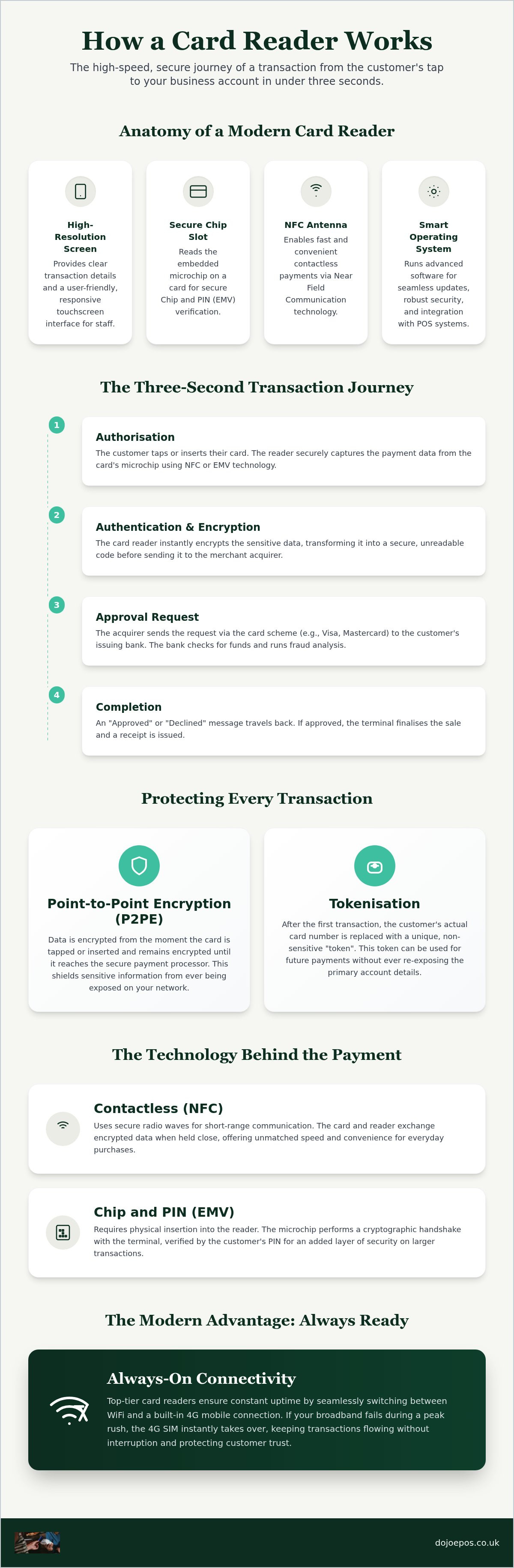
The physical anatomy includes a high-resolution screen for clear transaction details, a secure chip slot for physical verification, and a Near Field Communication (NFC) antenna for contactless taps. Whilst the hardware captures the data, the payment gateway software inside the terminal does the heavy lifting. This software acts as the digital courier, whisking encrypted information through a secure tunnel to the processor. Understanding how does a card reader work in this modern context helps you appreciate the leap from basic data capture to full-scale business intelligence.
Legacy "dumb" card machines were limited by fixed hardware and clunky buttons. Modern Android-based terminals, however, function more like smartphones. They're agile, powerful, and capable of running complex applications that integrate directly with your business operations. This shift from simple hardware to smart devices is why today's machines feel so much faster and more dependable than the technology of a decade ago.
The Role of the Operating System
Modern readers like the Dojo Go utilise advanced operating systems to provide a premium experience. This setup allows for seamless software updates, ensuring your security protocols are always current without the need for new hardware. It's a future-proof approach to payments. For your staff, this means a user-friendly interface that reduces training time and minimises input errors. A clear, responsive touchscreen makes a massive difference when you're trying to clear a queue of twenty people during a peak period.
Connectivity: WiFi, 4G, and Bluetooth
Reliability is non-negotiable in the UK market. A dropped connection doesn't just stall a sale; it damages customer trust and slows your growth. Leading terminals maintain constant uptime by switching between WiFi and 4G automatically. If your shop's broadband fails, the 4G SIM kicks in instantly to keep the queue moving. Cloud-based management also allows you to track the health of every reader in your fleet. You can see which devices are online and fully charged, ensuring your hardware is always ready to perform when your customers are ready to pay.
The Three-Second Journey: How Data Travels from Tap to Till
When you ask how does a card reader work, you're really asking about a high-speed digital relay race. Whilst it looks like a single "beep" to your customer, every transaction triggers a complex sequence of global handshakes. This process must be flawless; a single break in the chain means a failed sale and a frustrated customer. Understanding this journey helps you see why professional-grade hardware is essential for your business growth.
Step 1: Authorisation – The moment a customer taps or inserts their card, the reader captures the essential data. This is where Chip and PIN technology or NFC protocols initiate a secure handshake with the card's internal microchip.
Step 2: Authentication – The reader doesn't just pass on raw numbers. It encrypts the data instantly, turning sensitive information into an unreadable code before sending it to your merchant acquirer.
Step 3: Approval – Your acquirer forwards the request through the card network to the issuing bank. The bank checks for available funds and performs a lightning-fast fraud check before sending a "Yes" or "No" back down the line.
Step 4: Completion – The reader receives the approval, flashes the "Approved" message, and finalises the sale by printing a receipt or sending a digital version.
This complex sequence is the core of how does a card reader work in a professional retail environment. It's a miracle of modern engineering that this entire cycle typically completes in under three seconds.
The Key Players in Every Transaction
Three main entities work behind the scenes to move your money. The Merchant Acquirer is the financial institution that processes payments on your behalf. The Card Scheme, such as Visa or Mastercard, provides the central network that facilitates the data move. Finally, the Issuing Bank is the customer’s bank that holds the actual funds. Each player must communicate perfectly to ensure you get paid on time.
Why Latency Matters for Merchant Growth
Latency is the time delay between the initial tap of a card and the final approval message appearing on the screen. In a high-volume business, those extra seconds add up quickly. A ten-second delay might not seem like much, but across a hundred customers, it creates a bottleneck that kills your efficiency. Choosing a provider that prioritises this speed is vital for integrated payment success. When your hardware processes data faster, your queues move quicker, your staff stay productive, and your revenue grows without friction.
Security Protocols: Protecting Your Business and Your Customers
Security isn't an optional extra; it's the foundation of every transaction. If you're asking how does a card reader work to keep your revenue safe, the answer lies in layers of invisible, high-tech armour. Every time a customer taps their phone or inserts their card, a sophisticated defence mechanism activates. This ensures that sensitive financial data is never exposed to external threats, allowing you to trade with total confidence.
Modern readers don't just capture data; they transform it. By using advanced encryption and real-time monitoring, these devices act as a shield for your business. They're designed to detect and block suspicious or fraudulent card behaviour before a transaction is even approved. This proactive approach to security is what separates professional-grade hardware from legacy equipment that might leave you vulnerable.
Understanding P2PE and Tokenisation
Encryption starts the very millisecond a card touches the reader. Point-to-Point Encryption (P2PE) is the industry gold standard. It ensures that card data is encrypted at the point of interaction and remains unreadable until it reaches the secure decryption environment. This two-stage process is essential for modern commerce, as detailed in the U.S. Treasury's overview of payment processing. It means that even if a hacker managed to intercept the signal, they'd find nothing but useless, scrambled code.
Tokenisation takes this a step further by replacing sensitive card numbers with one-time, unique codes called tokens. Your business never stores the actual card details, which significantly reduces your risk profile. This level of protection is a core feature of the Dojo network, providing the peace of mind you need to focus on growth whilst we handle the technicalities of data safety.
PCI-DSS Compliance Simplified
PCI-DSS compliance is a non-negotiable requirement for any UK business accepting card payments. It's a set of security standards designed to protect merchants from liability and ensure a secure environment for customers. However, the administrative burden of compliance can be immense. Modern payment providers like Dojo take the heavy lifting out of this process by providing hardware that is already fully certified and secure by design.
Using outdated or non-compliant hardware is a risk you can't afford to take. It leaves your business open to heavy fines and devastating data breaches. By choosing a partner that prioritises high-level security, you ensure that your how does a card reader work query is answered with a solution that is both fast and incredibly resilient. Compliance becomes a seamless part of your operation rather than a stressful annual hurdle.
Contactless vs Chip and PIN: The Technology Behind the Transaction
The debate between contactless and physical insertion isn't just about speed; it's about the underlying science. If you're wondering how does a card reader work when a customer simply waves their phone, the answer lies in Near Field Communication (NFC). This technology uses short-range radio waves to transmit encrypted data through the air. Unlike older technologies that relied on physical contact, NFC creates a temporary, secure electromagnetic field between the device and the reader. It's a sophisticated leap from the legacy phone-line terminals that used to clutter UK counters.
The antenna inside a terminal like the Dojo Go stays in a low-power state until it detects a compatible chip nearby. Once "woken up", it initiates a lightning-fast handshake. This wireless protocol is designed to operate within a few centimetres, which prevents accidental payments from passers-by. It's a precise balance of convenience and engineering that allows you to process transactions with absolute confidence.
The Rise of NFC and Mobile Wallets
Mobile wallets like Apple Pay and Google Pay have revolutionised the checkout experience. These platforms are often more secure than physical plastic. Because they require biometric authentication, such as FaceID or a fingerprint, the risk of unauthorised use is virtually eliminated. Even if a customer loses their phone, their financial data remains locked behind a layer of advanced encryption. Preparing your business for a cashless consumer base means embracing these digital tools. When you upgrade to modern card machines, you're giving your customers the freedom to pay exactly how they choose, whilst maintaining the highest levels of security.
Chip and PIN: The Reliable Standard
Whilst contactless is the crowd favourite for speed, Chip and PIN remains the robust fallback for high-value sales or whenever a bank requires extra verification. This technology uses a physical connection between the reader's gold-plated pins and the card's microchip to verify a secret key. It's a mechanical handshake that hasn't lost its relevance in a digital world. Understanding how does a card reader work in this context means appreciating the physical security of the chip itself.
A durable, tactile keypad is essential for customer confidence. When a shopper enters their PIN, they expect a responsive, secure experience. Modern readers also handle "offline" PIN verification when required, ensuring that the transaction can proceed even if the network is momentarily patchy. This versatility is why a single device must manage the transition between different payment methods seamlessly. Whether it's a tap, a swipe, or a dip, your hardware should handle the logic automatically, allowing your staff to focus on the customer rather than the technology.
Beyond the Beep: Choosing a Reader That Scales Your Business
Choosing the right hardware is only half the battle. Whilst understanding how does a card reader work on a technical level is vital, the real value lies in the backend logic that supports your daily operations. A reader that simply beeps isn't enough to scale a modern business. You need a solution that connects your front-of-house experience with your back-office accounts. This turns every transaction into a data point for growth rather than just a simple exchange of funds.
Modern merchants are moving away from standalone devices that require manual data entry. When your hardware is isolated, your staff have to type the price into the reader and then the till separately. This creates a massive window for "fat-finger" errors where a simple typo can cost you significant revenue. By contrast, a system that integrates your reader directly with your POS software ensures that the right amount is charged every single time. It's about removing friction from the point of sale.
Integrating with Blinq POS
A reader that talks to your till simplifies your entire operation. Using Blinq POS integration means your end-of-day reconciliation happens in seconds rather than hours. You don't need to spend your evening cross-referencing paper receipts against digital reports. In hospitality environments, this connectivity allows you to take the reader to the customer. This improves table turnover and provides a premium service that encourages repeat business. It creates a seamless flow that benefits both your team and your clientele.
Unlocking Cash Flow with Next-Day Transfers
The biggest bottleneck for UK merchants is often the wait for funds. Waiting three to five days for your money to arrive is an outdated model that stifles stock management and payroll. When you understand how does a card reader work within the Dojo ecosystem, you realise that speed isn't just about the tap; it's about the settlement. Having yesterday's takings in your account today gives you the agility to respond to market demands instantly.
This rapid access to capital is a game-changer for cash flow. Whether you're paying suppliers or investing in new equipment, Next-Day Transfers ensure your money is working for you as soon as possible. To see how this fits into your overheads, you can review Dojo card machine rates to understand the full value of a modern payment partner. Position your business for success by choosing the Dojo Go, the standard for merchants who refuse to be slowed down by legacy banking delays.
Take Control of Your Transaction Technology
Understanding how does a card reader work is more than a technical exercise; it's about gaining the clarity needed to optimise your business. You've seen how data moves from a simple tap to a secure approval in seconds and how advanced encryption keeps your revenue shielded from external threats. The real difference between a standard terminal and a modern powerhouse lies in the ability to settle funds quickly whilst integrating seamlessly with your daily operations.
Trusted by over 110,000 UK businesses, our solutions are designed to eliminate the friction of legacy banking. By combining high-speed hardware with Next-Day Transfers and Blinq POS integration, you ensure that your cash flow remains as agile as your service. Switch to a faster, more reliable card reader with Dojo today and experience the confidence of a partner that prioritises your growth. Your business deserves technology that works as hard as you do. Let's make every beep count toward your next milestone.
Frequently Asked Questions
How does a card reader communicate with the bank?
A card reader communicates with the bank by sending encrypted transaction data through a secure internet connection to your merchant acquirer. This acquirer then routes the request through the card scheme network to the customer's issuing bank for approval. To understand how does a card reader work in this context, think of it as a digital messenger that ensures every handshake is authorised before the sale completes.
Are card readers secure for my business?
Card readers are incredibly secure when they utilise industry-standard protocols like Point-to-Point Encryption (P2PE) and tokenisation. These technologies ensure that sensitive card data is scrambled at the moment of contact, making it unreadable to unauthorised parties. Choosing a provider that is fully PCI-DSS compliant protects your business from liability. Our network is trusted by over 110,000 UK businesses because it prioritises this high-level data protection across every transaction.
What is the difference between a card reader and a card machine?
Whilst the terms are often used interchangeably, a card reader usually refers to the component that captures data, whereas a card machine is the complete terminal. Modern devices combine both into a single, powerful unit. When merchants ask how does a card reader work, they are usually referring to the entire process managed by a smart terminal like the Dojo Go, which handles everything from the tap to the final receipt.
Do I need a specific internet connection for my card reader to work?
You don't need a specific type of internet connection, but a stable one is essential for processing sales without delay. Most modern terminals connect via standard WiFi or a built-in 4G SIM card. This dual-connectivity is a hallmark of dependable hardware, as it allows the device to switch networks automatically if one signal drops. This ensures your business stays online and ready to accept payments even during local broadband outages.
How long does it take for money to reach my bank account after a sale?
Settlement times vary between providers, but the modern standard is much faster than the traditional three to five days. With Dojo, you benefit from Next-Day Transfers as standard, meaning yesterday's takings are in your bank account today. This rapid access to your revenue is vital for managing stock, paying staff, and maintaining a healthy cash flow. It eliminates the frustration of waiting for your hard-earned money to clear.
Can a card reader work without a physical phone line?
No, a physical phone line is no longer required for modern payment processing. Older analog terminals relied on dial-up connections, but today's hardware uses high-speed digital networks. By utilising WiFi or mobile data, your terminal can process transactions anywhere in your premises or even on the move. This shift away from fixed lines has made card machines more portable, reliable, and significantly faster than legacy equipment.
What happens if the customer’s card is declined?
If a customer's card is declined, the reader will display a clear message on the screen and the transaction will not proceed. This usually happens due to insufficient funds, an expired card, or a security block from the issuing bank. Your staff should simply ask for an alternative payment method. Because the authentication process happens in real-time, you are instantly protected from processing a sale that won't be settled.
Does a card reader need to be plugged in all the time?
Modern card machines don't need to be plugged in all the time. Devices like the Dojo Go and Dojo Pocket are equipped with long-lasting lithium-ion batteries designed to last through a full business day. You can charge them overnight or on a sleek charging base between uses. This cordless freedom allows your team to take payments directly to the customer, which is particularly effective for improving service speed in busy hospitality environments.


Comments