
How to Improve Restaurant Table Turnover: 2026 Guide
The best way to improve restaurant table turnover is to look for delays in the service, not to treat diners as the delay. When tables stay occupied longer than planned, the cause may be a slow handover, a missed order update or a wait to pay, rather than guests lingering. Pressuring people to leave can harm their experience without fixing the bottleneck.
If you manage a restaurant, you need a clear view of where time is being lost across a shift. Faster service does not have to feel rushed or impersonal. Small changes to the flow can make each stage smoother for guests and easier for your team.
This guide shows you how to spot avoidable delays from arrival through ordering, payment and clearing, then choose practical ways to address them. You’ll also learn how to track table turnover alongside guest feedback and service quality, so you can judge whether a change is genuinely helping. The aim is a more efficient operation that still leaves diners in control of their experience.
Table of Contents
What restaurant table turnover means, and why the whole guest journey matters
Where restaurant service loses time: map the journey from arrival to payment
Which changes improve table turnover without making diners feel rushed?
How to test table-turnover improvements and measure what changes
How POS and payments can support a smoother restaurant table flow
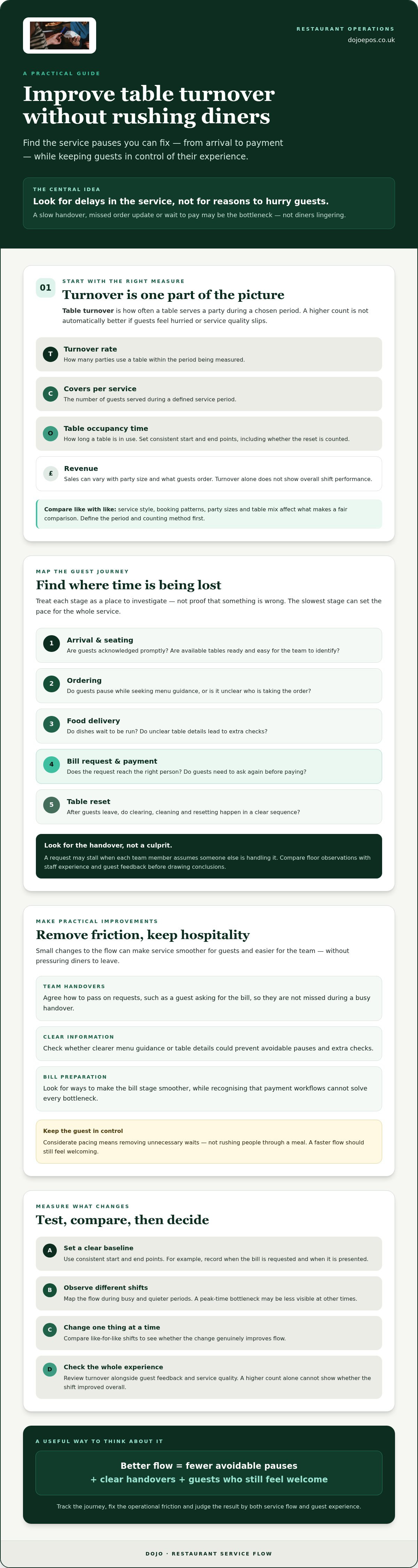
What restaurant table turnover means, and why the whole guest journey matters
Restaurant table turnover is how often a table serves a party of guests during a chosen period. For example, a manager might count how many parties use each table during an evening service. The Table-turn concept is a useful starting point, but turnover only tells part of the story. A higher count is not automatically better if guests feel hurried or service quality slips.
Turnover, covers, dining time and revenue describe different things. Covers are the number of diners served, while average dining time tracks how long guests spend at the table. Revenue records sales, which can vary with party size and what guests order. These measures are connected: reducing avoidable waits may free a table sooner, but turnover alone will not show whether service felt welcoming or the shift performed well overall.
Which restaurant table-turnover measures should managers understand?
Use a small set of clearly defined measures and compare like with like:
Covers per service: the number of guests served during a defined service period.
Table occupancy time: how long a table is in use. Decide whether tracking starts when guests are seated and ends when they leave, or whether it includes the time until the table is reset.
Turnover rate: how many parties use a table within the period you are measuring.
There is no single useful benchmark for every restaurant. Service style, booking patterns, party sizes and the mix of two-person and larger tables all affect what counts as a fair comparison. Define the period and counting method before reviewing results.
Why can turnover improve without compromising hospitality?
Guests benefit when the team removes unnecessary pauses, such as waiting to be seated despite a ready table, unclear menu information or a delay after requesting the bill. Staff benefit too: clear handovers can reduce confusion and help the shift run smoothly. That is considerate pacing, not a reason to hurry diners through a meal.
Illustrative example, not research: A party finishes eating and asks for the bill, but the request is missed during a busy handover. Agreeing how to pass on bill requests could help the team respond promptly, while leaving guests free to take the time they need. That is a practical way to improve restaurant table turnover: remove friction from the journey rather than pressuring people to leave.
Where restaurant service loses time: map the journey from arrival to payment
Delays can occur at any point between a guest arriving and the table being ready for the next party. Treat each stage as a place to investigate, not proof that something is going wrong. A wait may be unavoidable at one point and preventable at another.
The slowest stage can set the pace for the whole service, even when every other step runs smoothly.
Arrival and seating: Check whether guests wait to be acknowledged, and whether available tables are ready and easy for the team to identify.
Ordering: Look for pauses while guests seek menu guidance or staff confirm who is taking the order.
Food delivery: Notice whether dishes wait to be run or unclear table details lead to extra checks.
Bill request and payment: Track whether a request reaches the right person and whether guests have to ask again before they can pay.
Table reset: Check whether clearing, cleaning and resetting happen in a clear sequence after guests have left.
Map the flow during both busy and quieter periods before deciding which issue deserves attention. A bottleneck at peak service may be less visible at other times, while quieter periods can reveal unclear responsibilities without the pressure of a full floor. Use a simple shift log with consistent start and end points. For instance, note when the bill is requested and when it is presented, rather than relying on general impressions of how long the wait felt.
How can teams find delays during a restaurant service?
Observe the floor, then compare what you see with staff experience. Ask where handovers are missed, tasks are duplicated or responsibility is unclear. Invite guest feedback too, through a brief conversation or an existing feedback channel. A delay may be obvious at a table but invisible from the kitchen or till, so gather more than one perspective before drawing conclusions.
Why do ordering, billing and payment handovers matter?
At busy moments, a request can stall if each team member assumes someone else has picked it up. Agree who owns order updates and bill requests. You could also provide a straightforward way for guests to signal that they are ready to pay, without requiring repeated visits. Connected payment and point-of-sale workflows may help reduce handovers, but first check where the pause actually occurs. For broader context, read this guide to integrated payment solutions.
Efficiency does not have to come at the guest’s expense. Harvard Business Review’s discussion of efficiency and service offers a useful lens: design processes around the variation guests bring, rather than expecting every visit to follow an identical script. To explore Dojo’s payment and POS options, visit Dojo’s payment and POS solutions.
Which changes improve table turnover without making diners feel rushed?
Start with a recurring delay the team can influence, then choose a change that fits your existing procedures. Clarifying who owns a handover or making menu information easier to explain may remove friction without changing the character of your service. Test each adjustment against a baseline rather than assuming it will improve restaurant table turnover.
Which low-disruption service changes are worth testing first?
Match the action to the issue you observed. Consider the likely effort, the friction it addresses and what guests might notice:
Clearer team handovers: Agree who greets arriving guests, updates a table on an order and passes on a bill request. This takes coordination, but can prevent requests from being missed or repeated.
More useful menu communication: Make sure staff can explain dishes, options and likely waits clearly. This may reduce uncertainty for guests without steering them towards quicker choices.
Bill readiness: Set a simple way to recognise when guests want to pay and make sure the request has a clear owner. The aim is to avoid unnecessary waiting, not to present the bill before guests are ready.
Consistent table resets: Clarify who clears, cleans and resets a table between parties. A shared routine can reduce confusion while maintaining the standards guests expect.
These changes are usually easier to trial than altering the floor plan or booking policy. Layout and booking decisions affect capacity and the kind of service you can offer, so consider them separately from improvements to the flow of existing service. Keep guests’ choice central: communicate booking expectations clearly, but do not make diners feel they must finish by a particular time unless that is part of a policy they have been told about.
How should restaurants balance table turnover and guest satisfaction?
Review service-time measures alongside guest comments and staff observations. If a process change shortens a wait but guests report feeling hurried, it may be solving the wrong problem. Equally, a longer meal is not a failure if it suits your restaurant’s style and guests are enjoying their visit. Compare similar services and booking patterns, and change one thing at a time so you can judge its effect.
For related payment considerations in hospitality, see this guide to card machines for pubs and bars. Payment is one part of the experience, so assess any adjustment as part of the whole guest journey, not as a guaranteed route to faster table turns.
How to test table-turnover improvements and measure what changes
A useful test starts with a clear question, such as whether guests wait longer than expected between requesting the bill and receiving it. Record the current process before changing it, then check whether the adjustment improves the flow without creating extra work or a poorer guest experience. This gives you a sounder basis for improving restaurant table turnover than relying on a single shift or impression.
Use this four-step process to test a table-turnover improvement:
Choose one bottleneck. Identify a specific stage to investigate, such as order updates, bill delivery or table resets.
Record a baseline. Note how the stage currently works and capture its timing using consistent start and end points.
Test one change. Make a practical adjustment, such as clarifying who delivers requested bills, while keeping other procedures steady where possible.
Review the results. Compare the test with the baseline and consider guest feedback, staff experience and operational measures before deciding what to keep.
Which measures help evaluate a service change?
Choose measures that answer your question, rather than collecting numbers without a purpose. Depending on the bottleneck, you might track covers during a service, the wait at a particular stage, the interval between guests leaving and a table being reset, or feedback about the experience. No single measure tells the whole story: a shorter wait is useful only if it has not created confusion or made guests feel hurried.
Define each measure before recording it. For example, decide whether a reset interval starts when guests leave or when clearing begins. Keep the definition consistent across shifts. Note the service period, booking mix and staffing levels too, so a busy service is not compared uncritically with a quieter one.
How can a restaurant run a fair improvement test?
Where practical, change one process at a time and choose a review period that gives the team enough comparable observations. Compare similar services, but document unavoidable differences such as a change in booking pattern or staffing level. Explain the test’s purpose to staff, then ask whether the change was easy to follow, added workload or caused uncertainty. If results are mixed, adjust the process or run another test before making it standard.
Review the evidence with the team and keep the change only if it supports a smoother service without compromising hospitality. To explore payment and point-of-sale options as part of that wider operational review, discover Dojo’s payment and POS solutions.
How POS and payments can support a smoother restaurant table flow
Payment technology can support the final part of a restaurant visit, but it will not resolve every delay. If guests are waiting for menus, orders or food, changing the payment setup will not address the cause. First identify where the bill process creates friction, from the moment a guest asks to pay to the point the table is ready to reset.
What should restaurants consider in a payment workflow?
Map how bills are requested, prepared, presented and settled. Consider whether guests wait for staff to return with a payment device, or whether your team can take payment at the table in a way that suits your service style. Ask staff where the process involves extra trips, unclear ownership or repeated steps. Then check whether a different workflow would simplify that specific moment without disrupting hospitality.
Dine-in and takeaway have different needs. A restaurant may focus on closing the bill smoothly at the table, while a takeaway business may need to manage payment around order collection. Do not assume a workflow designed for one suits the other. This guide to card machines for takeaway businesses covers that distinct context.
When might integrated POS and payments be worth exploring?
A connected point-of-sale and payment workflow may be worth investigating if staff need to move between separate steps or systems to complete a transaction. Ask providers what their setup supports, how it fits your current process and whether it works with the tools your restaurant already uses. Confirm current functionality and compatibility rather than assuming every system connects in the same way.
Dojo offers Blinq POS software and integrated payments. These may be options to explore as part of a wider operational review, not a promise of faster table turns. Consider whether the available setup addresses a bottleneck you have actually observed, and assess it alongside guest feedback and the rest of the service journey.
Start with a practical next step: map a friction point in your bill process, then list what your team needs from a payment workflow. Use that as the basis for a conversation about suitable options. You can explore Dojo’s payment solutions and consider whether they fit your requirements.
Make your next service improvement count
To improve restaurant table turnover, focus on removing avoidable friction, not shortening every guest’s meal. Map the journey from arrival to table reset, identify one recurring bottleneck and test a practical change against a clear baseline. Review service measures alongside guest feedback and staff experience, so efficiency does not come at the expense of hospitality.
Payments can help smooth the bill stage, but they are only one part of the wider operation. Dojo offers payment solutions for card-present and online transactions, which you can explore as part of assessing your restaurant’s needs.
Explore Dojo payment solutions and consider how they might fit your payment workflow. Start with one friction point, involve your team and build on what the evidence shows. Small, well-tested changes can help create a smoother service for guests and staff alike.
Frequently Asked Questions
What does restaurant table turnover mean?
Restaurant table turnover describes how often a table serves a party during a defined period. To measure it consistently, decide what counts as a completed seating and set the service period, such as a lunch or dinner service. Use the result alongside covers, waiting times and guest feedback. Turnover is one way to understand service flow, not a target that should override your restaurant’s style or the experience diners expect.
How can I improve restaurant table turnover without rushing guests?
Improve restaurant table turnover by removing avoidable delays, not by shortening the meal. Observe the journey from arrival to payment and identify one recurring pause, such as a missed handover or a wait for the bill. Test a small process change, explain options clearly and leave guests in control of their visit. Then review operational measures alongside guest feedback to check that service feels smoother rather than hurried.
What is a good table turnover rate for a restaurant?
There is no single table turnover rate that suits every restaurant. Service style, menu, booking patterns and the experience you want to provide all affect what is appropriate. Establish a baseline using comparable services, then see whether a change improves operations without weakening guest feedback. Avoid treating an unsupported industry benchmark as a universal target. A useful measure reflects your business model and helps you make informed decisions about service flow.
Can faster payment processing improve restaurant table turnover?
A smoother payment experience may reduce friction at the end of a meal, but it addresses only one stage of table turnover. Delays may also happen during seating, ordering, food delivery or clearing. Map the whole guest journey before choosing a payment solution, and identify the specific problem you want to address. Check any provider’s claims about processing speed and system functionality rather than assuming they apply to your setup.
How do restaurants measure table turnover?
Set a consistent service period and define when a table counts as occupied and ready for the next party. Track completed seatings alongside covers and relevant waiting times, such as the interval between a bill request and payment. Compare similar shifts where possible, noting context such as staffing and booking mix. Include guest feedback too. A single speed measure can miss whether diners felt well looked after or the process added pressure.
Does a POS system help improve restaurant table turnover?
A POS system may support the organisation of orders and payments, depending on its capabilities and how your restaurant uses it. It will not automatically resolve staffing, kitchen or booking bottlenecks. First identify where information or handovers stall in your current process, then check whether a proposed system addresses that issue. Ask the provider to confirm relevant features and compatibility, and assess any change alongside service measures and guest feedback.
What should restaurants change first to increase table turnover?
Start with the most frequent avoidable delay your team can realistically influence. Observe comparable services, ask staff where tasks or handovers get stuck, and consider guest feedback to check what you may not see during service. Choose one change, record what happens and review both service flow and the guest experience. Testing changes individually helps you understand what made a difference before updating other procedures.


Comments