
How to Reduce Credit Card Processing Fees: A UK Merchant Checklist for 2026
The lowest advertised rate isn’t always the cheapest way to take a payment. To reduce credit card processing fees, look beyond the headline figure: interchange, card-scheme charges and your provider’s markup can all affect the final bill.
If your statements are packed with unfamiliar line items, or you’re paying for a terminal or service you rarely use, it can be hard to see what you’re really spending. Switching provider can feel like a risk when reliable payments matter every day.
This checklist shows you how to review your fees, use transaction data to identify realistic savings and query charges that may be avoidable. It explains which costs are generally set by card schemes or banks, and which parts of a provider’s pricing may be negotiable. You’ll also learn how to compare providers on transparent pricing, service and the practicalities of changing, so you can make an informed decision without overlooking payment reliability.
Table of Contents
Why UK businesses need to understand credit card processing fees
Credit card processing fees are the charges a business pays to accept and process card transactions. The transaction rate is only part of the picture. Your statement may also show recurring service charges, terminal costs or fees for services that no longer fit the way you trade. To identify realistic savings, review the full bill alongside your transaction mix, sales channels and contract terms.
It also helps to distinguish processing fees from the broader cost of accepting cards. Processing fees relate to handling transactions; the wider cost can include equipment, payment services and other charges attached to your agreement. This UK merchant services guide explains the types of provider options to consider when assessing what your business needs.
What makes up a card processing fee?
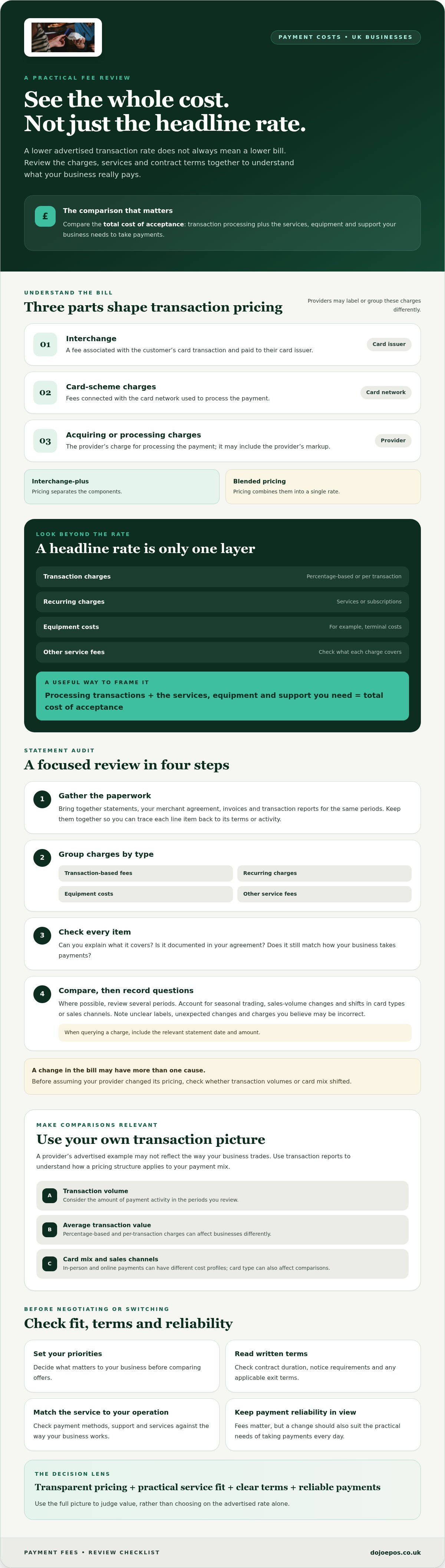
Three elements commonly shape transaction pricing. Interchange is a fee associated with the customer’s card transaction and paid to their card issuer. Read more about what an interchange fee is. Card-scheme charges are fees connected with the card network, while acquiring or processing charges cover the provider’s role in processing the payment and may include its markup.
Providers can present these costs differently. Interchange-plus pricing separates components, while blended pricing combines them into a single rate. Statements may use unfamiliar labels or group items together. Check your merchant agreement and ask the provider to explain any charge you can’t match to a service or transaction.
Why the lowest advertised rate may not mean the lowest bill
A headline rate won’t show every cost. A provider may charge transaction fees alongside recurring charges for services or equipment. A low rate may be less attractive if it comes with costs you don’t need or service requirements that don’t suit your operation. Check which terminals and services you use, then compare them with the charges on your invoices.
Your card mix, average transaction value and sales channels also affect comparisons. A business taking mostly in-person payments may have a different cost profile from one processing a large share of online transactions. Percentage-based and per-transaction charges can also affect businesses differently, depending on payment values and volumes. Use your own transaction reports, rather than an advertised example, to estimate how each pricing structure would apply.
Total cost of acceptance is the combined cost of processing transactions and maintaining the services, equipment and support your business needs to take payments. Compare this figure when you want to reduce credit card processing fees without overlooking reliability or operational fit.
Use this checklist to audit your card processing statement
Set aside time to match charges to the services and transactions they relate to. Gather statements, your merchant agreement, invoices and transaction reports for the same periods. Keep them together so you can trace a line item from the bill back to its terms or activity.
Group the charges: Separate transaction-based fees, recurring charges, equipment costs and other service-related fees.
Check each item: Can you explain what it covers? Is it documented in your agreement, and does it still match how your business takes payments?
Compare like with like: Review several periods where possible. Account for seasonal trading, changes in sales volume and shifts between card types or sales channels.
Record questions: Note unclear labels, unexpected changes and charges you believe may be incorrect. Include the relevant statement date and amount in your query to the provider.
Don’t assume a month-on-month change means the provider has altered your pricing. Transaction volumes or card mix may have shifted. For businesses taking online payments from EEA customers, the Payment Systems Regulator’s review of cross-border interchange fees provides context for why these transactions can carry different costs.
Which charges should merchants review?
On transaction lines, look for percentage-based charges, fixed amounts per transaction and differences by card type or payment channel. Then check invoices and agreements for terminal rental, software subscriptions and other recurring services. Providers may use different names for similar fees, so ask for an explanation if you can’t connect a charge to a transaction, service or contractual term. Record the answer alongside your audit notes.
How to calculate your effective processing cost
For an internal comparison, divide the processing charges you’ve chosen to include by card sales over the same period, then multiply by 100 to get a percentage. Decide in advance whether your calculation includes recurring service or equipment charges, and apply the same definition to every provider you compare. Don’t include unrelated business costs or compare charges from one period with sales from another.
Effective rate = included processing costs ÷ card sales for the same period × 100. This is an internal comparison tool, not a provider’s quoted rate or a prediction of future costs. Use it alongside transaction reports and contract terms to identify what needs explaining before asking for a review.
Once you’ve organised the evidence, you’ll be better prepared to discuss costs and operational requirements with potential providers. You can also assess Dojo’s payment solutions against your business’s needs.
Compare fee-reduction options without overlooking trade-offs
After reviewing your statements, compare options against the way your business takes payments. Look beyond the headline rate: ask what recurring charges apply, which services are included and whether the proposed terms fit your operations. The card machine rates comparison guide offers more detail on making like-for-like comparisons.
Which pricing model suits your transaction profile?
A fixed or flat-rate model applies a set rate to eligible transactions. Blended pricing combines fee components into a single rate, while interchange-plus pricing separates interchange, card-scheme charges and the provider’s markup. None is automatically the cheapest for every merchant. Suitability depends on transaction patterns, eligible cards, sales channels and the provider’s full terms. Ask each provider for a written example based on your recent processing data.
Use a comparison table to keep the discussion focused:
When you request a pricing review, share your transaction volume, average transaction value and card mix, including the channels through which you take payments. These details help a provider assess your profile. The Payment Systems Regulator guidance for merchants explains the Interchange Fee Regulation and the information acquirers must provide to merchants. Ask for revised pricing and associated terms in writing, then compare the full cost with your current arrangement.
Where operational changes may help
Review whether avoidable keyed transactions, payment errors or manual reconciliation are creating extra work or complicating your records. Process improvements may support smoother operations, but don’t assume they will lower your processing rate. Integrated payment workflows may reduce administrative effort; assess that benefit separately from any fee change. To reduce credit card processing fees, track operational improvements and processing costs as separate outcomes so you can see what has changed.
Follow these steps before negotiating or changing providers
A prepared review gives you a stronger basis for discussion than an unsupported savings target. Focus on what your business needs, what your current agreement charges and what an alternative would change. Use this sequence to negotiate confidently and protect payment continuity.
Define your goals. Decide whether you want clearer pricing, lower overall costs, services that better fit your operation or a combination of these.
Gather evidence. Bring together statements, invoices, your merchant agreement and recent transaction reports. Record charges you can’t explain and any services or equipment you may not need.
Request written terms. Ask your current provider to review your account, and request itemised pricing and relevant terms from any alternatives.
Compare total costs. Use the same transaction data and time period for each option. Consider recurring charges, equipment, service requirements and contract terms alongside transaction pricing.
Prepare a clear negotiation brief
Summarise your transaction volumes, average transaction values, card mix and payment channels. Add unclear charges, operational needs and the service levels your business relies on. Ask providers to explain each proposed charge and confirm pricing, contract duration, notice requirements and any applicable exit terms in writing. This makes it easier to compare offers on equal terms and identify anything that still needs clarification.
Protect the business during a provider change
Before committing, confirm timings, equipment requirements and account responsibilities directly with each provider. Plan any terminal or system changes, and tell staff what will change and when. Don’t cancel your existing service until the replacement is set up, tested and ready to accept payments. Keep copies of agreed terms, setup instructions and support contacts so your team knows where to turn during the transition.
These checks help you reduce credit card processing fees without treating the lowest quoted rate as the only measure of value. If you’re assessing another provider, compare its payment options and service requirements with your documented needs. Dojo’s payment solutions are another option to review.
Choose a payment partner based on total value, not fees alone
Your provider decision should reflect the payments your business takes and the service it needs to keep trading smoothly. A lower headline rate isn’t automatically better if recurring charges, contract terms or operational requirements add cost or disruption. Judge each offer against the same priorities, and verify current fees and terms directly with the provider before committing.
What to assess beyond the transaction rate
Look at the full arrangement, not just the percentage charged per transaction. Check recurring charges, contract duration, notice requirements, any applicable exit terms and settlement arrangements. Confirm which support channels are available and whether they meet your business’s needs.
Then check the practical fit. Do the terminals and software suit your payment channels and daily workflows? If you take payments in person and online, confirm which methods the provider supports and what each requires. The Dojo card machine rates guide provides provider-specific information. Confirm current fees and terms directly before making a decision.
A final checklist for a confident decision
Before you choose, make sure you’re comparing offers on equal terms. Check that each calculation uses the same time period, transaction mix and included cost categories. Keep your original statements alongside written proposals, so you can revisit the comparison if your trading pattern, services or provider terms change.
Transparent terms: Can you identify each charge and understand what it covers?
Suitable acceptance methods: Does the provider support the ways your customers pay?
Operational fit: Do the equipment and software work with your business’s day-to-day processes?
Service and settlement: Are the support arrangements and settlement terms clear and appropriate for your needs?
Dojo is one option to assess against those criteria. Its offerings include payment terminals, Blinq POS software, integrated payments and Next-Day Transfers. Check which options suit your requirements and confirm their current availability and terms. Judge savings by the full cost of accepting payments and the service you receive, not the headline rate alone.
Explore Dojo payment solutions and compare them with your documented needs, without assuming a particular saving.
Make your next payment review count
You don’t need to change providers to take control of payment costs. Start with a clear record of what you pay, question charges you can’t identify and compare written offers using the same transaction data. That gives you a practical basis to reduce credit card processing fees while keeping reliability and day-to-day needs in view.
Choose a payment partner for the complete service and terms, not one headline rate. Dojo provides card-present and online payment solutions and serves over 110,000 businesses worldwide. Consider it alongside other providers, checking current fees and terms against your own requirements.
With clear evidence and a careful comparison, you can make your next decision with confidence. Explore Dojo payment solutions and assess whether they fit your business.
Frequently Asked Questions
How can I reduce credit card processing fees for my business?
Start by auditing your statements and merchant agreement so you can see transaction charges, recurring costs and equipment fees together. Check which charges are unclear, unused or inconsistent with your agreed terms, then ask your provider for an explanation or written review. Use recent transaction data to compare offers on the same basis. Before switching, check contract conditions and plan the change carefully to protect payment continuity.
What fees are included in credit card processing?
Transaction processing costs can include interchange, card-scheme charges and the provider’s acquiring or processing charges. Depending on your arrangement, statements may also list per-transaction or authorisation charges. Separate these from recurring costs such as terminal rental, software subscriptions or other services. Providers use different pricing models and statement labels, so check your merchant agreement and ask the provider to explain any item you can’t identify.
Can I negotiate my card processing fees?
Yes, you can ask your provider to review its pricing, particularly the processing markup and any recurring charges covered by your agreement. Prepare transaction volumes, average transaction values, card mix and payment channels to support the discussion. Interchange and card-scheme charges are generally set outside the provider’s discretion, so ask which parts of your bill can change. Request revised pricing and associated terms in writing before deciding.
How do I calculate my effective card processing rate?
Divide the processing costs you’ve chosen to include by card sales for the same period, then multiply by 100 to express the result as a percentage. Decide whether to include recurring service or equipment charges, and use the same definition for every provider you compare. This effective rate is an internal comparison tool, not necessarily the rate a provider quotes or a forecast of future costs.
Does switching payment providers always reduce processing fees?
No. A new provider may offer different transaction pricing, but recurring charges, equipment costs, contract terms or service requirements can change the overall cost. Compare written offers using the same period, transaction mix and included charges. Before moving, check notice and exit terms, confirm setup responsibilities and test the replacement payment arrangements before cancelling your existing service. A switch makes sense only if the full offer suits your business.
Are card machine rental and processing fees the same thing?
No. Card machine rental is generally a recurring charge for equipment, while processing fees relate to handling card transactions and may be calculated per transaction, as a percentage or through a combination of charges. A provider might list both on separate statements or invoices. Check your agreement to see which equipment and services you’re paying for, whether they’re still needed and how they contribute to your total payment costs.
Should a business choose the provider with the lowest transaction rate?
Not on that figure alone. A lower transaction rate may be offset by recurring charges, equipment costs, contract conditions or service requirements that don’t fit your operation. Compare each provider’s total costs using your own transaction data, then assess payment methods, settlement arrangements, support and operational fit. Ask for unclear terms in writing. The right choice is the offer that meets your needs at a clear, acceptable overall cost.


Comments