
Integrated Card Payment System: The 2026 Guide to Unified Commerce
Manual payment matching carries an error rate of nearly 10%, quietly turning what should be a straightforward end-of-day close into hours of tedious receipt hunting. You already know the frustration when staff mistype figures on a card machine during a peak rush, or the headache of losing your evenings chasing discrepancies between the till and your terminal. An integrated card payment system eliminates that friction at the root. By creating an instant digital link between your EPOS and payment hardware, it cuts out manual double-keying, speeds up table turnover, and keeps queues moving without interruption.
Discover how an integrated card payment system eliminates manual errors, secures your data, and accelerates your business growth through automated reconciliation. In this guide, we break down how unified commerce bridges the gap between your till, card terminal, and accounting software, transforming transaction speeds and handing you back hours of valuable time.
Table of Contents
What is an integrated card payment system?
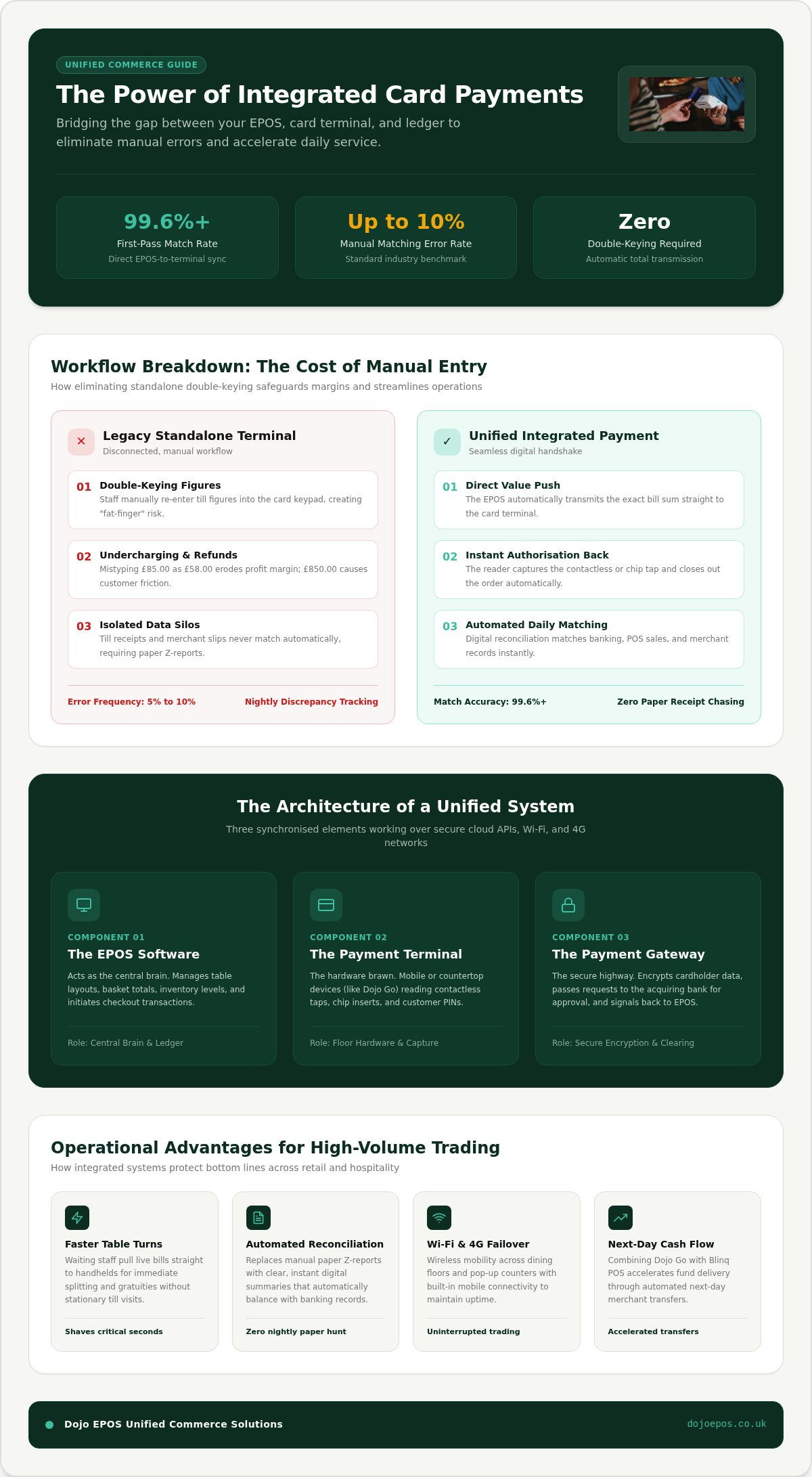
At its core, an integrated card payment system creates a direct digital conversation between your Electronic Point of Sale (EPOS) and your card terminal. Rather than treating payment hardware as an isolated calculator, integration links the two environments into a single operational unit. When an order is rung up at the till, the EPOS automatically pushes the exact transaction amount directly to the card machine. Once the customer taps or inserts their card, the terminal confirms the authorization back to the till, closing the sale instantly.
This automated interaction replaces the fragmented workflow of legacy standalone terminals. Rather than relying on physical serial cables or cumbersome local setups, modern setups use secure cloud APIs and network connections. The result is a unified checkout experience that minimises human intervention, accelerates service speeds, and keeps your transaction records accurate from the moment of sale.
Integrated vs Standalone: The cost of manual entry
Standalone terminals demand double-keying. A team member tallies the bill on the till, turns around, and manually punches that figure into a card machine keypad. This introduces the classic "fat finger" error. Mistyping an £85.00 restaurant bill as £58.00 immediately damages margins; accidentally typing £850.00 creates embarrassing customer friction and time-consuming refund admin.
Beyond accidental undercharges, standalone setups slow your service to a crawl during peak trading. Fatigued staff spend precious seconds checking numbers twice whilst queues lengthen. Worse, manual entry creates isolated data silos. Because your card terminal cannot communicate with your till, your EPOS records and your merchant statements never match up cleanly, turning nightly bookkeeping into an exhausting paper chase.
The technical components of a unified system
Understanding how integration works requires looking under the bonnet of modern retail technology. A truly unified solution relies on three synchronised elements:
The EPOS Software: Acting as the central brain, modern point-of-sale systems manage table layouts, inventory levels, and basket totals before communicating transaction amounts out to the floor.
The Payment Terminal: The secure hardware brawn, such as a mobile or countertop card machine, which reads customer cards, captures PINs, and executes contactless taps.
The Payment Gateway: The secure highway that encrypts cardholder data, passes the transaction to the acquiring bank for approval, and signals back to the EPOS that funds are cleared.
Cloud connectivity links these elements seamlessly over Wi-Fi and 4G networks. By abandoning outdated serial wires, your terminals can move freely across the shop floor or dining area while staying permanently locked to your central sales ledger.
The core benefits of connecting your payments and EPOS
Adopting an integrated card payment system delivers far more than convenience; it fundamentally protects your bottom line. According to AICPA benchmarks, manual matching carries an error rate between 5% and 10%. Integrating your card machine with your register pushes that figure down drastically, achieving first-pass match rates upwards of 99.6%. When your EPOS talks directly to your payment gateway, discrepancies vanish before they can corrupt your end-of-week reporting.
Modern businesses thrive on operational momentum. Removing unnecessary manual steps shaves critical seconds off every card interaction, enabling your staff to handle high-volume trading periods with poise. Investing in a robust unified commerce platform bridges your transactional workflow into one dependable channel, improving brand credibility whilst protecting your profit margins.
Speeding up the queue and the table
Every second saved at the till protects revenue. At a busy sales counter, manually typing totals causes noticeable delays, directly increasing queue abandonment when impatient shoppers walk away empty-handed. For in-depth sector advice, explore our guide on integrated card payments for retail uk.
In hospitality, the impact is even greater. Waiting staff no longer run back and forth between a stationary till and the customer's table. Instead, integrated pay-at-table functionality pulls the live bill straight to the card terminal. Guests can split the bill, add a gratuity, and settle in seconds. The table clears instantly on the EPOS, speeding up turnaround times so you can seat the next party without delay.
Enhanced security and PCI compliance
Protecting cardholder data is vital for preserving consumer trust and meeting strict regulatory standards. Deploying an integrated card payment system radically simplifies your annual compliance workload. Because customer card information is encrypted immediately via Point-to-Point Encryption (P2PE) inside the terminal hardware, sensitive payment details bypass your till software entirely. Your local internal network never sees plaintext card data, shielding you from costly data breaches and significantly reducing the scope of your mandatory PCI DSS assessments.
For a detailed breakdown of secure data transit, consult our secure merchant payment gateway guide. If you want to eliminate reconciliation headaches and secure customer data across your trading locations, explore how to upgrade your checkout with integrated payments built for modern business.
The rise of automated payment reconciliation software
Automated reconciliation represents the continuous digital matching of sales logged in your till against the funds landing in your merchant settlement account. Traditional retail and hospitality operations relied on late-night paper roll reconciliations. Managers spent hours unravelling crumpled Z-reports, tallying till tapes, and cross-referencing merchant receipts against bank deposits. Modern software removes this friction entirely, replacing physical auditing with live digital dashboards that verify every card transaction as it happens.
As electronic transaction volumes surge globally, a reality underscored by the Federal Reserve Payments Study tracking the sustained rise of cashless commerce, manual bookkeeping simply cannot keep pace. Today's systems automatically highlight transactional discrepancies, whether caused by processing fee deductions, chargebacks, or split-tender mistakes. By surfacing exceptions rather than requiring line-by-line verification, an integrated card payment system drives the shift towards true zero-touch accounting.
Saving hours on manual admin
The traditional closing routine drains valuable management resources. A supervisor prints the end-of-day summary, checks the card machine totals, counts the drawer, and logs figures onto a spreadsheet. If numbers diverge, the hunt begins. Automated modern workflows replace this process entirely by streaming batch authorizations straight into the general ledger.
Automated reconciliation acts as the essential digital bridge between your till and your bank account, balancing every transaction without human intervention. According to Sage accounting technology data, automated finance feeds can cut reconciliation workloads by up to 85%. That translates into hours reclaimed each week, freeing operators to focus on guest service, staff training, and commercial expansion instead of ledger checks.
Improving financial visibility and cash flow
Operating across multiple locations becomes far easier when trade data synchronises instantly. Multi-site operators gain real-time visibility across every site, comparing turnover, margin performance, and refund rates through a single screen. This rapid access to reliable numbers simplifies stock management, forecasting, and inventory purchasing.
Integration achieves its full potential when paired with swift settlement schedules. Traditional acquiring arrangements lock sales capital away behind two- to three-day holding periods, restricting cash flow during key trading cycles. When an integrated card payment system pairs real-time matching with automatic next-day transfers, your revenue hits your bank account every morning, seven days a week. Having instant access to clean, verified cash balances keeps your operations nimble and resilient.
Choosing the right integrated system for your business
Selecting the right integrated card payment system requires matching your daily operating rhythm to the underlying technical infrastructure. Consider your operational floor first. A compact retail shop with a dedicated till counter needs dependable hardware that never drops a connection, whilst an expansive venue demands mobile card machines that switch seamlessly between Wi-Fi and 4G mobile networks.
Software compatibility is equally vital. Choose a provider with pre-built integrations for your chosen EPOS to avoid costly bespoke software development. As your trading footprint expands from a single terminal to a multi-site operation, having a unified platform backed by a single point of customer support ensures any hardware or processing questions are resolved quickly without finger-pointing between vendors.
Cloud vs Local integration: What is the difference?
Cloud integration routes the transaction handshake through secure remote servers. This structure delivers incredible flexibility, letting you track trade performance, change menus, and sync inventory across multiple sites from any web browser. Local integration, by contrast, connects the till and payment terminal directly over your premises network without querying external servers for the initial prompt.
If your location suffers from patchy broadband, local network communication provides maximum lane stability. Conversely, cloud-based architectures suit dynamic retail and dining spaces that demand handheld mobility and remote operational management.
Sector-specific requirements
Every commercial environment handles checkouts differently, so your integrated card payment system must align with your sector's day-to-day workflow:
Hospitality: Demands fast bill splitting, intuitive tipping prompts at the terminal, and instantaneous table status updates that notify front-of-house staff the moment a bill is settled.
Retail: Requires rapid barcode scanning, live inventory deductions upon payment completion, simple refund processing to the original card, and unified click-and-collect tracking.
Evaluating these functional requirements upfront prevents operational bottlenecks later. Consult our integrated payment solutions guide for a full implementation checklist. To streamline your sales floor and elevate your customer experience, switch to Dojo integrated payments today.
Maximising growth with Dojo’s integrated solutions
A high-performance integrated card payment system should accelerate your business, not hold it back. Built around Red Dot award-winning hardware, the Dojo Go combines an intuitive 5.5-inch touchscreen with lightning-fast transaction speeds. Every payment connects instantly to your sales register, giving you responsive performance whether you operate a buzzing bar counter or a bustling retail boutique. Dual connectivity keeps operations running smoothly: if your primary Wi-Fi connection drops, the terminal switches to built-in 4G failover without interrupting service.
Pairing hardware with reliable financial infrastructure transforms your cash management. Legacy providers often make merchants wait days to access their earnings. Dojo deposits your funds directly into your bank account by 7:00 AM the next morning, seven days a week, including weekends and bank holidays. That daily liquidity puts you in firm control of supplier invoices, staff wages, and reinvestment plans.
Unified commerce with Dojo and Blinq
Pairing Dojo card machines with Blinq POS Software delivers complete operational control across your sales floor. This integration links order creation, tableside billing, and payment processing into a single channel. Whether you run a bustling restaurant using the ultra-lightweight Dojo Pocket or a busy retail environment with countertop setups, sales data flows naturally into your central ledger.
Over 110,000 businesses trust Dojo to power their daily transactions. The mobile dashboard puts real-time sales visibility in your pocket, making it easy to track takings, check reconciliation totals, and monitor card turnover remotely from any device.
Get started with a smarter system
Switching from an outdated card processing contract doesn't have to disrupt your everyday trading. Dojo simplifies the migration by helping cover up to £3,000 in early termination fees charged by your previous merchant acquirer, allowing you to transition without financial friction. Once you're live, dedicated UK-based support ensures technical assistance is always available when you need operational guidance.
Eliminate manual entry mistakes, simplify your bookkeeping, and protect your margins with a unified commerce setup. Upgrade to a Dojo integrated system today and experience the difference next-day settlement and seamless EPOS connectivity make to your business.
Transform your checkout and accelerate business growth
Operating without friction is no longer just an ambition; it's the standard for thriving UK businesses. Implementing an integrated card payment system removes the everyday bottlenecks that slow down your staff and disrupt your cash flow. By connecting your EPOS directly to your card terminals, you eliminate costly double-keying mistakes, keep queues moving during peak hours, and turn hours of manual reconciliation into a swift, automated review.
You don't need to juggle multiple vendors or wait days for your takings to clear. With secure P2PE encryption safeguarding customer card data, next-day transfers landing in your bank account seven days a week as standard, and a 4.8/5 Trustpilot rating reflecting trusted national support, you can focus on scaling your business. Your business deserves technology that works as hard as you do. Explore Dojo integrated payment solutions for your business and take your daily operations to the next level.
Frequently Asked Questions
What is the difference between integrated and non-integrated card machines?
Integrated card machines communicate directly with your EPOS, whereas non-integrated, standalone devices operate in complete isolation. With a standalone unit, staff must re-key totals manually, risking input errors and slowing queues. An integrated card payment system automatically pushes the bill amount straight to the terminal screen, closing the transaction on the register the moment payment is approved.
Does an integrated payment system work with any EPOS software?
An integrated payment setup requires native software compatibility between your merchant acquirer and your till platform. Modern cloud providers integrate out of the box with hundreds of market-leading systems or bespoke solutions like Blinq POS Software. However, older legacy cash registers often lack the open APIs required to connect. Always verify pre-built integration compatibility before signing a contract.
How much does it cost to set up an integrated card payment system?
Total setup costs depend on your monthly card turnover, hardware choices, and software requirements. Most providers charge a recurring monthly rental fee for each card machine alongside standard transaction processing margins. Leading platforms avoid charging hefty upfront integration fees, and providers often offer switching support to help cover early cancellation penalties from existing merchant contracts.
Can I use an integrated system if my internet goes down?
Yes, provided your payment terminal includes automatic mobile backup connectivity. Because integrated card machines must connect to acquiring networks to authorise payments, premium devices feature built-in 4G SIM failover alongside standard Wi-Fi. If your fixed broadband connection drops, the terminal automatically switches to mobile data, keeping your sales queue moving without missing a beat.
What is automated payment reconciliation software and do I need it?
Automated payment reconciliation software electronically matches card transactions recorded on your till directly against incoming bank settlements. Any growing business handling regular card volume benefits from this automation. Instead of spending hours matching paper till rolls against bank statements, the system automatically flags fee deductions, chargebacks, and odd discrepancies, saving hours of administrative legwork every single week.
How does integrated payment improve the customer experience in restaurants?
Integration streamlines tableside service by eliminating the need for servers to run back and forth between dining tables and fixed till points. Using mobile terminals like the Dojo Pocket, floor staff can pull open bills directly to the table, split balances effortlessly, and process contactless payments in seconds. Diners enjoy faster service, and your team turns tables much quicker.
Is an integrated payment system more secure than a standalone one?
Yes, an integrated card payment system provides superior security because it isolates cardholder data from your local network. Through certified Point-to-Point Encryption (P2PE), card information is encrypted inside the terminal before transmission. Plaintext card data never touches your EPOS software or internal computer systems, protecting you against data breaches and significantly reducing your PCI DSS compliance scope.
How long does it take to switch to an integrated payment provider?
Switching to a modern integrated provider typically takes just a few working days from application approval to going live. Leading terminals arrive pre-configured to your account, so setup is straightforward. You simply connect the card machine to your Wi-Fi, sync it with your compatible EPOS or Blinq POS Software, and begin taking payments immediately without trading downtime.


Comments