
Integrated Card Payments: UK Retail Implementation Guide
Every second your staff spend double-keying prices into a card machine is a second stolen from your customer experience and your bottom line. You likely know the frustration of end-of-day discrepancies that refuse to clear, or the stress of watching a queue grow during peak trading hours because of a sluggish, manual checkout. Transitioning to integrated card payments for retail UK stores isn't just a technical upgrade; it's the foundation of a unified commerce strategy that turns every transaction into a growth engine.
We'll help you master this transition to eliminate manual errors, slash queue times, and finally see your in-store and online sales as one cohesive picture. This guide provides a clear roadmap to implementing a seamless payment ecosystem that automates your daily reconciliation and improves cash flow through faster transfers. You'll learn how to unify your operations and deliver the high-speed, reliable experience your customers expect, ensuring your business stays agile in a competitive market.
Table of Contents
Why Integrated Card Payments are Essential for Modern UK Retail
The Mechanics of Integration: How Your EPOS and Card Machine Communicate
Calculating the Real ROI: Integrated vs Standalone Payment Systems
How to Implement Integrated Payments in Your Retail Store: A 5-Step Guide
Scaling with Dojo: Seamless Integration and Next-Day Cash Flow
Why Integrated Card Payments are Essential for Modern UK Retail
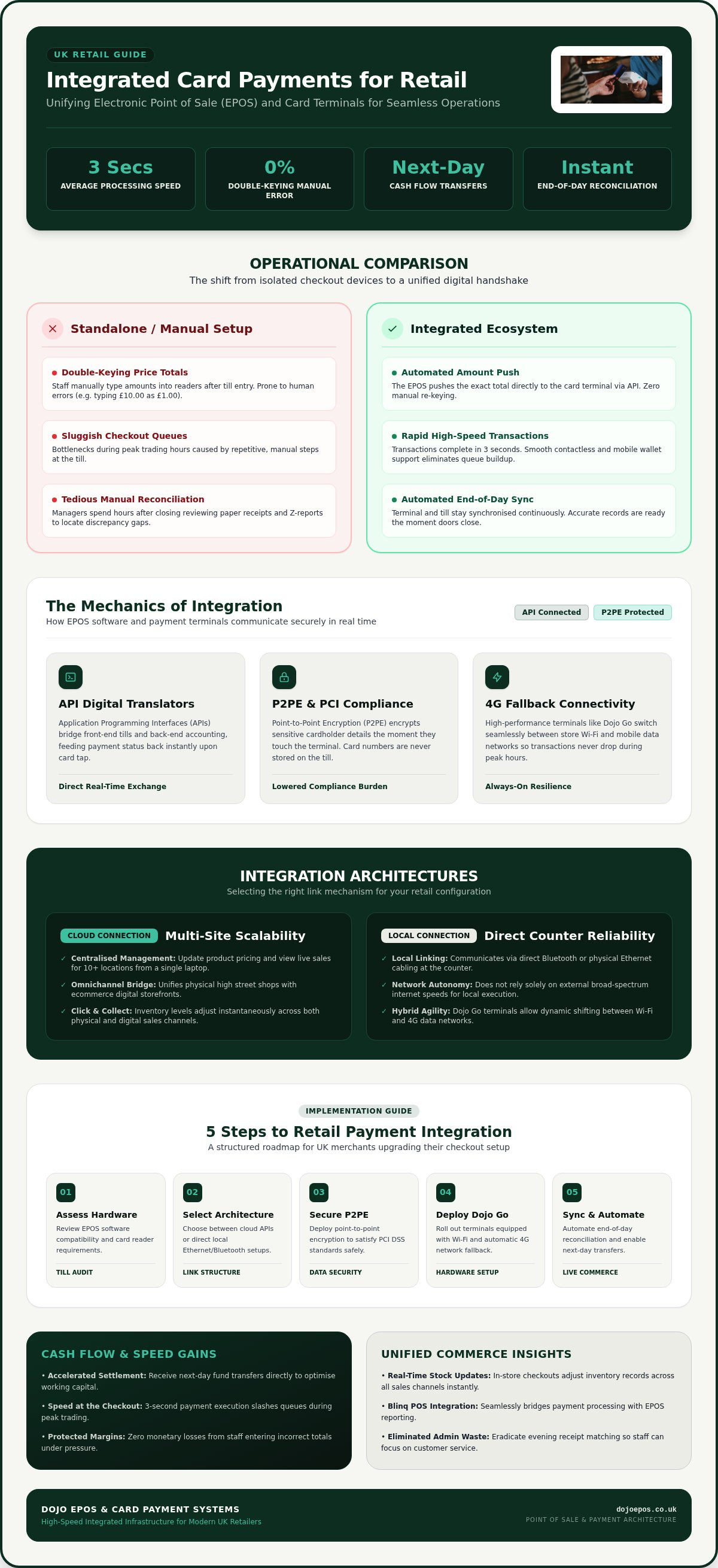
Integrated payments represent the digital handshake between your till and your card terminal. Instead of these two devices acting as isolated islands, they communicate in real-time to share transaction data. Modern electronic point of sale systems rely on this connectivity to eliminate the friction that slows down traditional trade. For many shop owners, adopting integrated card payments for retail UK operations is the single most effective way to protect margins and improve staff efficiency.
The primary enemy of a smooth checkout is "double-keying". This occurs when a staff member manually types the transaction total into the card reader after it's already been calculated by the till. It's a slow, repetitive process that invites human error. If a tired employee keys in £10.00 as £1.00, your business loses money instantly. If they overcharge, you face a frustrated customer and a potential chargeback. Integration removes this risk by pushing the exact amount from the till to the terminal automatically, ensuring every penny is accounted for without manual intervention.
The End of Manual Reconciliation
Reconciliation in the context of integrated payments is the automated process of ensuring your till's recorded sales match the actual funds captured by your card terminal. Traditionally, managers spent hours after closing time pouring over paper receipts and Z-reports, hunting for tiny discrepancies caused by mistyped amounts. It's a drain on morale and resources. Integrated systems automate this entire flow. Because the terminal and the EPOS are always in sync, your end-of-day reports are accurate the moment you close the doors. You'll stop paying staff to count receipts and start focusing on growth.
Improving the Customer Checkout Journey
Speed is the heartbeat of the high street. Customers expect a frictionless experience, and integrated card payments for retail UK stores deliver exactly that. When processing takes just three seconds, queues don't have the chance to bottle up. This efficiency is amplified by the rise of contactless payments and mobile wallets, which now dominate consumer behaviour. A unified checkout centre looks professional and instils confidence. It shows your customers that you value their time and use cutting-edge technology to protect their data. By removing the clunky, manual steps of the past, you create a premium environment that encourages repeat visits and builds brand loyalty.
The Mechanics of Integration: How Your EPOS and Card Machine Communicate
The magic behind integrated card payments for retail UK isn't just a physical cable. It's the sophisticated software architecture that links your front-end sales to your back-end accounting. At the heart of this system are Application Programming Interfaces (APIs). These interfaces act as digital translators, ensuring that when a customer taps their card, the transaction result is instantly fed back to your till without a single keystroke from your staff. This real-time exchange is what transforms a simple card reader into a powerful business tool.
Security remains the top priority in this exchange. Integrated systems are designed to meet and exceed PCI DSS compliance standards. By using Point-to-Point Encryption (P2PE), sensitive card data is encrypted the moment it touches the terminal and is never stored on your till system. This reduces your compliance burden and protects your business from data breaches. Reliability is equally vital. High-performance systems provide 4G fallbacks to ensure you never miss a sale, even if your shop's Wi-Fi drops out, keeping your business resilient during peak trading hours.
Cloud Integration vs Local Connection
Choosing between cloud and local integration depends on your business structure. Cloud-based systems are the gold standard for multi-site retail management. They allow you to update prices or view sales data for ten different locations from a single laptop. Local connections, often via Bluetooth or Ethernet, provide a robust link that doesn't rely entirely on external internet speeds. For retailers who need the best of both worlds, Dojo Go terminals offer an agile solution that maintains connectivity through shifting environments, switching between Wi-Fi and mobile data seamlessly.
Unified Payments for Ecommerce and In-Store
The future of retail isn't just on the high street; it's omnichannel. By implementing integrated payments for ecommerce UK, you bridge the gap between your physical shop and your digital storefront. This allows for efficient "click and collect" services where stock levels update in real-time across both channels. Instead of juggling separate systems, you get a single, unified dashboard for every transaction. If you're looking to streamline your setup, exploring the right integrated payment software can transform your daily operations. This holistic view of your finances simplifies bookkeeping and provides the data you need to scale your business with confidence.
Calculating the Real ROI: Integrated vs Standalone Payment Systems
Evaluating the value of your checkout technology requires looking past simple transaction fees. Many retailers fall into the trap of comparing "cost per transaction" whilst ignoring the "total cost of ownership". Standalone machines might appear cheaper on paper, but they carry heavy hidden costs in the form of lost labour and manual entry errors. When you switch to integrated card payments for retail uk, you're investing in a system that pays for itself by reclaiming unproductive hours and protecting your margins from avoidable leaks.
Beyond the immediate efficiency gains, integration provides a wealth of data that standalone units simply cannot match. Because every sale is linked directly to your inventory, you gain real-time insights into what's selling and what isn't. This prevents overstocking and ensures you never miss a sale due to "ghost" inventory. It turns your payment terminal from a passive tool into an active engine for business intelligence, allowing you to make stock decisions based on hard evidence rather than guesswork.
Cash flow is the lifeblood of any retail operation, and settlement speed is a critical part of the ROI equation. Standalone providers often hold onto your funds for days, creating a bottleneck in your ability to restock or pay suppliers. Modern integrated solutions prioritise liquidity. By choosing a partner that offers Next-Day Transfers as standard, you ensure that today's takings are in your account by tomorrow, keeping your business agile and ready to respond to market demands.
Time Savings and Labour Optimisation
Time is your most expensive resource. Shaving just 15 seconds off every transaction through automation can save your team hours of cumulative dead time during a busy week. This reclaimed time allows staff to step away from the till and focus on high-value tasks like upselling, merchandising, or providing personalised customer service. Training becomes significantly more efficient too, as new hires only need to master one unified interface rather than two separate devices. Integrated systems simplify the onboarding process, getting your team floor-ready in a fraction of the time.
The Financial Impact of Error Reduction
Manual entry errors are a quiet profit killer. Industry observations suggest even a 1% error rate can lead to thousands of pounds in lost revenue over a fiscal year. Tired staff members during a holiday rush are prone to "accidental discounts" or mistyped totals that are rarely caught until it's too late. Integration removes the human element from this part of the process, ensuring the amount on the till is exactly what the customer pays. For a deeper look at how these efficiencies impact your bottom line, consult this Integrated Payment Solutions: Guide for UK Merchants to see how fee structures and automation work in tandem to drive growth.
How to Implement Integrated Payments in Your Retail Store: A 5-Step Guide
Transitioning to integrated card payments for retail UK operations is a strategic move that requires a methodical approach. It isn't just about plugging in new hardware; it's about ensuring your software and hardware speak the same language. By following a structured implementation plan, you can avoid technical bottlenecks and ensure your team is ready to deliver a faster, more accurate checkout experience from day one.
Moving from a fragmented setup to a unified one is simpler than many business owners realise. The key is to address the hardware and software components in tandem rather than as separate projects. This ensures that every part of your payment ecosystem, from the customer-facing terminal to the back-office reporting suite, functions as a single, high-performance machine.
Step 1 & 2: Compatibility and Provider Selection
Your first task is to audit your existing electronic point of sale hardware. Not all legacy systems support the modern APIs required for real-time data exchange. If your current till is outdated, it's the perfect opportunity to upgrade to a provider that offers "out of the box" connectivity. Choosing a single partner for both your POS software and payment processing is a major advantage. It eliminates the "finger-pointing" that often happens when a till and a card machine from different companies stop talking to each other. Dojo supports a wide range of EPOS partners, ensuring your business has the flexibility it needs without the technical headaches of custom development.
Step 3 & 4: Technical Setup and Staff Onboarding
Once you've selected your hardware, you need to configure the digital "handshake". If you're using Blinq POS software, linking it to your Dojo Go terminal is a straightforward process that establishes a secure, encrypted bridge for your data. This connection ensures that transaction results flow instantly between devices, whether you're using a physical Ethernet link or a resilient Wi-Fi pairing. This technical foundation is what allows you to bridge the gap between physical stores and integrated payments for ecommerce UK sales, creating a truly omnichannel environment.
Training your team is the next priority. They must learn to initiate every payment from the till, not the card machine. This shift in behaviour is what guarantees your records remain accurate and prevents the double-keying errors discussed earlier. Create a simple checklist for the first day of integrated trading to keep stress levels low and ensure every staff member feels confident with the new automated workflow. If you're ready to modernise your checkout and reclaim your time, you can get started with integrated payments today.
Step 5: Testing and Go-Live
Run several test transactions before you open your doors to the public. Verify that the amount entered on the till matches the terminal exactly and that the sale is correctly recorded in your back-office reports. Check that your 4G fallback is active to ensure resilience during peak trading hours. Once you've confirmed that the data is flowing correctly and your staff are comfortable, you're ready to go live with a system that's built for growth.
Scaling with Dojo: Seamless Integration and Next-Day Cash Flow
Dojo provides the tools to turn payment processing from a chore into a strategic competitive advantage. Dojo Go and Dojo Pocket serve as the hardware backbone of your shop floor, whilst Blinq POS software provides the digital intelligence to manage complex retail environments. Adopting integrated card payments for retail uk with this ecosystem ensures your business operates with zero friction. By combining high-performance hardware with intuitive software, you create a system that scales alongside your ambitions and keeps your customers coming back.
Dojo Go: The Ultimate Retail Powerhouse
High-speed connectivity is non-negotiable in a busy trade environment. Dojo Go features both dual-band Wi-Fi and 4G connectivity, ensuring your checkout never stalls during peak hours. Its sleek, ergonomic design fits any modern retail centre, and the built-in thermal printer saves valuable counter space by removing the need for bulky external hardware. For smaller boutiques or staff who need to take payments on the move, Dojo Pocket offers the same power in a smartphone-sized device. This flexibility is why Dojo is a leading choice for integrated card payments for retail uk businesses that value mobility. Over 110,000 businesses already trust Dojo to handle their transactions, benefiting from a network that's as dependable as it is fast.
Unlocking Growth with Next-Day Transfers
Cash flow shouldn't be a bottleneck for your growth. Traditional providers often leave you waiting three to five days for your funds to clear, but Dojo makes that delay a thing of the past. With Next-Day Transfers as standard, your takings reach your account seven days a week, including weekends and bank holidays. This immediate access to capital helps you manage stock purchasing, settle supplier invoices, and handle payroll without the stress of "pending" funds. It's about giving you total control over your money. For a clear breakdown of how this fits your business budget, check the Dojo Card Machine Rates for transparent pricing information.
The Dojo network is built for maximum resilience. If your primary Wi-Fi fails, your terminal switches to mobile data instantly so sales keep flowing without interruption. This level of dependability is backed by 24/7 technical support, ensuring you're never left stranded during a busy shift. It's a dedicated partnership designed to work hard behind the scenes. By choosing a system that prioritises both speed and stability, you ensure your retail operation is always ready for the next customer.
Future-Proof Your Retail Business with Integration
Adopting integrated card payments for retail uk transforms your checkout from a manual bottleneck into a high-speed growth engine. By automating the link between your till and terminal, you eliminate the risk of human error and reclaim hours previously spent on manual reconciliation. This shift doesn't just protect your margins; it empowers your staff to focus on delivering the exceptional service that keeps customers coming back to your store.
You deserve a payment partner that understands the demands of modern commerce. With a 4.8/5 Trustpilot rating, Dojo provides a reliable ecosystem featuring 3-second payment processing and next-day transfers as standard. This ensures your cash flow remains fluid whilst your customers enjoy a frictionless, professional experience at every touchpoint. Don't let outdated hardware or fragmented data hold your ambitions back. Switch to Dojo today for seamless integrated payments and build a retail operation that's agile, efficient, and ready for the future.
Frequently Asked Questions
What are integrated card payments for retail?
Integrated card payments for retail uk involve a direct, digital link between your electronic point of sale (EPOS) system and your card machine. This connection ensures the transaction total is pushed automatically from the till to the terminal. It removes the need for staff to manually type in prices, which eliminates human error and speeds up the checkout process. By unifying these systems, you create a more professional environment and ensure your sales data is always accurate.
How much do integrated payments cost for UK businesses?
The cost of integrated payments for UK businesses typically consists of a recurring monthly hardware rental fee and a percentage-based commission on every transaction processed. These fees cover secure processing, interchange costs, and access to your management dashboard. Since every retail business has different requirements, costs are tailored to your transaction volume and the number of terminals you need. This model ensures you only pay for the service level your business actually utilises.
Can I use my existing EPOS system with Dojo?
Dojo is designed to be highly compatible and supports integration with a wide range of leading EPOS partners. If you're looking for a unified hardware and software experience, Blinq POS software is specifically built to work seamlessly with Dojo Go and Dojo Pocket terminals. This ensures a stable handshake between your till and card reader. You should check with your current software provider to confirm they support the modern APIs required for real-time data exchange.
Do integrated payments work for online and in-store sales?
Yes, integrated payments provide a unified solution for both online and in-store sales channels. This omnichannel approach allows you to manage all your transactions through a single dashboard, giving you a holistic view of your business performance. It's particularly beneficial for retailers offering "click and collect" services, as it ensures your inventory levels and financial reports are updated instantly across every platform. This integration simplifies your bookkeeping and provides a consistent experience for your customers.
How long does it take to set up an integrated payment system?
Setting up integrated card payments for retail uk is a streamlined process designed to minimise downtime. Once your merchant account is approved and your hardware arrives, the digital handshake between your POS software and Dojo terminals can often be completed in a single session. The hardware is designed for out of the box connectivity, allowing you to start taking secure, automated payments almost immediately. Your dedicated support team will guide you through the initial configuration and testing.
What happens if my internet goes down during a sale?
Your business remains resilient even if your primary shop Wi-Fi fails. Dojo Go and Dojo Pocket terminals feature built-in 4G connectivity that acts as an automatic fallback. If the internet goes down, the terminal switches to the mobile network instantly so you can continue taking payments without interruption. This ensures you never miss a sale during peak trading hours or local network outages, providing the dependability required for a high-volume retail environment.
Is integrated payment processing more secure than standalone?
Integrated processing is significantly more secure because it utilises Point-to-Point Encryption (P2PE) to protect sensitive information. When a customer taps their card, the data is encrypted immediately at the terminal and sent directly to the bank. No card data is stored on your EPOS system or till software, which reduces your PCI DSS compliance burden. This setup protects your business from data breaches whilst building trust with customers who value their financial privacy.
How do integrated payments improve my business cash flow?
Integrated systems improve cash flow by providing faster access to your takings. Whilst traditional providers might hold funds for three to five working days, Dojo offers Next-Day Transfers as standard. This means the money you earn today is in your bank account tomorrow, even on weekends and bank holidays. This immediate liquidity allows you to restock inventory, pay staff, and manage your daily operations with much greater flexibility and confidence.


Comments