
Integrated Payment Solutions: Guide for UK Merchants
The minutes your staff spend manually typing totals into a card machine aren't just a minor admin task; they're a direct leak in your profit margins. It's a common frustration for UK merchants to face end-of-day discrepancies or see checkout queues grow during peak hours because of disconnected systems. You likely already know that manual entry is the enemy of efficiency, yet many businesses still treat their till and their terminal as two separate worlds. Transitioning to integrated payment processing solutions changes this dynamic by creating a direct, digital handshake between your EPOS and your hardware.
We'll show you how to eliminate human error and reclaim the hours typically lost to manual reconciliation. This guide explores how tools like Dojo Go and Blinq POS software work in tandem to accelerate service and unify your sales data. By the end of this article, you'll understand how to optimise your operations and ensure your business is faster, more accurate, and ready for a highly profitable 2026. We'll look at the technical bridge that connects your front-of-house to your back-office reporting and the importance of next-day transfers for maintaining a healthy cash flow.
Table of Contents
What are integrated payment processing solutions?
Integrated payment processing solutions are the digital nervous system of a modern business. In the past, your till and your card machine lived separate lives. Your EPOS calculated the bill, and then your staff manually typed that figure into a terminal. Today, that manual step is a liability. Modern integration creates a seamless digital handshake where the exact transaction value travels instantly from your software to the hardware. This isn't just about convenience; it's about building a robust ecosystem that supports business growth.
Most payment service providers now focus on this connectivity because the UK high street has moved beyond simple transactions. In 2026, UK hospitality and retail brands use integrated payment processing solutions to unify their operations and protect their margins. The core components are straightforward: your EPOS software, the payment gateway that encrypts the data, and the physical hardware, such as a Dojo Go terminal. When these elements talk to each other, your business moves faster.
The difference between standalone and integrated systems
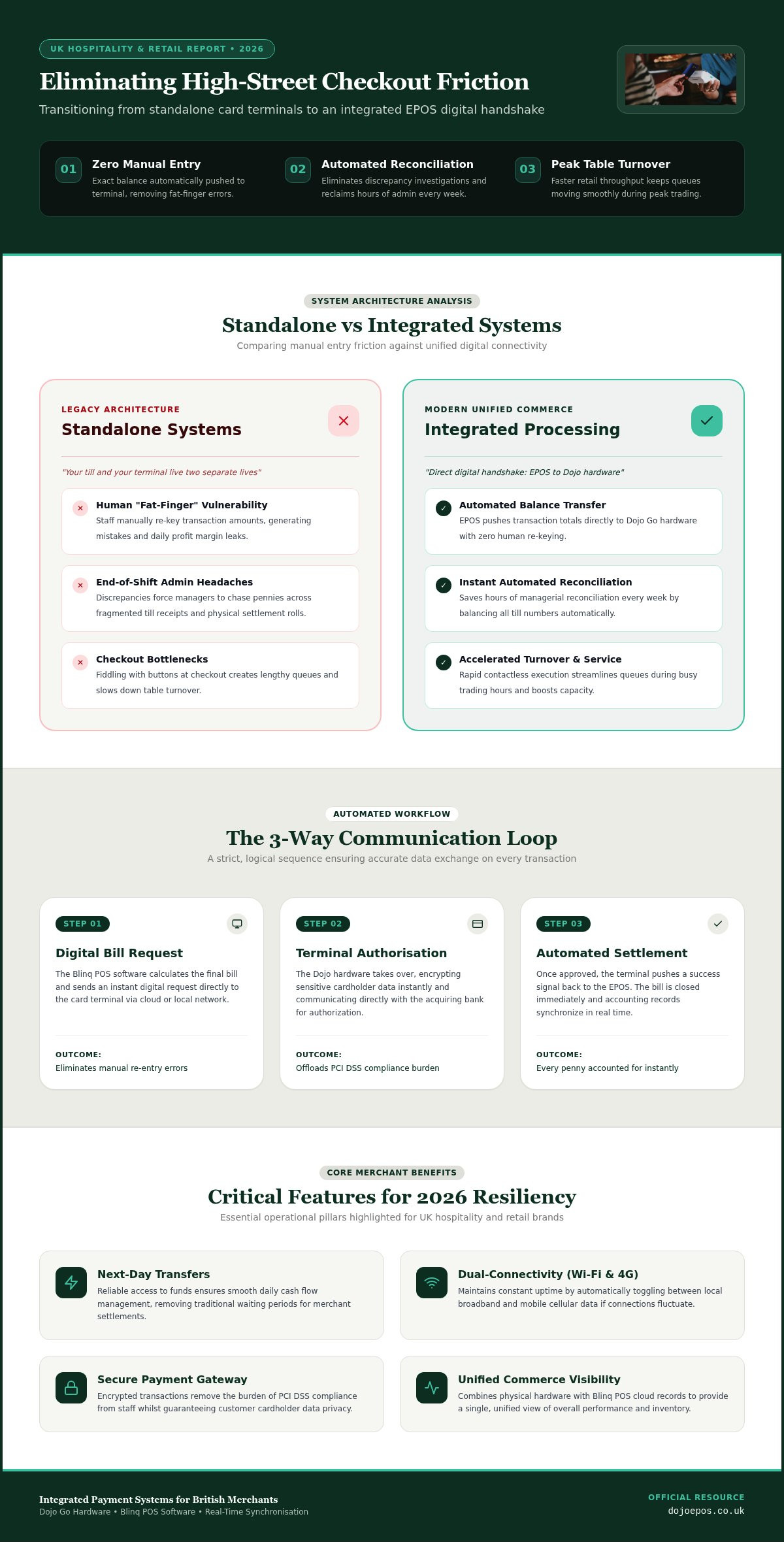
Standalone systems rely entirely on human intervention. A staff member looks at the till, remembers the price, and types it into the card machine. This "fat-finger" method is slow and prone to errors that cause major headaches during end-of-shift reconciliation. Integrated systems remove the human element from the data transfer. The EPOS automatically pushes the balance to the terminal. It's faster, it's more professional, and it eliminates the discrepancies that eat into your admin time. You'll spend less time chasing pennies and more time serving customers.
How unified commerce is reshaping the UK high street
Unified commerce is the next step in the evolution of retail and hospitality. It connects your online sales with your in-store inventory and physical payments. By using cloud-based data, you get a single, clear view of your business performance across all channels. Customers now expect a frictionless checkout experience where they don't have to wait for staff to fiddle with buttons. They want speed and they want accuracy. Providing this level of service isn't a luxury anymore; it's a fundamental requirement for staying competitive in a fast-paced market. Integration makes this possible by ensuring every sale is recorded correctly the first time.
How integrated payments work: A technical overview for non-techies
Whilst the technology behind the scenes is complex, the user experience is wonderfully simple. Integrated payment processing solutions rely on a rapid data exchange known as the "handshake". Instead of you typing numbers, your till talks directly to your card machine via the cloud or a local network connection. This digital bridge ensures that the amount your customer sees on the terminal is exactly what's recorded in your till. It's a precise, automated workflow that keeps your business moving without the friction of manual entry.
Security is baked into this process from the start. A secure payment gateway encrypts sensitive cardholder data instantly, moving the burden of PCI DSS compliance away from your team. As noted in the Payment Systems Regulator's market review, the evolution of card-acquiring services has made it easier for merchants to switch to more efficient, connected systems that offer better data transparency. This transparency allows for real-time syncing, meaning your inventory and accounting records update the second a sale is completed. If you want to see how this looks in practice, you can view our integrated systems to understand the impact on your daily workflow.
The 3-way communication loop
The process follows a strict, logical sequence to ensure every penny is accounted for. First, your EPOS calculates the final bill and sends a digital request to the terminal. There's no room for "fat-finger" errors here. Second, the terminal takes over, processing the card payment and seeking authorisation from the bank. Finally, once approved, the terminal sends a "success" signal back to the EPOS. This automatically closes the sale and updates your records. It's fast, clean, and perfectly organised.
Connectivity requirements for 2026
Reliability is non-negotiable for a busy UK merchant. To maintain constant uptime, your system should utilise dual-connectivity, switching between WiFi and 4G seamlessly. This ensures that even if your broadband dips, your ability to take payments doesn't. You also need to ensure your electronic point of sale hardware is compatible with modern API standards. Modern integrated payment processing solutions automate much of the security heavy lifting, keeping your business compliant without the manual paperwork. This setup allows your staff to focus on the customer whilst the technology handles the administrative burden in the background.
The operational ROI: Why your business needs integration
ROI isn't just a figure on a spreadsheet. For a UK merchant, it's the difference between leaving the shop at 6 PM or staying until 8 PM to fix accounting errors. Integrated payment processing solutions provide a direct return by eliminating the "fat-finger" problem. When your staff don't have to manually type figures, discrepancies vanish. This level of accuracy is essential as the volume of card transactions continues to rise across every sector.
Data from the UK Payment Markets report highlights how consumers are moving away from cash at an unprecedented rate. This shift means your terminal is now your primary revenue collector. If it isn't talking to your EPOS, you're flying blind. Unified data gives you real-time visibility into your cash flow, allowing you to make smarter stock and staffing decisions based on actual performance rather than guesswork. You gain the business intelligence needed to scale without the usual administrative friction.
Cutting down the "End of Day" stress
Cashing up should be a victory lap, not a chore. Integration turns the end-of-shift reconciliation into a five-minute formality. Because every transaction is automatically matched between your till and your terminal, there's no need to cross-reference paper receipts or hunt for missing pennies. You get immediate visibility of your transaction volumes and cash flow. This saves your management team hours of administrative work every week, allowing them to focus on business growth instead of manual spreadsheet updates.
Improving the customer experience
Customers in 2026 value their time above almost everything else. A slow checkout process is a silent brand killer that drives people toward your competitors. Shaving just one second off every transaction creates a compounding effect that clears queues faster and allows for additional sales during your most profitable peak hours. Whether you're offering flexible payments at the table in a busy restaurant or at a retail counter, speed is your greatest asset. Faster throughput means more customers served and higher revenue without increasing your overheads. It's about providing a frictionless service that keeps people coming back.
Choosing the right integrated payment partner
Selecting a provider for integrated payment processing solutions is a strategic decision that affects your daily cash flow and operational agility. Compatibility is the first hurdle. Your chosen partner must offer a plug-and-play experience with your existing EPOS or the software you plan to adopt. Beyond the technical fit, consider the speed of your settlements. Waiting three to five business days for your own money is an outdated practice that hampers growth. High-performance partners offer next-day transfers as standard, ensuring your Friday night takings are in your account by Saturday morning.
Transparency is equally critical. You should have a clear understanding of Dojo card machine rates and how they compare to the wider market, especially regarding contract flexibility. Avoid long-term ties that don't allow your business to pivot. When things go wrong, and in the world of technology they occasionally do, you need human help. Reliable, UK-based support is the difference between a minor glitch and a lost day of trading. It's about finding a partner that handles the complexity so you can focus on your customers.
Key features to look for in 2026
Modern systems must do more than just process cards. Native integration with popular UK hospitality and retail software ensures that your data flows without needing custom-built bridges. You should also demand mobile app access. This allows you to monitor real-time performance and transaction volumes from your phone, whether you're on the shop floor or at home. Security remains a top priority, but it shouldn't come at the cost of speed. Your system needs to handle encryption and compliance checks in the background whilst maintaining that sub-second transaction time customers expect.
Avoiding the "Integration Trap"
Be wary of proprietary ecosystems that lock you into a single vendor's hardware and software. This "integration trap" leads to rising costs and limited choices as your business evolves. Always check for hidden fees in the integration layer; some providers charge extra just to let their devices talk to your till. Finally, ensure the hardware is future-proofed. Your terminals should be ready for new payment methods as they emerge, protecting your investment for years to come. If you're ready to upgrade your setup, you can explore our integrated payment options to see how we support UK business growth.
Future-proofing with Dojo: Seamlessly integrated payments
Dojo stands as a bold innovator for UK merchants who demand high-performance technology. By providing integrated payment processing solutions that bridge the gap between hardware and software, we empower over 110,000 businesses to operate with absolute confidence. Our hardware lineup, featuring the Dojo Go and the ultra-portable Dojo Pocket, offers the ultimate flexibility for diverse trading environments. Whether you're taking payments at a fixed retail counter or moving between tables in a bustling restaurant, our devices ensure you never miss a sale. We handle the technical complexity behind the scenes so your team can focus on the customer.
A primary advantage of choosing our ecosystem is the ability to unlock your cash flow through next-day transfers as standard. In a market where liquidity is vital, receiving your funds the following day provides the financial agility needed to reinvest and grow. This focus on speed and reliability is why so many UK businesses have moved away from traditional, disconnected systems in favour of a more agile approach. Our integrated payment processing solutions are built to be dependable, using both WiFi and 4G to ensure your business stays online even if your local broadband fails.
The Dojo and Blinq ecosystem
The synergy between our hardware and Blinq POS software creates a unified business view that simplifies complex operations. In hospitality, this means streamlining the entire workflow from the initial order to the final payment. For retail managers, it translates to simple management with real-time inventory syncing across all channels. Getting started is a straightforward process. We provide a tailored integrated solution that fits your specific business model, ensuring your technology works as hard as you do from day one.
Expert support for UK merchants
Technology is only as good as the support behind it. We provide reliable, UK-based assistance to keep your business moving at all times. Our setup process is designed for speed, often getting merchants ready to take payments in days rather than weeks. We understand the daily pressures of the UK high street and have built our service to be as human-centric as it is high-tech. You won't be left waiting when you need help most. See how Dojo integrated payments can transform your business and start your journey toward a more profitable and efficient future.
Build a more resilient business
Adopting integrated payment processing solutions is a decisive step toward eliminating the friction that holds your business back. By synchronising your EPOS with your payment hardware, you remove the risk of manual entry errors and reclaim valuable hours lost to administrative tasks. This streamlined approach doesn't just improve your back-office efficiency; it transforms the customer experience by ensuring every checkout is fast, accurate, and professional. You now have the roadmap to turn disconnected data into a unified engine for growth.
More than 110,000 businesses already rely on our technology to maintain their competitive edge. With next-day transfers helping you manage cash flow and a UK-based support team ready to assist, you have everything needed to scale with confidence. Upgrade to Dojo integrated payments today to start your journey toward a more profitable 2026. Your business deserves a partner that values speed and reliability as much as you do. We're here to help you succeed every step of the way.
Frequently Asked Questions
What is an integrated payment system?
Integrated payment processing solutions create a digital link between your card machine and your EPOS software. Unlike standalone systems where you manually type in transaction amounts, integration allows the two devices to share data automatically. This ensures the price on the till matches the price on the terminal instantly. It's a faster, more accurate way to handle sales that eliminates the risk of human error during the checkout process.
How much time does automated reconciliation actually save?
Automated reconciliation can save your management team hours of administrative work every single week. Instead of spending your evenings cross-referencing paper receipts with till reports to find discrepancies, the system does the matching for you in real-time. For busy UK merchants, this turns a stressful end-of-day task into a simple five-minute check. You'll spend less time on spreadsheets and more time focusing on business growth and customer service.
Can I use my existing EPOS with an integrated payment solution?
Compatibility depends on your specific software provider, but many modern EPOS systems are designed for easy integration. Dojo partners with a wide range of software providers, including our own Blinq POS software, to ensure a seamless connection. You should check if your current provider supports API connections or native integrations. If they don't, switching to a more connected ecosystem like Blinq can help future-proof your business operations.
Do integrated payments cost more than standalone card machines?
The cost structure for integrated payment processing solutions typically involves a combination of hardware rental and transaction-based fees. Whilst some providers might charge an integration fee, the operational ROI usually far outweighs any initial setup costs. You'll save money by reducing "fat-finger" errors and increasing your throughput during peak hours. It's an investment in efficiency that directly protects your profit margins and improves your overall business performance.
What happens if my internet goes down during an integrated transaction?
Reliable systems like Dojo Go use dual-connectivity to prevent any downtime. If your primary WiFi connection fails, the terminal automatically switches to a 4G mobile network to keep your payments moving. This ensures that your integration remains active and your sales data continues to sync without interruption. You won't have to revert to manual entry or lose out on sales because of a temporary broadband dip in your premises.
How long does it take to set up integrated payment processing?
Setting up integrated payments is often much faster than merchants expect. Many UK businesses can get their system up and running in a matter of days rather than weeks. Once your hardware arrives and your EPOS is configured, the digital "handshake" happens almost instantly. Our team provides expert support to guide you through the process, ensuring your staff are trained and your business is ready to take payments without delay.
Is integrated payment processing secure for my customers?
Yes, integrated systems are highly secure and often simplify your PCI DSS compliance. When a transaction occurs, sensitive cardholder data is encrypted by the payment gateway before it ever reaches your EPOS. This means your till software never "sees" or stores full card details, significantly reducing your security risk. It provides peace of mind for both you and your customers whilst maintaining the sub-second transaction speeds that modern shoppers expect.
What is the difference between integrated and embedded payments?
Integrated payments connect two separate systems, such as a Dojo terminal and Blinq POS software, to share data. Embedded payments go a step further by weaving the payment processing directly into the software's core functionality, often removing the need for a separate terminal interface. Whilst integrated systems are the standard for physical retail and hospitality, embedded solutions are frequently found in e-commerce platforms. Both aim to create a frictionless checkout experience.


Comments