
Merchant Account with No Hidden Fees: The Ultimate 2026 Audit Checklist
What if the 'competitive' transaction rate you signed for is actually draining your profit through a sieve of unmapped admin charges? You've likely felt that sinking feeling when opening a monthly statement that looks more like a complex riddle than a financial document. Finding a merchant account with no hidden fees is essential when you're tired of seeing sudden 'admin fees' appear without warning or feeling trapped in long-term contracts with high exit costs.
Securing a transparent payment solution isn't just about saving a few pence; it's about reclaiming total control over your business's bottom line. We'll show you how to master the art of spotting obscured costs and identify a partner that prioritises your growth. This 2026 audit checklist provides a clear framework to compare providers, lower your effective transaction rate, and find a solution that supports your cash flow with fast, next-day transfers. By the end of this guide, you'll have the tools to audit your current setup and ensure your payment partner works as hard as you do.
Table of Contents
The Hidden Cost of Complexity in UK Merchant Services
The UK payments industry often feels like it's speaking a different language. Jargon isn't just a byproduct of technology; it's frequently used to obscure the true cost of doing business. Understanding what is a Merchant Account and how it functions is the first step in cutting through this noise. When providers use dense terminology, it often serves to mask where your money is actually going.
For many, "fee fatigue" is a daily reality. It's the mental exhaustion that comes from trying to reconcile a monthly statement where "PCI compliance" and "minimum monthly service charges" seem to fluctuate without reason. This complexity isn't accidental. It creates a barrier that prevents you from questioning the numbers, leading many to settle for "good enough" whilst their margins erode. You shouldn't need a degree in finance to understand your own billing.
Beware the "teaser rate." Many providers lure businesses with ultra-low headline percentages that only apply to a tiny fraction of transactions. Once the contract is signed, the reality of non-qualifying fees and secondary surcharges sets in. A genuine merchant account with no hidden fees focuses on the total cost of ownership, not just a flashy opening offer that disappears after the first quarter.
There's a vital distinction between a service margin and a hidden charge. Every provider needs a margin to facilitate payments, maintain security, and develop new technology. However, a hidden charge is a cost that wasn't disclosed upfront or is buried deep in the small print. Transparency means knowing exactly what you're paying for and why, without the fear of an unexpected "admin fee" appearing on next month's statement.
Why "Flat Rates" aren't always the simplest choice
Flat-rate models offer predictable billing, but they often come with an "efficiency tax." If you process a high volume of UK debit cards, a flat rate might be significantly higher than the regulated interchange caps. You're essentially paying for the convenience of one number. As your turnover grows, these small differences compound into thousands of pounds in lost revenue. It's often the point where businesses need to move toward more tailored, transparent models to protect their cash flow and lower their effective rate.
The true price of poor customer support
A broken card machine isn't just a technical glitch; it's a direct halt to your revenue. If you're stuck in a queue for an automated bot whilst customers walk away, the "cheap" rate you negotiated becomes incredibly expensive. A dedicated partner is a financial asset, not just a perk. Dojo prioritises human-centric support, ensuring you talk to experts who understand that every minute of downtime matters. In a sea of automated responses, having a reliable team behind your hardware keeps your business moving.
Decoding Your Merchant Statement: Where Fees Hide
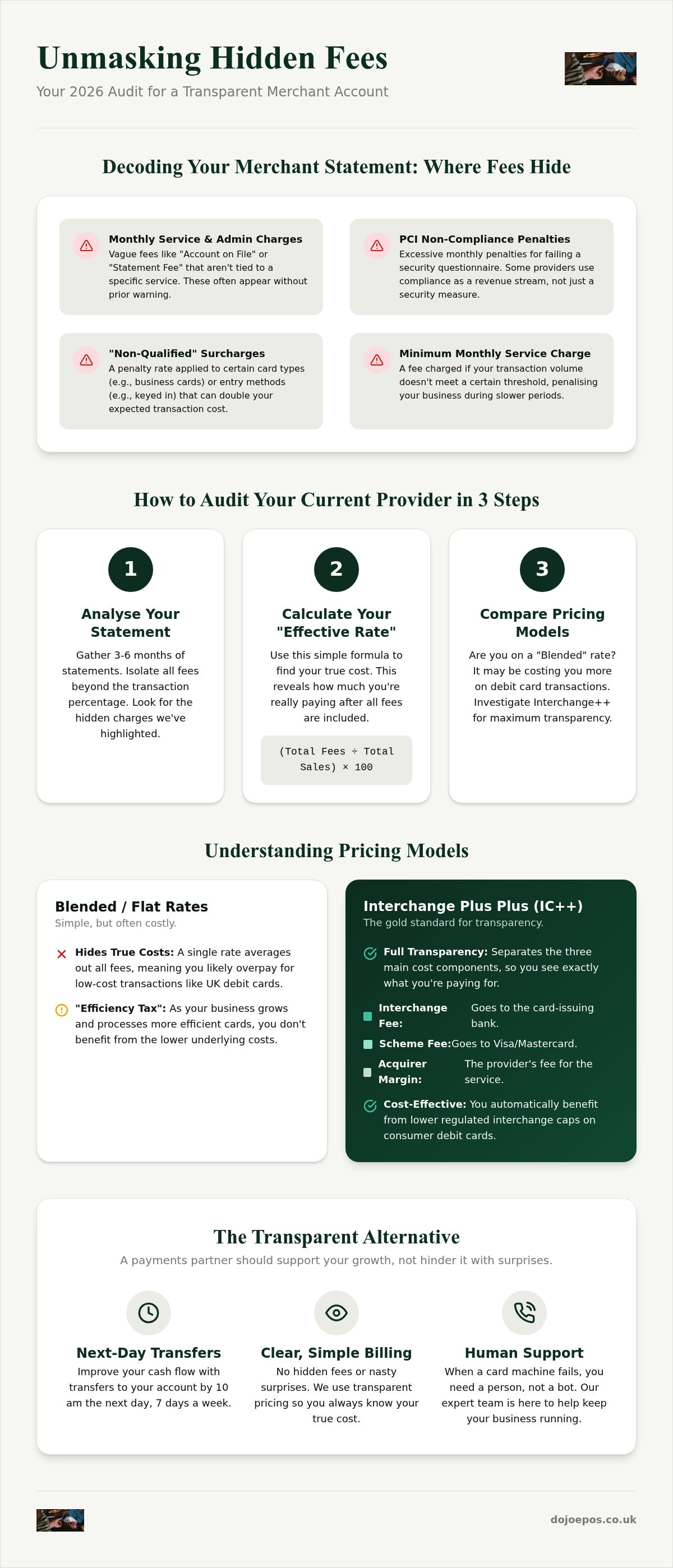
Your monthly statement shouldn't require a decoder ring. Most UK statements are a dense list of acronyms and percentages that make it difficult to track your actual spend. A standard breakdown usually includes the merchant service charge, terminal hire, and a cluster of "sundry" items. If you're searching for a merchant account with no hidden fees, you must first learn to identify which of these lines are legitimate and which are simply padding the provider's margin.
The most transparent models use Interchange Plus or Interchange Plus Plus (IC++). Interchange is the fee paid to the card-issuing bank, whilst the "Plus" refers to the processor's margin and card scheme fees. IC++ is generally superior because it separates these costs, ensuring you benefit when regulated interchange caps are lowered. Conversely, "blended" rates often hide a higher margin by averaging costs across all card types, meaning you might overpay for simple debit transactions.
Watch out for "Non-Qualified" surcharges. These appear when a transaction doesn't meet specific criteria, such as a business card payment or a manually keyed entry. These surcharges can quietly double your expected rate. Whilst the UK market differs from the US, the principles found in FTC regulations on fee transparency reflect a growing global demand for clear pricing. You should never be penalised with "admin fees" just for the privilege of receiving a digital statement. Finding a partner that offers integrated payments can simplify this process by providing a single, clear view of your costs.
PCI Compliance and Non-Compliance Penalties
PCI DSS is a mandatory security standard, but providers often use it as a revenue stream. You'll frequently see "PCI Management Fees" on your statement. These are often charged even if the provider isn't actually helping you maintain compliance. If you don't complete your annual self-assessment, you'll be hit with non-compliance penalties that can reach £50 per month. Organise your compliance early to avoid these avoidable drains on your cash flow.
Minimum Monthly Service Charges (MMSC)
The MMSC is an "invisible" floor on your billing. If your total transaction fees don't reach a set amount, the provider charges you the difference. This is a significant trap for seasonal businesses or startups with fluctuating volumes. It ensures the provider makes a profit even if you don't process a single penny. When switching, look for a partner that offers flexibility rather than a rigid monthly minimum that punishes your quieter periods.
The No-Hidden-Fees Checklist: 10 Red Flags to Spot
Identifying a merchant account with no hidden fees requires a keen eye for what isn't on the flashy sales brochure. Whilst regulators are increasingly focused on combating junk fees across the financial sector, many providers still use the small print to inflate their margins. Before signing any agreement, use this checklist to spot common red flags that could drain your profit:
Notice periods exceeding 30 days.
Authorisation fees charged on declined transactions.
Liquidated damages for early contract termination.
Auto-renewal clauses that reset your term.
Opaque "PCI Management" monthly fees.
Minimum monthly service charges (MMSC).
Hidden 4G/LTE connectivity costs for mobile units.
Third-party app or integration surcharges.
Mid-contract price escalation rights.
Non-qualified surcharges for business or international cards.
Finding a merchant account with no hidden fees is about ensuring your provider's incentives align with your growth. A three-month rolling contract is often the standard to beat; anything longer suggests the provider is relying on inertia rather than quality of service to keep your business. Similarly, "liquidated damages" can make leaving a bad deal prohibitively expensive. These are often calculated based on your average monthly turnover for the remainder of the contract, effectively holding your business hostage whilst you wait for the term to expire.
Contractual "Gotchas" in the Small Print
Check your agreement for auto-renewal clauses. These can silently lock you into another twelve-month term if you miss a narrow cancellation window. You should also look for price escalation clauses that allow the provider to raise your rates mid-contract without your explicit consent. A transparent agreement will always include a clear "Summary Box" at the start, outlining every potential charge in plain English. If this box is missing, the fees likely are too. Transparency isn't just about the rate; it's about the certainty that the rate won't change without warning.
Hardware and Software Hidden Costs
The lure of "free" machines often hides long-term hardware rental costs that far exceed the device's actual value. You might also find yourself paying "integration charges" just to connect your card machine to your POS system. Portable devices often carry hidden 4G connectivity costs that aren't mentioned until the first bill arrives. When you compare Dojo card machine rates, you'll see the value of an all-in approach that prioritises performance without the surprise surcharges. High-performance retail and hospitality environments need hardware that works everywhere, without the "app store" fees often found in legacy systems.
How to Audit Your Current Provider in 3 Steps
You don't need an expensive consultant to find a merchant account with no hidden fees; you simply need to interrogate your own data. An audit is the only way to expose the gap between the "teaser rate" you were promised and the actual cost of doing business. By following these three steps, you'll gain the leverage needed to negotiate a better deal or make a clean break for a more transparent partner.
Step 1: Calculate your "Effective Rate." This is the most critical metric in your audit. Take the total fees charged on your monthly statement and divide them by your total card turnover for that same period. If your headline transaction rate is 1.2% but your effective rate is 2.4%, you've identified a significant leak in your profit margins. This reveals the true cost of all those "sundry" items and hidden surcharges.
Step 2: Isolate "Service Fees." List every charge that isn't directly tied to a transaction. This includes statement fees, PCI management costs, and minimum monthly service charges. These are often flat costs that providers use to pad their revenue during your quieter months. If these fees don't provide a tangible service to your business, they are effectively "junk fees."
Step 3: Benchmark against the 2026 UK market. Typical merchant service charges in the UK currently range from 0.3% to 1.6%, with monthly fees sitting between £0 and £40. If your audit shows your effective rate or monthly costs are significantly higher than these benchmarks, your provider is likely overcharging you for outdated infrastructure. Use these figures as hard evidence when discussing your contract renewal.
Gathering the right data from your dashboard
To get an accurate picture, distinguish between gross and net settlement. Gross settlement is far easier to audit because the full transaction amount hits your bank account before fees are deducted separately. Export at least twelve months of CSV data to identify seasonal spikes in authorisation charges. You might find that your "hidden" costs increase during peak periods like December, where high transaction volumes can trigger tiered pricing traps you didn't know existed.
Interrogating your account manager
If your statement remains a riddle, call your account manager and ask three direct questions. First, ask for a line-by-line breakdown of every "Miscellaneous" charge. Second, demand to know your total cost of processing divided by total volume. Finally, ask if there are any fees currently being charged that don't appear on your primary summary box. If they refuse to simplify your billing or provide clear answers, it's a definitive sign that it's time to switch to a transparent payment partner that prioritises your business growth over hidden margins.
Dojo: Payments Built on Transparency and Business Growth
Choosing a merchant account with no hidden fees shouldn't mean compromising on technology or speed. Whilst traditional banks often rely on legacy systems and opaque billing, Dojo has built a platform specifically for the demands of modern commerce. Serving over 110,000 businesses, we've replaced the smoke and mirrors of the old guard with a commitment to transparent technology. Whether you utilise the Dojo Go for countertop reliability or the Dojo Pocket for tableside agility, you're investing in hardware designed for high-performance retail and hospitality environments.
Transparency is about more than just a clear statement; it's about a partner that removes the friction from your daily operations. We move away from the complex "teaser" models discussed earlier, providing a solution where the price you see aligns with the value you receive. This clarity allows you to focus on scaling your brand rather than auditing your processor every month.
Integrated Payments: The end of manual errors
Manual reconciliation is a silent drain on your time and accuracy. By using integrated payments via Blinq POS software, your card machine and point-of-sale system speak the same language. This seamless connection eliminates the need for staff to type amounts into the terminal manually, which directly reduces the risk of "mis-keys" and costly "walk-outs" in busy restaurant settings. When the transaction is complete, the data syncs instantly. Your end-of-day reporting becomes a push-button exercise rather than a late-night headache, ensuring your sales data is always accurate and actionable.
Next-Day Transfers as a Standard, Not a Premium
Waiting three to five working days for your own money is an outdated practice that creates a hidden liquidity cost for your business. In a fast-paced economy, cash flow is your most vital asset. We provide next-day transfers as standard, ensuring your hard-earned revenue is in your bank account when you need it. This isn't a premium add-on; it's a fundamental part of how we support your success.
For weekend-heavy businesses, the benefit is even more pronounced. Our system supports transfers seven days a week, meaning your Saturday and Sunday takings aren't trapped in a processing queue until Tuesday morning. This constant forward momentum allows you to restock, pay suppliers, and manage staff costs with total confidence. Dojo works behind the scenes to ensure your funds are always moving as fast as your customers, providing the financial agility required to thrive in the 2026 landscape.
Take Control of Your Business Margins
Transparency in payment processing is a fundamental requirement for sustainable growth. By mastering the audit process and identifying red flags in your monthly statements, you've taken the first step toward protecting your bottom line. You now have the framework to distinguish between a fair service margin and the junk fees that erode your profit. This knowledge ensures you're never left guessing where your revenue is going.
Securing a merchant account with no hidden fees allows you to reinvest in what matters most. Dojo is already trusted by over 110,000 UK businesses to provide that exact clarity. We've removed the complexity of traditional banking by offering next-day transfers as standard and flexible terms with no long-term tie-ins for many businesses. This ensures your cash flow remains fluid whilst your billing remains predictable and easy to manage.
Switch to a transparent merchant account with Dojo today and experience a partnership built on performance and trust. It's time to leave the jargon behind and focus on your next phase of success.
Frequently Asked Questions
What is a merchant account with no hidden fees?
A merchant account with no hidden fees is a payment processing solution where every cost is clearly disclosed upfront without buried surcharges or surprise admin penalties. It simplifies your billing by removing "junk fees" like PCI management charges or statement fees that don't add value. This transparency allows you to predict your monthly outgoings accurately. It ensures your profit margins remain protected as you scale your business operations.
Why do merchant accounts have so many different charges?
Merchant accounts involve multiple charges because the payment ecosystem includes several stakeholders, including the card-issuing bank, the card scheme like Visa or Mastercard, and the payment processor. Each party takes a small cut to cover security, infrastructure, and risk. However, traditional providers often add their own "admin" layers to these regulated costs. This complexity makes it easier to obscure higher margins behind technical jargon that confuses the business owner.
What are the most common hidden fees in card machine contracts?
Common hidden costs include minimum monthly service charges (MMSC), authorisation fees on declined transactions, and PCI non-compliance penalties. You might also find "app store" fees for your POS software or hidden 4G connectivity charges for portable terminals. These costs are often omitted from headline rates but appear on your monthly statement. Identifying these "red flags" is essential to ensuring your payment partner supports your cash flow rather than draining it.
How much does a merchant account typically cost per month in the UK?
UK merchant accounts typically involve a combination of monthly terminal hire and transaction-based fees. Monthly rental for hardware usually ranges between £15 and £40 per device, whilst transaction rates vary depending on your turnover and card types. Some providers also charge a small platform fee for dashboard access. You should always look for a provider that offers a clear summary box of these costs to avoid the "teaser rate" trap.
Can I switch merchant providers if I am still in a contract?
You can switch providers, but you must first check your current contract for "liquidated damages" or early exit fees. Many traditional banks lock businesses into long-term agreements that make switching prohibitively expensive before the term ends. However, some modern partners offer to help cover these costs or provide flexible rolling contracts. It's often worth paying a small exit fee if the long-term savings on a transparent account outweigh the initial cost.
What is the "effective rate" and why does it matter for my business?
Your effective rate is the total amount you pay in fees divided by your total card turnover. It's the only metric that reveals the true cost of your processing because it includes all those "hidden" monthly extras and surcharges. If your headline rate is low but your effective rate is high, you're overpaying. Monitoring this number helps you benchmark your provider's performance against the wider UK market averages and identify profit leaks.
Do no-hidden-fee merchant accounts actually exist?
Yes, transparent merchant accounts exist, but they require you to look beyond the initial sales pitch. These accounts prioritise simple billing models like Interchange Plus and avoid the "junk fees" that plague legacy providers. A genuine merchant account with no hidden fees will provide a clear, line-by-line breakdown of every charge without burying penalties in the small print. This honesty builds a stronger, more reliable partnership for your business growth.
How does Dojo ensure their fees remain transparent for merchants?
Dojo ensures transparency by providing a clear pricing structure and a high-performance dashboard that tracks every penny in real-time. We've eliminated the "smoke and mirrors" of traditional banking by including next-day transfers as standard and offering integrated payments via Blinq POS. This removes the need for manual reconciliation and ensures you're never surprised by hidden admin costs. Our focus remains on supporting over 110,000 businesses with dependable, straightforward technology.


Comments