
Merchant Services UK: The Comprehensive 2026 Provider Roundup and Guide
Your card processing system should actively accelerate business cash flow, not trap daily revenue behind multi-day clearing cycles and opaque charges. Yet for thousands of businesses researching merchant services uk options today, standard trading often involves sluggish hardware bottlenecks during peak rushes, indecipherable interchange statements, and restrictive multi-year contracts. If you feel that legacy acquirers care more about locking you into early termination fees than helping your checkout run smoothly, you aren't alone.
Modern payment infrastructure ought to work for your bottom line. In this 2026 guide, you'll discover how next-generation payment systems operate, unpack the real anatomy of an acquiring setup, and gain an objective framework to compare flat-rate payment facilitators against dedicated acquiring accounts. We'll preview the top provider models across the market so you can secure rapid checkout speeds, transparent terms, and reliable next-day settlements that fuel daily momentum.
Table of Contents
Understanding Merchant Services UK: The Core Payment Architecture
Decoding Merchant Processing Pricing: Fee Structures Explained
UK Merchant Services Provider Roundup: Comparing Options for 2026
How to Evaluate Merchant Services: Core Criteria for UK Businesses
Setting Up Your Merchant Services: Implementation and Migration
Understanding Merchant Services UK: The Core Payment Architecture
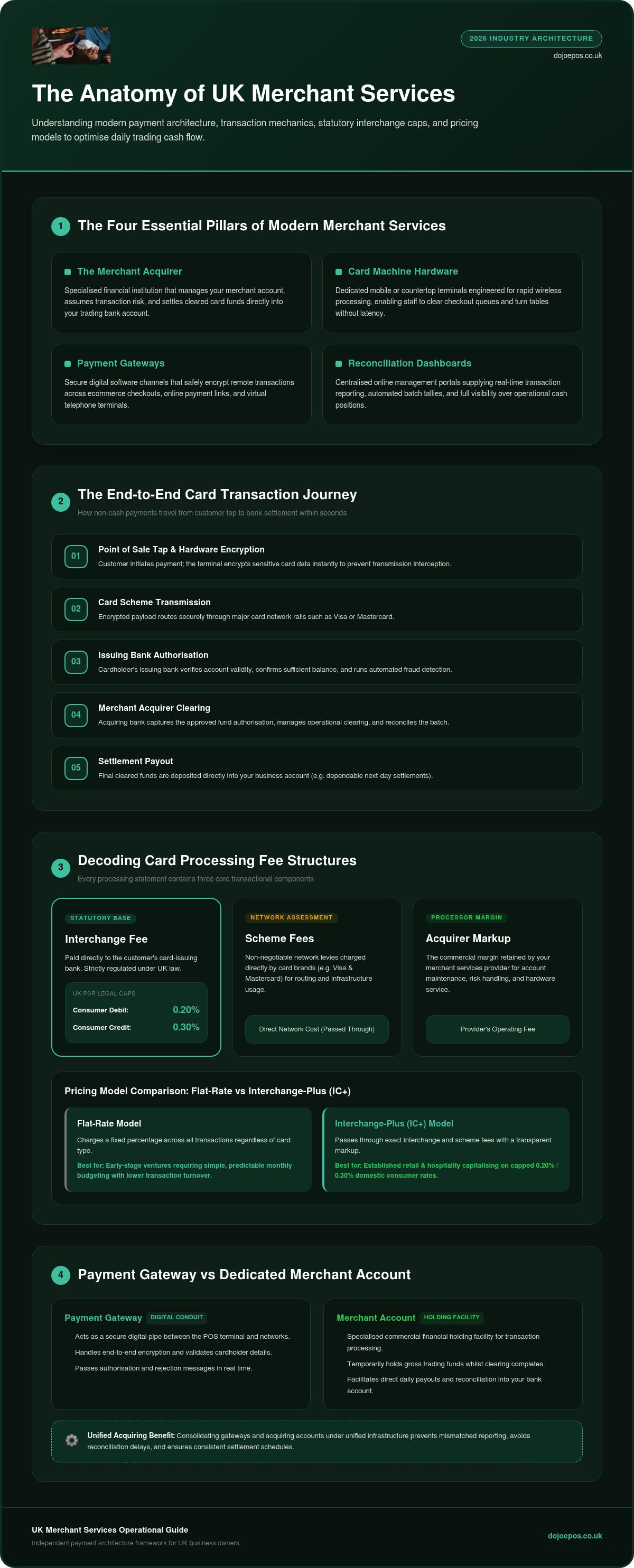
Accepting card payments doesn't simply mean plugging in a rented countertop terminal. At its fundamental level, merchant services encompass the complete financial and operational framework that allows your enterprise to accept, process, and settle non-cash transactions safely. Every card payment triggers an intricate digital relay within seconds. The payment terminal encrypts the customer's card details and transmits them through card schemes like Visa or Mastercard directly to the cardholder's issuing bank. Once that bank confirms available funds and checks for fraud, your merchant acquirer secures the authorised sum and readies it for payout into your business account. Dependable architecture protects this loop, preventing dropped sales, safeguarding customer confidence, and keeping daily operations moving.
The Four Essential Pillars of Modern Merchant Services
A high-performance payment setup relies on four coordinated components working behind the scenes:
The Merchant Acquirer: A specialised financial institution that manages your merchant account, assumes transaction risk, and settles cleared card funds into your trading account.
Card Machine Hardware: Dedicated mobile or countertop terminals built for rapid wireless processing, helping staff clear checkout queues and turn tables without latency.
Payment Gateways: Secure digital software channels that safely encrypt remote transactions across ecommerce checkouts, payment links, and virtual phone terminals.
Reconciliation Dashboards: Centralised online portals that supply real-time transaction reporting, automated batch tallies, and clear oversight of your operational cash position.
Payment Gateways vs Merchant Accounts: The Crucial Differences
Business owners often confuse payment gateways with merchant accounts, but they serve distinct operational functions within merchant services uk infrastructure. A payment gateway acts purely as a secure digital conduit; it validates card details, handles encryption, and passes authorisation messages between your point of sale and the processing network. In contrast, a dedicated merchant account is the underlying financial holding facility where gross funds temporarily rest while transactions undergo full clearing.
Relying on disconnected third-party gateways alongside separate legacy acquirers introduces unnecessary risk. Disjointed systems lead to mismatched reporting, delayed batch reconciliation, and administrative gridlock when technical faults happen. Choosing unified acquiring infrastructure keeps your transactional data consolidated, slashes backend bookkeeping hours, and keeps settlement schedules consistent.
Decoding Merchant Processing Pricing: Fee Structures Explained
Card processing statements often look like an impenetrable wall of codes and percentage deductions. In reality, every transaction fee in merchant services uk environments comprises three distinct elements: interchange fees, scheme fees, and the acquirer's operating margin. Interchange fees represent the base cost paid directly to the customer's card-issuing bank. In the UK, the Payment Systems Regulator caps domestic consumer interchange rates at 0.20% for debit cards and 0.30% for credit cards. Card schemes such as Visa and Mastercard then levy non-negotiable network assessments, known as scheme fees. Whatever remains represents your acquirer's markup for processing the transaction.
Gaining absolute clarity on these mechanisms helps you protect operational profitability. Exploring transparent frameworks such as Dojo card machine rates illustrates how predictable, straightforward billing empowers growing enterprises without trapping them behind obscure line items.
Flat-Rate vs Interchange-Plus Fee Frameworks
Modern providers typically bill transactions using either a flat-rate or an interchange-plus (IC+) structure. Flat-rate plans charge an identical percentage regardless of the underlying card type used. This offers predictable budgeting for early-stage ventures with lower turnover. Conversely, established retailers and hospitality venues benefit from interchange-plus models. IC+ directly passes through exact wholesale interchange and scheme costs, adding a transparent processor fee on top. This model allows merchants to capitalise on capped domestic consumer cards, though international, commercial, and premium rewards cards will attract higher underlying interchange charges.
Uncovering Hidden Costs in Traditional Merchant Contracts
Headline processing rates rarely tell the whole financial story when dealing with traditional acquirers. Legacy vendors regularly add ancillary line items to monthly statements. These include minimum monthly merchant service charges (MMCSC), separate statement creation fees, and per-attempt transaction authorisation costs. Moreover, strict compliance with the Payment Card Industry Data Security Standard (PCI DSS) is non-negotiable; failing to complete self-assessment questionnaires often triggers punishing monthly non-compliance penalties.
Audit your monthly statements closely to ensure unexpected operational penalties aren't eroding margins. When you're ready to upgrade your checkout efficiency with straightforward reporting, explore modern solutions at dojoepos.co.uk to run your business with total confidence.
UK Merchant Services Provider Roundup: Comparing Options for 2026
Selecting the right merchant services uk provider requires looking past surface-level marketing to evaluate the operational model running behind the counter. Today's commercial payments market divides into three distinct categories: entry-level payment facilitators, heritage high-street clearing banks, and modern integrated acquirers. Choosing the model that matches your transaction profile ensures you don't overpay for basic processing or struggle with hardware bottlenecks during peak trading.
Payment Facilitators: Accessible Entry for Micro-Merchants
Payment facilitators (PayFacs) pool thousands of independent sellers into one giant master merchant account. This aggregated setup allows new ventures to complete setup within minutes without traditional credit underwriting. PayFacs provide a practical starting point for pop-up shops, hobbyists, and micro-traders testing new concepts.
This simplicity carries clear trade-offs. Automated risk algorithms frequently trigger abrupt fund freezes or account suspensions when sudden sales spikes occur. Furthermore, basic mobile readers rely heavily on phone Bluetooth connections, making them ill-suited for sustained, fast-paced service. Once turnover climbs beyond casual trade, the flat fees and lack of direct support create unnecessary friction.
Traditional High-Street Acquirers: Legacy Systems and Long Contracts
Heritage banking institutions have dominated UK acquiring for decades, handling commercial accounts for established retailers. These institutions offer dedicated merchant accounts, giving your enterprise an individual risk profile and stability at scale.
Yet these legacy arrangements regularly frustrate operators. Many contracts lock merchants into multi-year commitments enforced by steep early termination fees. Countertop card machines are often leased through third parties, leading to sluggish transaction speeds and finger-pointing when technical faults occur. Settling payouts across multiple banking days also stalls working capital.
Modern Acquiring Innovators: The Dojo Integrated Ecosystem
Modern innovators combine agile software with enterprise-grade acquiring reliability. Serving over 110,000 businesses across the UK, Dojo delivers rapid transaction speeds built specifically to eliminate queue latency in bustling hospitality and retail spaces.
Operators deploy sleek, robust terminals including the Dojo Go and the ultra-mobile Dojo Pocket, keeping service swift across countertops and dining areas. By pairing these devices directly with electronic point of sale hardware through integrated payments, venues remove manual bill entry and stop staff reconciliation errors. Coupled with dependable next-day transfers, this unified ecosystem keeps operations efficient and daily cash flow accessible.
How to Evaluate Merchant Services: Core Criteria for UK Businesses
Auditing merchant services uk providers requires looking beyond introductory discounts to assess day-to-day operational impact. A cheap terminal quickly becomes a liability if transactions crawl during a lunchtime rush or takings sit stranded in banking clearing cycles over a bank holiday. Evaluating providers against a rigorous operational standard guarantees that your chosen solution supports commercial growth rather than restricting it.
Settlement Speed: Protecting Your Working Capital
Cash flow remains the lifeblood of every trading business. Standard acquirers routinely impose multi-day settlement delays, holding Friday and Saturday earnings until Tuesday or Wednesday morning. This practice starves operators of active working capital when supplier invoices and staff payroll fall due. Modern acquiring removes this friction entirely by delivering next-day transfers seven days a week, including weekends and bank holidays. Having immediate access to daily earnings transforms commercial momentum and keeps your business agile.
Hardware Reliability and Till Integration
Checkout friction directly depresses profitability. Card terminals engineered for rapid, sub-second processing reduce customer queues, helping hospitality venues turn tables faster and retail stores serve more shoppers per hour. Reliable connection redundancy matters just as much. Hardware must feature intelligent switching between dual-band Wi-Fi and integrated 4G mobile SIM connectivity to guarantee zero offline downtime if broadband drops.
Equally critical is direct EPOS connectivity. Deploying integrated payment processing solutions links terminals natively with till software such as Blinq POS Software. Pushing transaction amounts automatically from till to terminal stops cashiers keying in wrong totals, prevents reconciliation mismatches, and saves staff hours of evening bookkeeping.
Operational Evaluation Checklist:
Daily Settlement: Do takings land next day every day, or does the bank enforce multi-day holds?
Network Redundancy: Does the hardware provide built-in 4G fallback alongside Wi-Fi?
Native Integration: Can the card machine communicate directly with your point of sale software?
Support Accessibility: Is dedicated UK support available during demanding trading shifts?
Contract Flexibility and Support Standards
Scrutinise commercial commitments before signing acquiring contracts. Avoid auto-renewing multi-year terms that carry punitive termination penalties if your business needs evolve. Demand certified security standards like Point-to-Point Encryption (P2PE), which protects customer data at hardware level and simplifies administrative compliance. Finally, verify that customer assistance operates when you trade; an acquirer with technical teams available during peak evening and weekend trading runs rings around automated call queues.
Ready to upgrade your payment setup? Get started with a tailored Dojo solution today to streamline checkouts and unlock standard next-day transfers.
Setting Up Your Merchant Services: Implementation and Migration
Modern onboarding protocols have permanently replaced the slow, paper-heavy commercial banking applications of the past. Securing robust merchant services uk infrastructure now moves with the agility your business requires. Streamlined digital portals assess commercial risk swiftly, enabling fast terminal dispatch and setup so you can accept payments without operational delays.
The Step-by-Step Merchant Account Onboarding Process
Getting your trading account approved centres on straightforward compliance verification. Acquirers conduct routine Anti-Money Laundering (AML) and Know Your Customer (KYC) checks to ensure security across the national payment network. Having the following verification documents ready keeps digital underwriting rapid:
Proof of Trading Identity: Valid photographic ID (UK driving licence or passport) for company directors or primary business partners.
Business Operating Verification: Your Companies House registration number, registered trading name, and business utility documentation.
Settlement Banking Details: A recent commercial bank statement confirming the business sort code and account number for daily payouts.
Once automated underwriting approves the account, physical card machines arrive pre-configured. Getting started requires zero technical expertise: unbox the terminal, power on the hardware, pair it to your local Wi-Fi or rely on the active mobile SIM, and conduct a nominal test sale to confirm communication with acquiring networks.
Switching Merchant Providers Seamlessly
Migrating between merchant providers doesn't mean risking counter downtime or missing sales. Start by auditing your existing acquiring agreement to confirm termination clauses and notice windows. Running an overlapping setup provides complete operational peace of mind. Simply unbox and power up your replacement terminal alongside your existing card reader for a single trading shift.
Once you verify that payments process smoothly and transactions route correctly to your business dashboard, retire the old equipment and submit formal cancellation notice to your former provider. When returning leased hardware, always use tracked courier delivery to guarantee proof of receipt. Training team members on modern hardware takes minutes; staff need only master running the daily end-of-day banking batch and checking settlement totals against the till system to ensure smooth, uninterrupted daily trade.
Upgrade Your Checkout Experience and Take Control of Cash Flow
Your card processing shouldn't hold your business back with complex statements, sluggish hardware, or delayed banking settlements. By choosing an acquiring model designed around operational speed and direct till integration, you protect margins, eliminate administrative errors, and give customers a frictionless checkout experience every time.
Selecting modern merchant services uk infrastructure should actively power commercial momentum. Trusted by over 110,000 businesses across the UK, Dojo delivers blazing-fast transaction speeds that eliminate queues and accelerate table turnover, alongside standard next-day transfers that deposit trading funds seven days a week, including weekends and bank holidays. When you're ready to leave legacy constraints behind and run your business with total efficiency, discover modern UK merchant services and card machines with Dojo today.
Frequently Asked Questions
What exactly is included in a UK merchant services package?
A comprehensive UK merchant services package typically bundles dedicated card acquiring facilities, hardware terminals, secure payment gateways, and real-time transaction reporting portals. Providers often combine physical card readers like the Dojo Go with software management tools. This full-stack setup enables businesses to authorise in-person or online customer payments safely, monitor gross receipts, and route settled revenue directly into their chosen commercial bank account.
How quickly do merchant services providers settle funds into UK bank accounts?
Settlement speeds vary significantly depending on your provider's acquiring infrastructure. Legacy merchant services uk agreements frequently hold funds across two to three working days, delaying weekend revenue until midweek. In contrast, modern innovators offer standard next-day transfers every day of the week. This ensures your daily takings land in your account the following morning, protecting immediate cash flow and operational liquidity.
Can my business accept card payments without a traditional high-street bank account?
Yes, modern payment providers can route settlements directly into digital business accounts or app-based financial institutions. As long as your account possesses a valid UK sort code, account number, and is registered in your legal trading name, merchant acquirers can deposit payouts. This flexibility means you don't need a conventional high-street commercial bank facility to process everyday debit and credit card payments.
What is the difference between an integrated and non-integrated card terminal?
Integrated terminals link directly to your EPOS software, automatically pushing transaction totals from the till to the payment screen. Non-integrated or standalone card machines require staff to manually type the bill amount into the terminal keypad. Using integrated payments removes human keying mistakes, speeds up queue throughput, and automates end-of-day reconciliation across your till software and acquiring reports.
How do next-day transfers work across weekends and bank holidays?
Advanced merchant acquirers operate automated batching systems that settle funds seven days a week rather than waiting for standard clearing cycles. Regardless of whether you trade on a Saturday, Sunday, or public holiday, your daily card sales batch automatically at closing time and transfer into your bank account the following morning. This provides uninterrupted cash flow every day of the year.
Why is PCI-DSS compliance required for UK card processing?
The Payment Card Industry Data Security Standard is a mandatory global regulation established to protect customer cardholder data against digital theft and fraud. Every business accepting merchant services uk card payments must adhere to these baseline operational standards. Maintaining compliance safeguards your enterprise against severe financial penalties, minimises exposure to chargeback liabilities, and reassures shoppers that their sensitive payment information remains completely secure.
What happens if our premises internet connection fails during busy service?
Modern commercial card terminals safeguard trading with automated network redundancy. Dedicated hardware like the Dojo Go and Dojo Pocket features built-in multi-network 4G mobile SIM connectivity alongside standard Wi-Fi. If your local broadband drops during a busy service, the device instantly shifts to cellular data without dropping live transactions, ensuring your team continues serving customers and accepting payments without interruption.
How difficult is it to switch from our existing merchant service provider?
Switching acquiring providers is straightforward when managed with an overlapping handover window. Once your replacement terminals arrive pre-configured, you power them up and process test transactions while keeping your old system on standby. After verifying that everything communicates properly with your bank and EPOS software, you submit formal cancellation notice to your outgoing provider and return any leased hardware via tracked courier.


Comments