
Merchant Transaction Fee Comparison: How to Compare the Real Cost in 2026
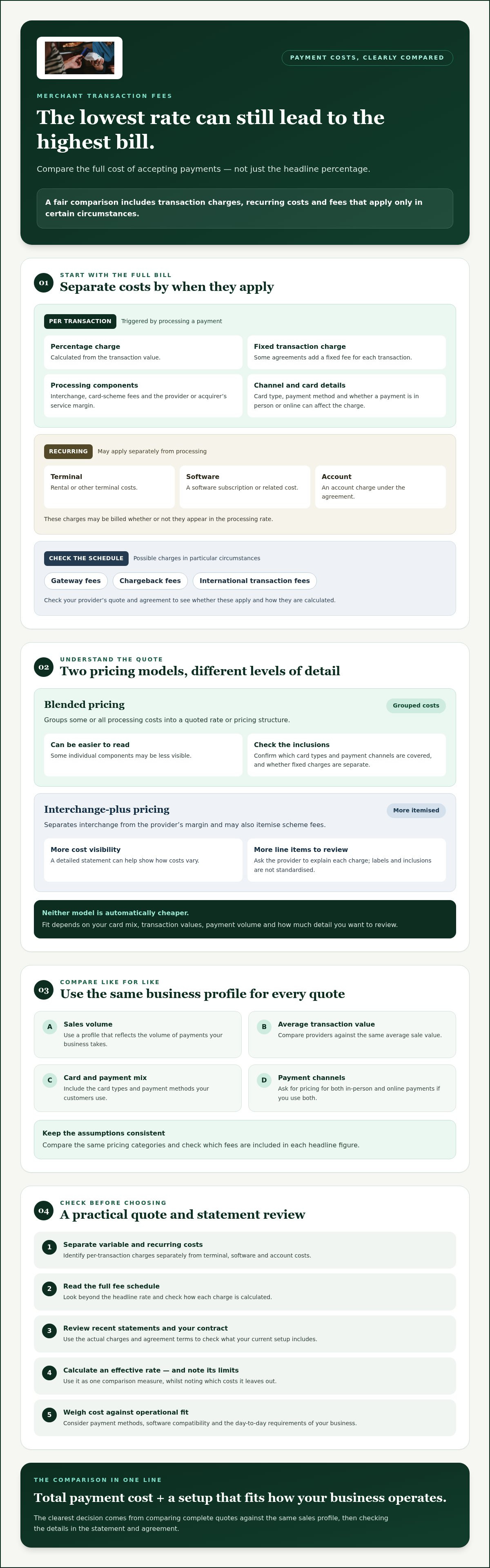
The lowest transaction rate can still lead to the highest bill. A useful merchant transaction fee comparison looks beyond the headline figure to the full cost of accepting payments, including charges listed elsewhere in a provider’s quote.
Comparing providers can be difficult because one quote may show a blended rate, while another separates processing costs and other charges. Your sales volume, average transaction value and mix of in-person and online payments all affect which option may suit your business.
This guide explains the main types of merchant transaction fees, how to compare quotes on a like-for-like basis and what to check before choosing a payment setup. It covers processing, monthly, gateway, chargeback and international transaction fees, as well as relevant terminal and software costs. The aim is to help you see your total payment bill and weigh cost against the way each provider fits your day-to-day operations.
Table of Contents
Merchant transaction fees explained: what are you paying for?
A transaction fee is only one part of the cost of accepting card payments. Your total bill may also include recurring charges for a payment terminal, software or an account, depending on your agreement. To compare quotes fairly, separate costs triggered by each transaction from charges that apply regardless of how many payments you take.
Definition: A merchant transaction fee is a charge for processing a customer’s card payment. It may include costs linked to the transaction and the payment provider’s services. The exact charges and how they are calculated should be set out in your agreement.
What does a merchant transaction fee cover?
When a customer pays by card or device, payment information moves through the payment system for authorisation. The card issuer, usually the customer’s bank, checks the payment. The card scheme provides the network and rules connecting participants. The acquirer processes card payments for the merchant, while the payment provider supplies or coordinates services used to accept them. Once approved and processed, funds are settled to the merchant under the provider’s arrangements.
The fee can reflect several parts of that process. An interchange fee is one cost associated with a card payment, alongside card-scheme charges and the provider or acquirer’s service margin. The exact breakdown depends on the pricing model and agreement. Card type, payment method and other transaction details can also affect the charge, so a quoted rate may not apply in the same way to every sale.
Why the headline rate is not the whole bill
A percentage charge is calculated from the transaction value. Some agreements also include a fixed charge for each transaction, so the processing cost can vary with both sale value and payment count. Check how each quote treats different card types and payment channels, and which charges are included in its headline figure.
Recurring costs sit alongside transaction-based charges. A terminal rental, software subscription or account charge may be billed separately, whether or not it appears in the processing rate. Other fees may apply in particular circumstances. Review the full schedule of charges rather than relying on a single percentage.
For a wider view of the services and considerations involved, see this UK merchant services provider guide. A sound merchant transaction fee comparison starts with the complete payment setup and agreement, not just the most prominent rate.
The main merchant transaction fee components and pricing models
To understand a quote, separate the underlying costs of a card payment from the provider’s pricing. The main components are interchange, card-scheme fees and the acquirer or provider’s service margin. The amounts and how they appear on your statement depend on the agreement and transaction details.
Interchange, scheme fees and the provider margin
Interchange is a fee associated with a card transaction between the acquirer and the card issuer, typically the customer’s bank. Card-scheme fees relate to using a card network, such as Visa or Mastercard. Each scheme sets its own charges, so don’t assume they are identical.
The provider or acquirer margin is the charge for the services involved in processing payments. A quote may show it separately or include it in a broader rate. For a wider overview of the components, see this guide to credit card processing fees. Its examples may reflect a different market, so use your UK provider agreement to confirm the charges that apply to you.
Blended pricing versus interchange-plus pricing
With blended pricing, a provider groups some or all processing costs into a quoted rate or pricing structure. This can make a quote easier to read, but may provide less visibility of individual components. Check which card types and payment channels the rate covers, and whether fixed per-transaction charges are separate.
Interchange-plus pricing separates interchange from the provider’s margin and may also itemise scheme fees. That can make statements more detailed and help you see how costs vary, but you will have more line items to understand. Labels and inclusions aren’t standardised across providers, so ask for a clear explanation of each charge.
Neither model is automatically cheaper. The better fit depends on your card mix, transaction values, payment volume and how much detail you want to review. A merchant transaction fee comparison should also check whether card-present payments, such as those taken in person, are priced differently from card-not-present payments, such as online transactions. Ask providers to quote for each channel you use.
Check the agreement for other possible charges, such as gateway, chargeback or international transaction fees. These aren’t universal and may depend on your services and activity. If you’re assessing in-person and online payment options, you can also review Dojo’s payment solutions against the same business requirements.
How to compare merchant transaction fees fairly across providers
The lowest headline rate doesn’t necessarily mean the lowest total cost. A quote with a lower percentage charge could include a fixed charge per transaction or recurring costs that raise the overall bill. For a useful merchant transaction fee comparison, model each provider against the same business activity, then compare all applicable charges rather than one rate.
Which details should you compare in each quote?
Ask providers which payment types and card transactions their quoted processing rates cover. Record percentage charges and fixed per-transaction charges separately, then add applicable terminal, software, account or other charges shown in the quote or agreement. Check the contract duration, notice requirements and any charges that may apply under the stated terms.
Use the same comparison period, sales volume, average transaction value and card mix for every provider. Forbes’ guide to credit card processing fees offers context on fee components and pricing models, but check each UK provider’s quote and terms to confirm what applies to your business.
How business type and card mix affect the comparison
Your transaction mix affects the comparison because providers may price in-person card-present payments differently from online or other card-not-present payments. Average transaction value and transaction frequency matter too. A fixed charge on each sale has a different effect on frequent lower-value payments than on fewer higher-value sales. The cards customers use can also affect charges under some pricing structures.
Use recent sales or processing records to describe your actual mix when requesting quotes. Don’t assume one rate applies to every card or channel. Ask providers to show how each is treated. For more on terminal pricing considerations, see this UK card machine rates comparison guide.
Include Dojo in the same like-for-like assessment if its card-present or online payment options fit your requirements. You can review Dojo’s payment solutions alongside other providers, then compare the quoted costs with your operational needs.
How to calculate and check your business payment costs
Use your payment records to turn provider quotes into a realistic cost estimate. Start with recent processing statements and your provider contract, then apply each quote to the same sales data. This gives your merchant transaction fee comparison a consistent baseline instead of relying on headline rates or assumptions.
Use statements to establish a reliable baseline
Gather records for a representative period. Collect processing statements and invoices, alongside the contract and fee schedule. Choose a period that reflects your normal trading pattern, and use the same dates and sales scope for every provider you assess.
Sort charges into clear categories. Separate transaction-based processing charges from recurring terminal, software and account charges. Keep other charges shown on your statement in their own category. This makes it easier to see which costs change with payment activity and which apply separately.
Check how transactions are treated. Note how refunds, chargebacks and any excluded transactions appear in your records. Apply the same treatment to every quote so you’re not comparing different sales totals or fee scopes.
Turn provider quotes into an apples-to-apples comparison
Apply each provider’s quoted pricing structure to the same verified transaction data. Include actual transaction values, frequency, card mix and payment channels where available. If a quote doesn’t define a charge or explain which transactions it covers, record that as an assumption and ask the provider to clarify before relying on the result.
You can calculate an effective processing rate as:
Effective processing rate = eligible processing charges ÷ card sales × 100
Take the processing charges included in your chosen scope, divide them by card sales for the same period, then multiply by 100 to express the result as a percentage. Be consistent about what counts as an eligible processing charge. If you exclude terminal rental or software subscriptions, the result won’t represent the full cost of your payment setup. The effective rate summarises past activity, not future costs. Changes in transaction volume, average sale value or card mix can change the result.
For practical ideas on reviewing costs, see the credit card processing fee reduction checklist. If your comparison leads you to consider changing provider, use this merchant-provider switching guide to help plan your next steps.
To compare your requirements with Dojo’s payment options, explore Dojo payment solutions and assess any quote against the same records and cost categories.
Choose a merchant transaction fee solution that fits your business
The right provider isn’t automatically the one with the lowest quoted rate. A useful merchant transaction fee comparison weighs the full cost against how your business takes payments, the reliability you need and the fit with day-to-day operations. The right choice depends on your requirements, not a universal cheapest-provider ranking.
Match fee structures to operational needs
Start with the payments you need to accept. Does your business rely on physical terminals, online payments or both? If payment information needs to connect with point-of-sale software, include that workflow in your assessment. A lower processing cost may not be the best fit if the overall setup adds friction or doesn’t support your operations.
Compare recurring hardware and software charges with the features and usage your business needs. If point-of-sale software is part of your evaluation, consider whether Blinq POS Software suits your requirements. Dojo offers card-present and online payment solutions, so you can assess it alongside other providers using the same transaction data, costs and operational criteria. That doesn’t make it the automatic lowest-cost choice.
Questions to ask before choosing a provider
Before you decide, ask each provider for clear, written answers. This helps you check that the quote and agreement match the assumptions in your comparison.
What does each fee cover, and which transaction types does it apply to?
Are any terminal, software, account or other charges separate from processing fees?
How and when are funds settled, and what settlement arrangements apply to your account?
Which support channels are available, and what should you expect if a payment issue disrupts trading?
What are the agreement duration, notice requirements and any applicable charges for ending or changing the arrangement?
Confirm settlement arrangements, support channels and agreement terms directly with the provider. Don’t rely on assumptions or verbal summaries when the details can be set out in writing. Then compare the full cost with your practical requirements, including payment methods, software fit and the service you need to operate smoothly.
Once you’ve defined your requirements, explore Dojo payment solutions as one option to include in your assessment. Review the relevant features and request details for your business, then weigh them against other providers on a like-for-like basis.
Make your next payment decision with confidence
A strong merchant transaction fee comparison looks beyond the headline rate. Separate transaction charges from recurring costs, compare quotes using the same sales period and card mix, and check how each provider’s payment setup fits your business. An effective rate can help you review processing costs, but it only tells part of the story if it excludes hardware, software or other charges.
Cost matters, but so do the payment methods you need, how well the service fits your workflows and the support available. There’s no universal cheapest provider for every business. Look for the balance of clear costs, operational fit and the service you need.
Dojo is a UK-based payment provider offering card-present and online payment solutions. Consider it alongside other providers, using your own requirements and a like-for-like assessment. Explore Dojo payment solutions to see whether they could suit your business.
With clear figures and the right questions, you can choose a payment setup that supports your business with confidence.
Frequently Asked Questions
What is a merchant transaction fee?
A merchant transaction fee is a charge for processing a customer’s card payment. Depending on how the provider structures its pricing, it can reflect interchange, card-scheme charges and the provider or acquirer’s service margin. It’s separate from recurring costs such as terminal rental or software subscriptions. Check your agreement to see which transaction types a fee applies to and whether the quote includes all processing components.
How do I compare merchant transaction fees between providers?
Compare providers using the same sales period, transaction volume, average transaction value and card mix. Record percentage charges, fixed fees per transaction and applicable recurring charges separately. Check which payment channels and card types the quoted rate covers, and review relevant agreement terms, including duration and notice requirements. A like-for-like merchant transaction fee comparison shows how the full cost may fit your business, rather than ranking quotes by headline rate alone.
What is the difference between interchange-plus and blended pricing?
Blended pricing groups some or all processing costs into a combined rate or structure, which can make a quote simpler to read. Interchange-plus pricing separates interchange from the provider’s margin and may itemise scheme charges too, giving you more detail to review. Providers can use these labels differently, so ask what each quote includes. Neither approach is automatically cheaper. The outcome depends on your card mix, sales and agreement.
How much do merchant transaction fees cost in the UK?
There isn’t one standard UK cost that applies to every business. Your charges depend on the provider agreement, pricing model, card mix, transaction details and payment channels. A quote may include percentage-based processing charges, fixed per-transaction charges and separate recurring costs for equipment or software. Ask providers for a written breakdown based on your actual payment activity, then compare the same period and costs across each quote.
Can a low transaction rate still cost my business more?
Yes. A low percentage rate may be offset by fixed charges per transaction, recurring terminal or software costs, or other charges specified in the agreement. The impact also depends on how many payments you take and their average value. For a fair comparison, apply every provider’s pricing to the same sales and transaction data, and include applicable costs beyond processing. Don’t judge the overall bill by one rate alone.
What is an effective rate for card processing?
An effective rate is the eligible processing charges for a period divided by card sales for that same period, multiplied by 100. For example, if your selected processing charges total £X and card sales total £Y, calculate £X ÷ £Y × 100. Define which charges you include and keep the period consistent. This rate summarises past processing costs. It may exclude recurring costs and can change as your transaction mix changes.
Are card-present and online transaction fees always the same?
No. Providers may price card-present payments, such as those taken in person, differently from online or other card-not-present payments. The applicable charge can depend on the provider’s agreement and transaction details, so don’t assume a quote covers every channel at the same rate. Ask for the fees that apply to each payment type you use, then compare providers using the same channel mix and sales information.


Comments