
Secure Merchant Payment Gateway: UK Business Guide 2026
In 2025, criminals stole a staggering £1.28 billion through payment fraud in the UK, with remote card purchases driving the majority of these losses. In this high-stakes digital economy, a secure merchant payment gateway is no longer just a technical utility; it's the foundation of your business's integrity and customer trust. You've worked hard to build your brand, and the fear of a data breach or the headache of complex PCI compliance shouldn't hold you back from scaling. It's exhausting to manage high chargeback rates when you should be focusing on your next big commercial move.
This guide will empower you to take total control of your transaction security. You'll discover how the right infrastructure protects your revenue, ensures you stay on the right side of regulation, and creates a frictionless experience for your customers. We will explore the mandatory requirements of PCI DSS v4.0.1, the mechanics of AI-driven fraud scrubbing, and how to choose a partner that handles the technical complexity behind the scenes. By the end, you'll have a clear roadmap for faster, safer processing that keeps your cash flow healthy and your reputation spotless.
Table of Contents
Understanding the Role of a Secure Merchant Payment Gateway
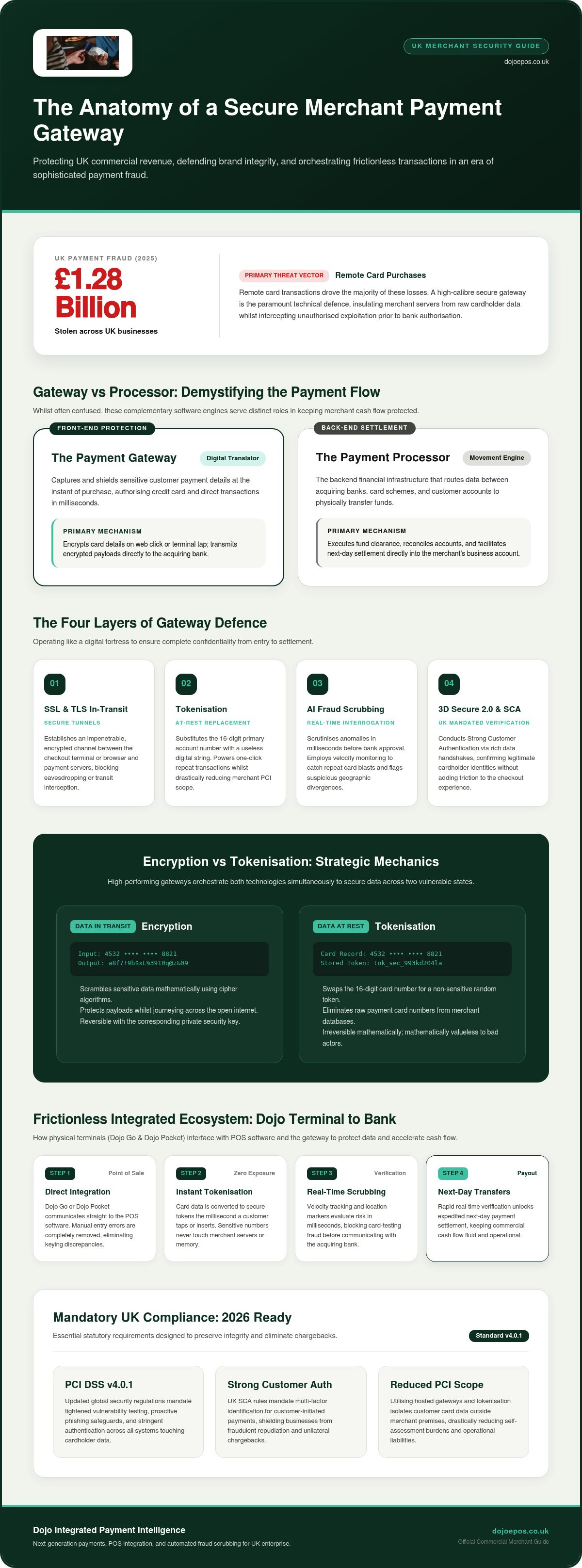
Think of a secure merchant payment gateway as the invisible, high-speed bridge connecting your customer's bank account to your own. It's the critical piece of infrastructure that ensures every transaction is legitimate, safe, and efficient. Whilst many business owners focus on the physical card machine or the checkout button, the gateway is where the real work happens. It's the digital translator that allows different financial institutions to communicate securely in milliseconds.
The distinction between a payment processor and a gateway is often blurred, but it's vital for your strategy. The gateway is the front-end software that captures and protects card data. The processor is the back-end engine that actually moves the funds. By using a secure merchant payment gateway, you ensure that sensitive information never touches your own servers. This is particularly effective when using integrated payments, where your Dojo Go or Dojo Pocket terminal communicates directly with your POS software, eliminating manual entry errors and keeping data exposure to an absolute minimum.
What is a Payment Gateway?
At its core, a payment gateway is the software layer that authorises credit card or direct payments for both e-commerce and physical stores. When a customer taps their phone on a terminal or clicks 'buy' on your website, the gateway immediately encrypts the data. It then sends this information to the acquiring bank for approval. Understanding these payment gateway mechanics is essential for any merchant who wants to scale. Without this secure middleman, you'd be forced to handle raw cardholder data, which is a massive security risk that most UK businesses simply aren't equipped to manage.
The Business Case for High-Level Security
Security isn't just about defence; it's a powerful tool for growth. When customers see recognisable security protocols and experience a smooth, glitch-free checkout, their trust in your brand increases. This confidence translates directly into higher conversion rates and repeat business. High-level security also acts as a shield against the rising tide of UK fraud, which cost businesses over £1.2 billion in 2025. By filtering out fraudulent attempts before they reach your account, you protect your bottom line from expensive chargebacks.
Reliable security also unlocks operational speed. When your gateway provides robust, real-time verification, it allows for faster next day payment settlement. This means your hard-earned revenue is in your bank account when you need it, rather than being tied up in lengthy verification delays. Choosing a secure merchant payment gateway that prioritises both safety and speed gives you the peace of mind to focus on what matters: growing your business and serving your customers.
The Layers of Defence: How Gateway Security Actually Works
A secure merchant payment gateway operates like a digital fortress; it uses multiple layers of defence to ensure that every transaction remains private and protected. The first line of security is the communication channel itself. SSL and TLS certificates establish a secure tunnel between the customer's device and the payment server, ensuring that data cannot be intercepted or tampered with during transit. This foundation allows for the sophisticated processing of sensitive information without exposing your business to unnecessary risk.
Encryption vs Tokenisation: A Simple Breakdown
Whilst encryption protects data whilst it's moving across the web, tokenisation secures it when it's stored. Tokenisation is the process of turning a 16-digit card number into a useless string of characters for hackers. This technology allows you to offer 'one-click' repeat purchases because the actual card details never reside on your system. By replacing sensitive data with unique digital identifiers, you significantly reduce your PCI DSS scope and protect your business from the fallout of a potential data breach. It's a proactive way to manage customer information without the liability of holding the actual card numbers.
Advanced Fraud Detection Mechanisms
Modern gateways don't just pass data; they interrogate it. Real-time fraud screening assesses risk in milliseconds, checking for anomalies before the transaction is even authorised. Velocity checks identify suspiciously rapid patterns, such as dozens of small transactions attempted from the same IP address in seconds. Geographic tracking flags transactions from high-risk locations that don't match the cardholder's usual behaviour. These systems use machine learning to evolve, spotting new fraud tactics by analysing millions of global data points and learning from every successful or blocked attempt across the network.
This level of scrutiny is essential to meet the FCA Strong Customer Authentication rules, which mandate extra layers of identity verification for most UK e-commerce payments. Ensuring your business uses a secure merchant payment gateway allows you to automate these complex checks, keeping your checkout flow fast whilst maintaining the highest levels of protection. By handling the technical complexity behind the scenes, you can provide a seamless experience that encourages customer loyalty and drives long-term growth.
Essential Features of a Secure Merchant Payment Gateway
Choosing a secure merchant payment gateway involves looking for features that actively simplify your daily operations. It isn't just about blocking bad actors; it's about giving you the tools to monitor your business health in real-time. A high-performance gateway should offer comprehensive reporting dashboards that let you track transaction success rates and identify bottlenecks instantly. For physical retailers, this security must extend to your electronic point of sale hardware, ensuring that data captured at the till is just as protected as an online checkout. Foundational checks like Address Verification Service (AVS) and Card Verification Value (CVV) remain non-negotiable. These simple steps verify that the person making the purchase actually possesses the card and knows the registered billing address, acting as a crucial filter for any secure merchant payment gateway provider.
3D Secure 2.0 and Frictionless Authentication
3D Secure 2.0 (3DS2) has revolutionised identity verification by balancing rigorous security with a smooth user experience. Gone are the days of clunky, forgotten passwords that caused customers to abandon their carts. Instead, 3DS2 uses rich data sharing between the merchant and the bank to authenticate most transactions silently. When a challenge is required, it relies on modern methods like biometric scans or SMS codes. This frictionless approach is vital for meeting UK regulatory standards in 2026, ensuring you remain compliant without sacrificing your conversion rates. It allows you to prove the customer's identity with confidence whilst keeping the checkout process fast and energetic.
Chargeback Management and Protection
A chargeback is more than just a lost sale; it's a drain on your resources. Between lost stock, shipping costs, and administrative fees, the true cost can be double the original transaction value. A robust gateway helps you fight back by providing a clear audit trail and the evidence needed to dispute unfair claims. This is especially important for tackling 'friendly fraud', where a customer makes a legitimate purchase but later claims it was unauthorised. By meeting PCI DSS compliance requirements through your gateway provider, you ensure that every transaction is backed by the highest industry standards. This gives you a stronger leg to stand on during disputes and protects your hard-earned revenue from being eroded by fraudulent claims.
Navigating UK Compliance: PCI DSS and SCA in 2026
Operating a business in the UK means adhering to some of the world's most rigorous financial regulations. Compliance isn't just a legal hurdle; it's a commitment to your customers that their data is handled with the highest level of care. Choosing an FCA-regulated payment provider ensures that your partner meets these stringent standards, giving you the confidence to trade without fear of regulatory intervention. By using a secure merchant payment gateway that offers a hosted checkout, you offload the vast majority of the technical burden, allowing you to focus on growth rather than red tape.
Demystifying PCI DSS Compliance
The Payment Card Industry Data Security Standard (PCI DSS) is structured into four levels, determined primarily by your annual transaction volume. Level 1 is for global giants, whilst Level 4 covers the majority of small to medium enterprises. Regardless of your tier, the operative standard is now PCI DSS v4.0.1, which introduced mandatory requirements for script management and tamper detection on payment pages as of March 2025. PCI DSS compliance is a mandatory requirement for any business accepting card payments, regardless of size. A high-quality gateway handles the heavy lifting by ensuring card data never enters your environment, which can simplify your annual Self-Assessment Questionnaire (SAQ) from hundreds of questions down to a handful.
Strong Customer Authentication (SCA) Requirements
Strong Customer Authentication (SCA) is a central pillar of UK payment security. It requires customers to verify their identity using at least two of three independent factors: something they know (like a PIN), something they have (like a smartphone), or something they are (like a fingerprint). Whilst this adds a layer of protection, it shouldn't stall your sales. Smart gateways apply exemptions where possible to maintain a fast checkout flow. For example, remote transactions under £25 are typically exempt from two-factor authentication, provided the cumulative spend hasn't exceeded £85 or five consecutive payments. Ensuring your gateway is prioritising integrated card payments for retail uk is the most efficient way to stay compliant whilst keeping the customer experience effortless. You can also benefit from Transaction Risk Analysis (TRA) exemptions, which allow for frictionless payments up to £440 if your provider maintains a fraud rate below 0.01%.
Staying ahead of these regulations requires a partner that understands the nuances of the British market. If you want to streamline your compliance and protect your revenue, get started with a secure Dojo gateway today.
Choosing the Right Gateway for Your Business Growth
Selecting a secure merchant payment gateway is a strategic decision that dictates how quickly you can scale. It moves your business beyond simply accepting payments to actively optimising your cash flow. A partner that understands the practical, day-to-day challenges of modern commerce will provide more than just a connection to a bank; they'll provide a platform for expansion. Your choice should reflect your ambition, balancing cutting-edge technology with the reliability that your customers expect.
Integrated vs Standalone Gateways
Relying on a standalone gateway often creates data silos and increases the risk of human error. When you choose integrated payments, your gateway communicates directly with your Blinq POS software. This connection ensures that the amount entered at the till matches the amount processed by the terminal every single time. You gain a unified view of your online and in-store sales, which simplifies your reporting and provides deeper insights into customer behaviour. This integration also transforms your end-of-day routine. Instead of manually tallying receipts, your systems reconcile automatically, saving you hours of administrative work every week.
Reliability also means having access to expert help when you need it. You shouldn't have to navigate a maze of automated bots when a transaction fails during a busy lunch rush. Being able to talk to a human support agent is essential for maintaining your peace of mind. Speed is the other half of the equation. Settlement speed has a direct impact on your liquidity. Dojo provides next-day transfers as standard, ensuring your hard-earned revenue is in your account within 24 hours. This rapid access to funds allows you to pay suppliers, manage payroll, and reinvest in growth without the typical three-to-five-day wait.
Future-Proofing Your Payment Strategy
The digital economy is evolving, with customers increasingly favouring digital wallets and alternative payment methods. Your secure merchant payment gateway must be ready to handle the next generation of transactions without requiring a total system overhaul. Scalability is equally critical. Your infrastructure needs to remain stable and responsive during peak trading periods, such as seasonal sales or local events. Dojo is the preferred choice for over 110,000 businesses because it offers this technical resilience alongside a premium user experience. When comparing Dojo card machine rates and security, it's clear that an integrated ecosystem is the most efficient way to future-proof your business.
Take Command of Your Transaction Security
A secure merchant payment gateway is the bedrock of your commercial success in 2026. By implementing advanced encryption and tokenisation, you protect your revenue and build the lasting customer trust essential for scaling. You now understand how modern features like 3D Secure 2.0 and integrated POS software don't just shield you from fraud; they actively streamline your daily operations and simplify the complexities of PCI DSS compliance.
Your choice of partner determines your speed of growth. You deserve a solution that works as hard as you do, providing next-day transfers as standard and the reassurance of UK-based support seven days a week. With no hidden exit fees, you have the freedom to focus on your ambition without being held back by technical hurdles or opaque costs. It's time to move beyond fragmented systems and embrace a unified approach to commerce.
Switch to Dojo for secure, integrated payments today and join over 110,000 businesses already prioritising speed, safety, and reliability. Your future growth starts with a payment infrastructure you can trust implicitly.
Frequently Asked Questions
Is a payment gateway the same as a merchant account?
No, they serve different functions. A secure merchant payment gateway is the software that authorises and protects transaction data during the checkout process. In contrast, a merchant account is a specialised bank account where funds from card sales are temporarily held. You need both to accept card payments effectively. Modern solutions often bundle these services together to simplify your setup and ensure your revenue flows smoothly from the point of sale to your bank account.
How much does a secure merchant payment gateway cost in the UK?
UK pricing generally consists of two main components. You will typically pay a monthly rental fee for your hardware or software subscription and a percentage-based commission on every transaction processed. These transaction fees cover the cost of secure processing and interchange fees. Because every business is unique, rates are often tailored to your specific transaction volume and industry requirements to ensure you get the best value for your growth.
Can I use a payment gateway without a website for phone orders?
Yes, you can process phone orders without a website by using a virtual terminal. This feature allows you to enter card details manually into a secure online portal provided by your gateway. It's a vital tool for businesses that take bookings or sales over the phone. By using a secure merchant payment gateway for these transactions, you ensure that sensitive card data is protected even when you aren't dealing with customers face-to-face.
How does a secure gateway prevent credit card fraud?
Secure gateways use a multi-layered approach to stop fraud before it impacts your business. This includes real-time tools like velocity checks to spot rapid-fire transactions and geographic tracking to flag high-risk locations. They also employ 3D Secure 2.0 (3DS2) to verify the cardholder's identity via biometrics or SMS. Machine learning algorithms constantly evolve to recognise new fraud patterns, ensuring your checkout remains a hostile environment for criminals but a smooth one for customers.
What happens if my business is not PCI compliant?
Failing to maintain PCI compliance can have severe financial and reputational consequences for your business. You may face monthly non-compliance fines from your bank and significantly higher transaction fees. Most importantly, a lack of compliance leaves your business vulnerable to data breaches and fraud. If a breach occurs whilst you are non-compliant, you could lose the ability to accept card payments entirely, which would be devastating for your long-term commercial success and customer trust.
What is the difference between a hosted gateway and an integrated one?
A hosted gateway redirects your customers to a secure, third-party page to complete their payment, which can sometimes disrupt the user experience. An integrated gateway connects your checkout or POS software directly to the payment server. This creates a seamless, professional experience that keeps customers on your platform. Integrated solutions, like those provided by Dojo, reduce manual entry errors and provide a unified view of your sales across both online and in-store channels.
How long does it take to set up a secure payment gateway?
The setup time for a secure payment gateway has decreased significantly with modern technology. Whilst traditional banks might take weeks, agile providers can often get your account approved and your systems integrated within a few business days. The exact timeframe depends on the complexity of your existing POS setup and how quickly you can provide the necessary business documentation. Once approved, you can start accepting payments and benefit from features like next-day transfers almost immediately.
Can a payment gateway help with recurring billing and subscriptions?
Yes, many gateways are designed to handle recurring billing and subscriptions with ease. They use tokenisation to store sensitive card details as secure digital identifiers, allowing you to charge customers automatically at set intervals. This is perfect for gym memberships, subscription boxes, or ongoing service contracts. It removes the need for customers to re-enter their details every month, which reduces friction, improves your retention rates, and ensures a steady, predictable cash flow for your business.


Comments