
Small Business Card Machines: 2026 UK Buying Guide
Late payments and slow settlement times cost the UK economy an estimated £11 billion every year. For an independent retailer or busy cafe owner, this isn't just a statistic; it's the difference between paying a supplier on time and facing a cash flow crisis. You've probably experienced the annoyance of waiting days for funds to hit your account or dealing with a clunky small business payment terminal that loses connection during peak hours. It's time to demand more from your hardware and your provider.
We understand that you need reliability and speed to keep your business moving forward. This 2026 buying guide will help you choose a payment solution that secures your revenue and accelerates your growth. You'll discover how to achieve next-day access to your takings and integrate your payments with software like Blinq POS. We'll explore the latest UK standards, including PCI DSS v4.0.1 compliance and high-speed hardware like Dojo Go, to ensure your transactions remain seamless and professional.
Table of Contents
What is a Small Business Payment Terminal in 2026?
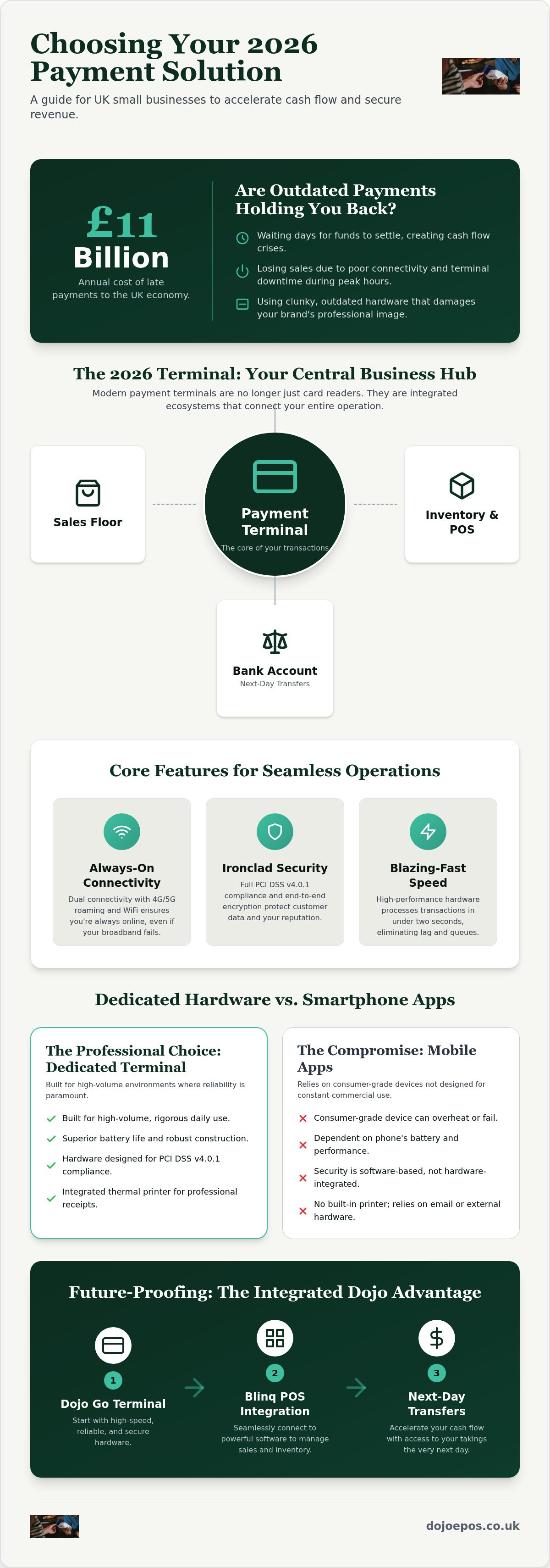
The days of the clunky, standalone card reader are over. In 2026, a small business payment terminal is a multifunctional hub that sits at the centre of your operations. It connects your sales floor to your bank account and your inventory, transforming a simple transaction into a data-driven growth opportunity. UK consumer behaviour has shifted decisively; shoppers now expect 100% contactless capability, whether they're using a physical card, a smartphone, or a wearable device. According to UK Finance, contactless payments already account for the vast majority of transactions, and that trend has only accelerated.
Modern commerce relies on a "Payment Ecosystem". This isn't just about the plastic in your hand. It's a synergy between high-performance hardware, intelligent software like Blinq POS, and rapid settlement through Next-Day Transfers. If you look back at the history of what is a payment terminal?, you'll see a transition from passive tools to active business partners that secure revenue and simplify your life behind the scenes.
The Evolution of Card Machines
Payment technology has moved at lightning speed. We've transitioned from the early days of "Chip and PIN" to a market dominated by biometric authentication and mobile wallets. Standalone terminals that require manual amount entry are being replaced by integrated smart devices. These machines talk directly to your point-of-sale system, eliminating human error and speeding up the queue. Beyond functionality, a professional, sleek aesthetic is now a requirement. Customers trust a business that uses premium, modern hardware, whilst outdated kit can make your brand feel stagnant and unreliable.
Why Dedicated Hardware Trumps Mobile Apps
Some providers suggest using a standard smartphone as a terminal, but for a serious business, dedicated hardware remains the gold standard. During a frantic lunch hour rush, you can't afford to rely on a consumer-grade device that might overheat or run out of battery. Dedicated terminals like Dojo Go are built for high-volume environments and offer reliability that mobile apps simply can't match. They're designed to handle the rigours of daily trade without failing when you need them most.
Security is another critical factor. Dedicated hardware is designed from the ground up to meet the latest PCI DSS v4.0.1 standards, keeping your customer data safe and your business compliant. Additionally, many sectors still require physical receipts. Having a built-in thermal printer ensures you can provide a professional service without fumbling with external accessories or forcing customers to provide an email address for a digital-only copy. Choosing a dedicated small business payment terminal ensures you stay fast, secure, and professional at every touchpoint.
Critical Features: Connectivity, Security, and Speed
Connectivity is the heartbeat of your checkout. Without a stable link, even the most advanced small business payment terminal becomes an expensive paperweight. In a high-pressure environment, you can't afford to wait for a spinning wheel whilst a queue forms at the door. Modern hardware now utilises 4G, 5G, and WiFi roaming to ensure you're always online, regardless of local broadband fluctuations. This level of reliability is what separates professional operations from those struggling with consumer-grade tech.
The 4G and WiFi Fail-Safe
For mobile businesses or those in areas with patchy service, "Dual Connectivity" is a non-negotiable requirement. Enterprise-grade terminals use roaming SIMs that automatically switch between major UK networks to find the strongest signal. This prevents downtime during local broadband outages, ensuring you never miss a sale. You can learn more about how this works in our Card Reader with WiFi and 4G: The Complete 2026 Merchant Guide. Unlike standard consumer WiFi, these systems are built to prioritise payment traffic, reducing processing latency to under two seconds.
PCI Compliance and Data Protection
Security isn't just about fraud prevention; it's about protecting your reputation. Every merchant must adhere to the Payment Card Industry Data Security Standard (PCI DSS). In 2026, the active standard is version 4.0.1, which focuses on continuous compliance and risk management. Modern terminals like Dojo Go automate much of this process, using end-to-end encryption to secure sensitive data from the moment a card is tapped. This protects both you and your customers, making compliance a background task rather than a manual burden.
Processing speed is the final piece of the puzzle. High-performance hardware eliminates the lag that frustrates customers and slows down your staff. When transactions are processed instantly, customer satisfaction improves, and your floor remains efficient. If you want to see how these features work together to support your growth, you can explore our latest high-speed payment solutions today. Investing in a terminal that prioritises connectivity and security ensures your business is built on a foundation of dependability.
Evaluating the Real Cost of Payment Processing
Choosing a small business payment terminal involves more than just picking a piece of hardware; it requires a clear understanding of the maths behind every tap. Many providers lure you in with low headline rates whilst hiding secondary costs in the fine print. To protect your margins, you must look beyond the surface and evaluate the total cost of ownership. This includes transaction margins, monthly service fees, and the impact of settlement speed on your daily operations.
Most providers offer "Blended Rates", which charge a flat percentage regardless of the card type used. This simplicity is often preferred by smaller merchants, but it can be more expensive if your customers primarily use basic debit cards. In contrast, "Interchange Plus Plus" pricing breaks down the specific costs from the card issuer and the network. Whilst this model is transparent, it is often too complex for businesses without a dedicated finance team. For a deeper dive into these structures, understanding credit card processing fees through independent analysis is essential to avoid overpaying.
Watch out for hidden extras that drain your profits. PCI management fees, statement charges, and non-compliance penalties can add up quickly. Choosing a partner that automates compliance and provides transparent billing ensures your revenue stays in your pocket. Additionally, consider the rental versus ownership model. Buying a terminal outright might seem cost-effective, but it leaves you responsible for repairs and stuck with outdated tech. A rental model ensures you always have access to the latest high-performance hardware and security updates.
Understanding Transaction Fees
Debit card transactions generally carry lower margins than premium credit or international cards. If your business processes under £100,000 annually, look for a transparent structure that doesn't penalise you for growth. Transaction fees across the UK market vary significantly between providers, and the lowest upfront rate often masks higher costs elsewhere. You can find a full breakdown of how to navigate these costs in our guide to Dojo Card Machine Rates: A Comprehensive UK Guide to Payment Fees in 2026.
The Cash Flow Factor
The most significant "hidden" cost is often the delay in receiving your money. Waiting three to seven days for settlement restricts your ability to restock inventory or cover payroll. Next-Day Transfers change the game by giving you access to your takings the following morning, even on weekends. This speed allows for better stock management and a real-time view of your business health via digital dashboards. In a competitive market, securing your cash flow with a fast small business payment terminal is a vital competitive advantage that supports your ambition rather than hindering it.
Choosing the Right Terminal for Your Sector
A restaurant's requirements differ wildly from those of a plumbing business or a high-street boutique. To maximise your investment, you must select a small business payment terminal that aligns with your specific operational pace. Efficiency isn't just about processing a card; it's about how the device integrates into your staff's workflow to remove friction and drive revenue. One size rarely fits all in the diverse UK market.
For service-based businesses, simplicity and flexibility are paramount. You might not need a permanent counter-top setup, but you certainly need a reliable way to take payments on-site or via remote payment links. Unified reporting through EPOS integration ensures that every transaction is logged in one place. This saves hours of manual reconciliation at the end of the month whilst providing a clear view of your business performance across all channels.
Optimising Table Turnover in Restaurants
In the hospitality sector, every minute saved is a boost to your bottom line. Handheld devices allow staff to take orders and payments directly at the table, significantly reducing travel time to a central till. This keeps waiters on the floor where they can provide better service and upsell more effectively. You can explore the latest tech in our guide to Handheld Card Machines: Faster Table Service in 2026. Integrated features like bill splitting and automated tipping are also essential, as they simplify the final moments of the guest experience and ensure your staff are rewarded for their hard work.
Mobile Selling for Retail and Pop-ups
Retailers are increasingly moving away from fixed checkout points to embrace floor-walking sales. This approach reduces queues and allows you to close sales the moment a customer makes a decision. Portable machines with robust battery life are vital for this, especially for pop-up shops or outdoor markets where power outlets are scarce. A dependable small business payment terminal with enterprise-grade battery performance ensures you can trade all day without interruption. For a deeper look at these mobile solutions, see our Portable Card Machines: Shop Floor Selling Guide 2026.
Ready to find the perfect fit? Explore our range of sector-specific payment solutions to see how the right hardware can transform your daily operations.
Future-Proofing with Dojo: The Integrated Advantage
As we've explored, a small business payment terminal must be more than a simple card reader; it's a growth engine for your brand. Dojo has already empowered over 110,000 businesses across the UK by providing the tools needed to thrive in a digital-first economy. By choosing a partner that prioritises speed and reliability, you ensure your business remains agile as consumer behaviours evolve. This isn't just about taking payments. It's about building a foundation for long-term success.
Dojo Go and Dojo Pocket: Which is for You?
Selecting the right hardware depends on your physical space and service style. Dojo Go is the powerhouse designed for busy counters and high-traffic restaurants. It's built for speed, processing transactions in under two seconds to keep your queues moving during peak hours. For businesses that require ultimate mobility, Dojo Pocket provides the same high-speed performance in a compact, smartphone-sized form. This makes it the perfect companion for floor-walking sales or table-side service. Both devices represent a significant leap forward in merchant technology, offering the dependability required for modern trade.
The Blinq POS Integration
Efficiency reaches its peak when your hardware and software work in perfect harmony. By connecting your terminal to Blinq POS software, you eliminate the need for manual amount entry. This removes the risk of human error and ensures your records are always accurate. Unified data allows you to see all your sales, stock levels, and staff performance in one central place, providing the insights needed to make informed decisions. Discover how Dojo can transform your business payments today.
Reliability is about more than just the tech; it's about the people behind it. Our UK-based support team understands the pressure of running a business and actually picks up the phone when you need help. Before you sign a contract with any provider, use this final checklist to ensure they meet your standards:
Do they offer Next-Day Transfers as standard, including weekends?
Is their support team based in the UK and easily accessible?
Does the terminal integrate seamlessly with your existing POS software?
Are there hidden fees for PCI compliance or monthly statements?
Will they help you switch by covering your current exit fees?
Choosing the right small business payment terminal is an investment in your future. By focusing on integrated payments and reliable settlement, you secure your revenue and simplify every transaction.
Take Control of Your Business Payments
Your choice of small business payment terminal determines how quickly you can reinvest in your growth. We've seen how critical connectivity and security are for maintaining customer trust, whilst integrated systems like Blinq POS remove the manual errors that drain your time. By prioritising hardware that offers dual-connectivity and rapid settlement, you ensure your business remains resilient in an increasingly competitive UK market. Reliability isn't just a feature; it's the foundation of your daily trade.
It's time to stop waiting days for your funds. Demand hardware that works as hard as you do. With a 4.7/5 Trustpilot rating and UK-based expert support available 7 days a week, Dojo provides the reliability you need to focus on your customers. You can switch to Dojo and get next-day transfers as standard, ensuring your takings hit your account even on weekends. Equip your business with the tools it deserves and join the thousands of UK merchants who have already upgraded their payment experience. Your future success starts with a faster, smarter checkout.
Frequently Asked Questions
What is the best card terminal for a small business in the UK?
The best terminal depends on your specific sector needs, but high-speed devices like Dojo Go are leading the market for busy environments. For businesses requiring mobility, Dojo Pocket offers a compact, powerful alternative. These machines provide transactions in under two seconds and come with next-day transfers as standard. This ensures you maintain a healthy cash flow whilst providing a professional experience that keeps your customers returning to your business.
How much does a small business payment terminal cost per month?
A small business payment terminal usually involves two main costs: a monthly hardware rental fee and a percentage-based commission on each transaction. These rates can vary based on your annual turnover and the types of cards your customers use. It's important to look for a provider that offers transparent billing without surprising you with extra charges. This dual-cost structure ensures you always have access to the latest secure technology and expert support.
Do I need a business bank account to use a payment terminal?
Yes, you generally need a dedicated business bank account to receive funds from your card transactions. This is a standard requirement for merchant services to ensure compliance with UK financial regulations and to keep your personal and professional finances separate. Having a business account also simplifies your tax returns and allows for smoother integration with your accounting processes. It ensures your next-day transfers are processed efficiently and securely into the correct account.
Can I take payments without a WiFi connection?
Absolutely, you can still process sales if your WiFi fails. Modern devices like Dojo Go feature dual-connectivity, meaning they automatically switch to a mobile data network, such as 4G or 5G, if the local broadband drops out. This fail-safe is essential for pop-up shops, outdoor markets, or mobile service providers. It ensures your small business payment terminal remains online at all times, preventing lost revenue during peak trading hours or connectivity outages.
What is the difference between a card reader and a payment terminal?
Whilst the terms are often used interchangeably, a card reader is typically a basic device that requires a smartphone or tablet to function. In contrast, a payment terminal is a standalone, multifunctional device with its own operating system, security features, and often a built-in printer. Terminals like Dojo Go offer faster processing speeds and superior reliability for high-volume trade. They provide a more professional aesthetic and don't rely on a secondary consumer device to take payments.
How long does it take to set up a new Dojo terminal?
Setting up a new Dojo terminal is designed to be incredibly fast and straightforward. Once your hardware arrives, you can usually be up and running in just a few minutes by following the simple on-screen instructions. There's no need for complex technical knowledge or lengthy configuration. This speed allows you to start accepting payments almost immediately, ensuring there's minimal disruption to your daily operations. Our UK-based support team is also available if you need any assistance.
Are there any hidden fees in card machine contracts?
Many traditional contracts include hidden costs like PCI management fees, statement charges, and non-compliance penalties. It's vital to choose a provider that prioritises transparency and simplifies the compliance process for you. Some modern providers will even help you switch by covering your current provider's exit fees. Always review your contract for any secondary costs that could drain your margins, ensuring your transaction rates are the only major variable in your monthly outgoings.
Can I integrate my payment terminal with my existing accounting software?
Yes, you can integrate your payment data with major accounting platforms to streamline your bookkeeping. This is often achieved through your point-of-sale software, such as Blinq POS, which syncs your transactions automatically. This integration eliminates the need for manual data entry, reducing the risk of errors and saving you hours of admin time every week. It provides a real-time view of your finances, making it much easier to manage your cash flow and tax obligations.


Comments