
Ultimate Guide to Contactless Card Machines for Shops 2026
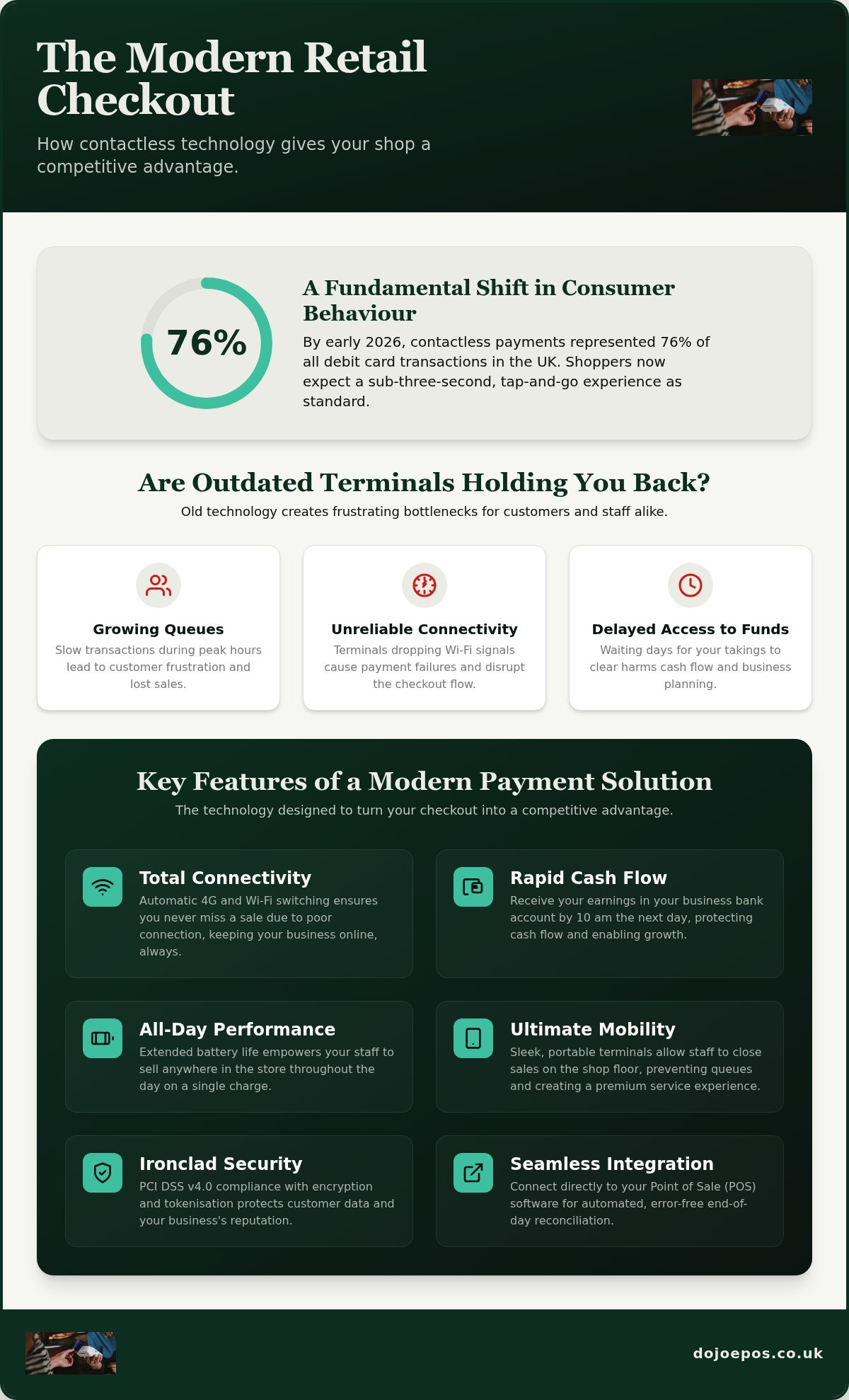
Did you know that by early 2026, contactless payments accounted for a staggering 76% of all debit card transactions in the UK? For retail owners, this shift means that the speed and reliability of your contactless card machines for shops are no longer just technical details; they are the heartbeat of your business. You've likely felt the frustration of watching a queue grow while a terminal hangs on a weak Wi-Fi signal, or the anxiety of waiting days for your Friday takings to finally clear in your bank account.
It's time to demand more from your payment technology. This guide will help you identify the tools needed to achieve lightning-fast customer turnover and total connectivity. We'll explore how modern hardware like the Dojo Go and Dojo Pocket utilise 4G and Wi-Fi switching to prevent missed sales, whilst ensuring you get access to your earnings by the next day. From understanding PCI DSS v4.0 compliance to integrating your POS software, you're about to discover how to transform your checkout from a bottleneck into a competitive advantage.
Table of Contents
What are Contactless Card Machines for Shops?
Modern retail moves at a relentless pace. Contactless card machines for shops are the specialised hardware that allow customers to pay by tapping their debit cards, credit cards, or smart devices against a terminal. This technology relies on Near Field Communication (NFC), a short-range wireless link that facilitates data exchange between the card and the reader. Unlike the clunky, "chip and pin" only devices of the past, today's terminals are built for speed and mobility. They require a dedicated merchant account to function, which acts as a holding area for funds before they are settled into your business bank account. Choosing the right provider ensures this process is seamless, moving money from the shop floor to your balance sheet with minimal delay.
The Rise of Contactless Payments in UK Retail
Consumer behaviour has shifted permanently. By early 2026, Contactless payment represented 76% of all debit card transactions in the UK. Shoppers no longer want to fumble with change or wait for a PIN to be authorised. They expect a sub-three-second transaction experience that mirrors the efficiency of their digital lives. With the surge in digital wallets like Apple Pay and Google Pay, your shop's ability to accept mobile payments is now essential. Beyond speed, these systems offer a significant hygiene advantage by reducing physical contact at the till, a factor that remains a priority for many high-street shoppers. If your checkout process is slow, you aren't just losing time; you're losing customers to competitors who offer a more agile experience.
How NFC Technology Protects Your Business
Security is the foundation of every successful transaction. When a customer taps their device, the terminal uses tokenisation and encryption to protect sensitive data. Instead of sharing actual card numbers, the system transmits a unique, one-time "token" that is useless to hackers. This makes modern contactless card machines for shops amongst the most secure ways to take revenue in 2026. NFC security relies on a proximity-based cryptographic handshake that ensures payment data is only transmitted within a range of four centimetres to prevent unauthorised interception. This high-tech barrier works behind the scenes, allowing you to focus on growth whilst your hardware handles the heavy lifting of fraud prevention. By adopting these standards, you protect your shop's reputation and ensure your cash flow remains shielded from the risks associated with older, less secure payment methods.
How Contactless Technology Streamlines High-Street Retail
High-street retail success depends on the flow of customers. If your checkout is slow, you're building a wall between your product and your profit. The latest contactless card machines for shops break down that barrier by facilitating rapid, tap-and-go interactions that take seconds. During peak trading hours, this speed is vital. It allows you to process a higher volume of transactions without staff feeling overwhelmed or customers becoming impatient. By removing the need for manual card insertion and PIN entry for most daily purchases, you also eliminate the common errors that lead to payment failures and administrative headaches. This allows you to organise your staff more effectively, moving team members from the till to the floor to assist more customers whilst footfall is at its highest.
Improving the Customer Checkout Experience
A friction-free environment is the foundation of loyalty. When shoppers see modern, high-tech hardware at the till, it elevates their perception of your brand. It signals that you value their time and stay current with technological shifts. Using portable card machines for retail allows your team to close sales anywhere in the store. This prevents bottlenecks at a single fixed point and creates a more personal, high-end service feel. When your staff can assist a customer and take payment on the spot, you turn a browsing session into a completed sale instantly. Reliable hardware is amongst the most important investments for any brick-and-mortar business looking to modernise its checkout experience.
Operational Efficiency Behind the Counter
Efficiency extends far beyond the moment of sale. Digital logs generated by modern terminals drastically reduce the time spent on end-of-day reconciliation. You no longer need to spend hours hunting for discrepancies in paper receipts or manual entry logs. These machines are engineered to handle high transaction volumes without lag or overheating, even during the busiest Saturday shifts. This reliability aligns with the UK's National Payments Vision, which emphasises the need for a resilient and innovative digital payment infrastructure. Intuitive interfaces also mean you can get new staff up to speed in minutes rather than days. If you want to see how these efficiencies can transform your daily operations, you should discover the benefits of integrated payments that link your sales data directly to your business management tools.
Comparing Portable and Integrated Card Terminals for Your Shop
Your hardware architecture defines the speed and accuracy of your shop floor. Whilst standalone readers work independently, integrated systems connect directly to your point-of-sale software to create a unified commerce environment. According to UK Finance payments data, mobile wallet adoption is surging, making the flexibility of your hardware more important than ever. Integrated contactless card machines for shops communicate directly with your till, automatically pushing the transaction total to the terminal. This eliminates double-keying errors, where a staff member might accidentally type the wrong amount, and significantly reduces the total time spent at the checkout.
Portable vs Countertop: Which Suits Your Layout?
Your choice depends on your shop's physical layout and how your customers prefer to interact with your team. A countertop powerhouse like the Dojo Go is perfect for fixed till points where reliability and high-volume processing are paramount. It provides a sturdy, professional presence at the main checkout hub. However, if you want to bust queues or offer a more personalised service, a handheld device like the Dojo Pocket is the ideal solution. It allows your staff to take payments anywhere on the shop floor, effectively turning every team member into a mobile checkout point. For these portable scenarios, having a card reader with WiFi and 4G is non-negotiable. It ensures your terminal stays connected even if your primary shop Wi-Fi experiences a momentary dip, preventing missed sales during critical trading windows.
The Power of Integrated EPOS Systems
True retail efficiency occurs when your hardware and software work as a single unit. Using Blinq POS software allows you to connect your inventory management directly to your card machine. Every tap at the terminal updates your stock levels in real-time, providing an accurate picture of your business at any moment. This level of oversight offers deep insights through real-time sales reporting, helping you manage your shop with precision and confidence. Whilst handheld card machines are often associated with hospitality, they are increasingly vital for retail environments where floor-based selling is the norm. By integrating your payments, you ensure that every transaction is logged accurately without manual intervention, making your end-of-day reconciliation faster and more dependable than ever before.
Essential Features for Shop Payment Terminals in 2026
Selecting the right contactless card machines for shops involves looking beyond the initial price tag. Low-cost, entry-level readers often hide significant costs in the form of slow processing speeds and frequent downtime. In a busy retail environment, these delays cost you more than just a transaction; they damage your reputation and frustrate your regulars. You need hardware that prioritises connectivity, endurance, and seamless security. These features aren't just "nice to have" additions; they are the fundamental tools that protect your revenue during peak trading periods.
Reliability and Connectivity
Wi-Fi outages are a persistent reality of high-street trading. If your terminal relies solely on a local network, a single router failure can bring your business to a standstill. The gold standard for 2026 is dual-sim 4G and Wi-Fi switching. This "always-on" technology ensures that if your Wi-Fi dips, your terminal instantly connects to a mobile network without interrupting the sale. Connectivity is the backbone of modern retail because it ensures your ability to trade remains independent of local infrastructure failures. It provides the peace of mind that every tap will be authorised, regardless of external technical hitches.
Your hardware must also possess the stamina to last through a full Saturday shift. There's nothing more disruptive than a machine that needs charging during your busiest trading window. High-performance terminals like the Dojo Go are engineered for endurance, ensuring they stay powered from the moment you open until the final customer leaves. This dependability allows your team to focus on service rather than hunting for charging cables whilst the shop is full.
Security and Compliance Simplified
Compliance shouldn't be a source of stress for independent retailers. Since March 31, 2025, meeting the full PCI DSS v4.0 standard has been mandatory for all businesses processing card data. This standard is rigorous and complex, but your provider should handle the heavy lifting. By using Point-to-Point Encryption (P2PE), sensitive data is protected from the moment a card is tapped until it reaches the bank. Dojo manages this compliance for you, allowing you to focus on running your business rather than navigating complex regulatory paperwork.
When technical questions arise, waiting for an email response isn't an option whilst your shop is open. Access to expert customer support is vital for maintaining a smooth operation. Having a dedicated partner who understands the daily challenges of commerce provides the reassurance you need to scale your business with confidence. If you're ready to upgrade your checkout with hardware that never lets you down, explore our range of high-performance card machines and discover the difference that professional-grade technology makes to your bottom line.
Optimising Your Shop’s Revenue with Dojo Payment Solutions
Success on the UK high street requires more than just a great product; it demands a payment partner that moves at the same speed as your business. Dojo Go and Dojo Pocket are engineered to be the ultimate contactless card machines for shops, providing the reliability you need to scale without friction. By choosing a solution tailored to your specific turnover, you benefit from simple, transparent rates that make financial planning straightforward. This isn't just about taking payments. It's about building a foundation for growth with a partner that understands the practical, day-to-day challenges of modern commerce.
Next-Day Transfers: Cash in Your Bank, Not in Limbo
Cash flow is the lifeblood of any retail operation. Waiting three to five working days for your hard-earned revenue to reach your account is a legacy behaviour that restricts your ability to restock or pay suppliers. With Dojo, next-day transfers come as standard, seven days a week. This means your Friday, Saturday, and Sunday takings are available to you by the next day, ensuring you always have the liquidity needed to seize new opportunities. Eliminating this settlement gap allows you to manage your finances with a level of agility that older systems simply cannot match. To understand how our pricing structures support this level of service, you can explore the details of Dojo card machine rates to find the best fit for your turnover.
The Dojo Advantage for UK Merchants
Aesthetics matter in a retail environment. The sleek, professional design of Dojo hardware complements your shop’s brand, signalling quality and modernity to every customer who taps their card. Beyond the look of the devices, the true value lies in the support system behind them. You get fast setup and 24/7 technical support, providing total peace of mind whilst your shop is open. If a question arises during a busy Saturday rush, an expert is always available to help you resolve it instantly. This commitment to service is why over 110,000 businesses already trust us to handle their payments. You're not just buying a terminal; you're joining a community of ambitious retailers who prioritise efficiency and reliability above all else. It's time to leave unreliable legacy tech behind and empower your shop with the tools it deserves for a successful 2026 and beyond.
Future-Proof Your Shop’s Payments
The retail landscape is evolving at a relentless pace; your hardware must keep pace to ensure you never miss a sale. By prioritising speed and dependability, you turn your checkout from a potential bottleneck into a streamlined engine for growth. Modern contactless card machines for shops provide the "always-on" connectivity and integrated reporting required to thrive in a competitive high-street environment. You now understand how dual-sim 4G switching and integrated POS software can transform your operational efficiency whilst protecting your professional reputation.
Don't let legacy technology or slow settlement times hold your business back. It's time to partner with an innovator that provides next-day transfers as standard and dedicated 24/7 UK-based support. Join over 110,000 businesses that have already upgraded their payment experience to a more agile, secure, and supportive model. Your shop’s ambition deserves hardware that works as hard as you do behind the scenes.
Switch to Dojo for fast, reliable shop payments today and take total control of your cash flow with confidence. Your journey towards a more efficient and profitable future begins with a single tap.
Frequently Asked Questions
How do contactless card machines for shops actually work?
Contactless card machines for shops work by using Near Field Communication (NFC) to establish a secure wireless link between the terminal and a payment device. When a customer taps their card or phone, the machine initiates a cryptographic handshake within a four-centimetre range. This exchange transmits an encrypted token rather than actual card details. It is a fast, efficient process that allows you to complete transactions in under three seconds whilst maintaining high security standards.
Is there a limit on contactless payments in the UK for 2026?
As of September 2026, the mandatory £100 limit per transaction was removed by the Financial Conduct Authority. However, most major UK banks, including Barclays and NatWest, have chosen to maintain the £100 ceiling for physical cards to protect against theft. Mobile wallet payments like Apple Pay and Google Pay don't have this restriction because they use biometric authentication on the device to verify the user's identity securely and instantly.
Do I need a Wi-Fi connection to use a contactless card machine?
You don't need a fixed Wi-Fi connection if your terminal supports mobile data. Modern contactless card machines for shops, such as the Dojo Go, utilise dual-sim 4G and Wi-Fi switching to ensure constant connectivity. This means if your shop's router fails, the machine instantly switches to a mobile network. This "always-on" capability is essential for independent retailers who cannot afford to miss a sale due to local internet outages.
How much do contactless card machines cost for a small shop?
Costs for small shops typically involve a combination of monthly hardware rental and transaction-based commission fees. Industry averages for transaction fees generally range between 0.95% and 1.75% per tap. Monthly terminal rental often starts from around £13.99 plus VAT depending on the provider. It is important to choose a plan that matches your shop's turnover to ensure you aren't overpaying for services or features that your business does not require.
Can I take contactless payments on my phone instead of a machine?
You can use "Tap-to-Phone" technology to accept payments directly on a smartphone, but dedicated hardware is usually preferred for high-street retail. Professional terminals like the Dojo Pocket offer superior battery life, faster processing, and integrated receipt printing that consumer phones lack. Customers often feel more comfortable tapping their cards on a dedicated, secure-looking device. This builds trust and maintains a professional aesthetic that complements your shop's overall brand identity.
How long does it take for the money to reach my bank account?
With Dojo, your earnings reach your bank account the very next day, including weekends and bank holidays. This is a significant improvement over legacy providers that often keep funds in limbo for three to five working days. Fast access to your revenue is vital for managing shop stock and paying suppliers promptly. Next-day transfers ensure your cash flow remains fluid, allowing you to reinvest in your business growth without any delay.
Are contactless card machines safe from hackers and fraud?
Contactless payments are highly secure and protected by the latest PCI DSS v4.0 standards. Every transaction uses tokenisation and Point-to-Point Encryption (P2PE) to ensure that sensitive cardholder data is never exposed to hackers. Fraud rates for contactless taps remain extremely low. Additionally, banks require a PIN entry after a certain number of consecutive transactions or a cumulative spending threshold to re-verify the customer's identity and prevent unauthorised use of the card.
What is the difference between a portable and a mobile card machine?
Portable card machines usually operate via Wi-Fi or Bluetooth within a specific range of a base station or router on your shop floor. Mobile card machines use GPRS or 4G technology to process payments anywhere with a cellular signal across the UK. Modern terminals often combine both features. This allows your team to serve customers at the till or move freely amongst the aisles to take payments exactly where the sale happens.


Comments