
What Is a Chargeback? A UK Business Guide to Payment Disputes
A chargeback isn’t a routine refund, and it doesn’t guarantee that a customer will get their money back. For a business, understanding what is a chargeback means recognising that a customer has asked their bank to dispute a card payment. The transaction may then be reviewed, and funds could be debited or held while the case is considered.
If you’ve dealt with a customer complaint, a payment query or an unfamiliar notice from your provider, you’ll know how quickly uncertainty can create extra admin. A refund is handled directly between you and the customer. A chargeback follows a card-scheme dispute process, which may affect your funds while the case is investigated.
This guide explains why chargebacks happen, how the process differs from refunds and information requests, and what to expect as a dispute moves forward. You’ll also find a practical response checklist, examples of records that may help, and ways to improve payment processes and customer communication.
Table of Contents
What is a chargeback, and why should UK businesses understand it?
If you’re asking what is a chargeback, the plain-English answer is that it’s a card payment dispute raised by a cardholder through their bank. The bank can pass the dispute through the relevant card network and payment chain, prompting a review of the transaction. A chargeback may result in the payment being reversed, but the initial dispute is not a final decision and doesn’t mean the merchant has automatically lost.
A chargeback is a card-scheme dispute initiated through the customer’s bank; a refund is a repayment the merchant issues directly through its own process. The distinction matters when you’re deciding how to respond to a complaint. A merchant may resolve an issue by issuing a refund, while a chargeback follows the relevant scheme’s procedures. The Chargeback overview provides useful background, but the rules and steps for a particular case can vary by card scheme and dispute reason.
What happens to the payment when a chargeback is raised?
The cardholder contacts their bank to challenge a transaction. If the bank proceeds, it raises the dispute through the relevant payment network. The merchant’s payment chain may then ask for transaction information or evidence to pass on for consideration. Depending on the case and applicable rules, funds may be debited or held during the process. The outcome and timing depend on the dispute, the evidence and the rules that apply.
A request for information may come before a formal chargeback, but it doesn’t happen in every case. When you receive a notice, identify the transaction, note what is being challenged and follow the response instructions. The stages and terminology can differ, so don’t assume every case follows the same route.
Why chargebacks matter to merchants
A disputed payment can mean lost revenue if the decision goes against the business. It can also create administrative work: staff may need to find receipts, order or delivery records, and relevant customer communications, then prepare a response within the stated timeframe. Even when a dispute is resolved in the merchant’s favour, the process takes time and attention away from serving customers.
There’s a customer relationship to consider, too. A dispute may reflect a misunderstanding, an unrecognised transaction or an unresolved service issue. It isn’t proof that the customer committed fraud. Respond calmly, check the available records and use them to understand what happened.
Repeated disputes can bring additional scrutiny, but consequences aren’t automatic or identical for every business. Card schemes and payment providers may apply monitoring rules, thresholds or actions that vary by scheme and circumstances. Clear transaction records and customer communications make it easier to review each case and spot recurring issues.
How does the chargeback process work from dispute to decision?
The route from a customer’s concern to a chargeback decision isn’t always the same. It depends on the card scheme, the reason for the dispute and the process used by the parties handling the payment. For a merchant, the practical priorities are to act promptly, understand what information is requested and keep a clear record of each step.
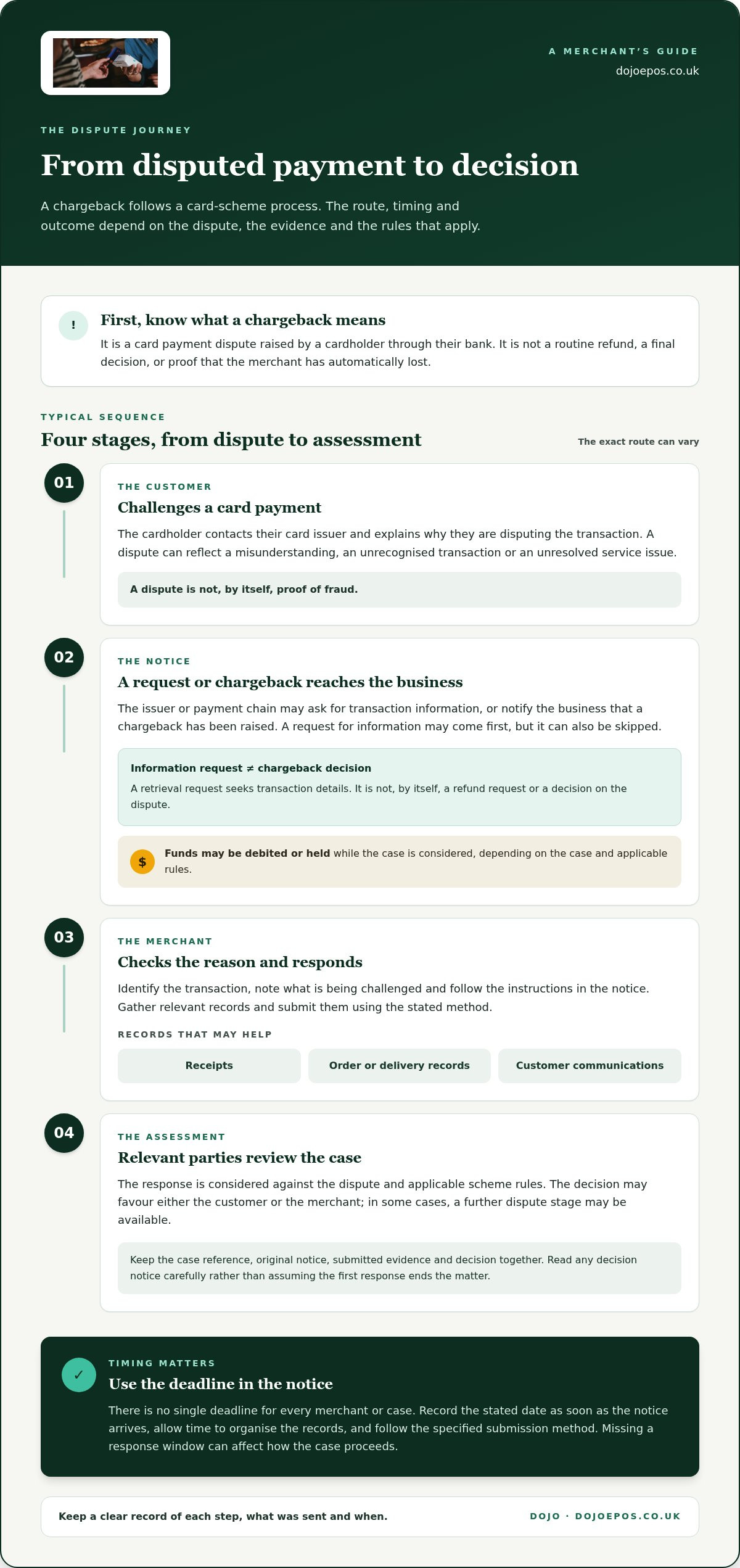
A typical sequence looks like this:
The customer disputes a payment: They contact their card issuer and explain why they’re challenging the transaction.
A notice reaches the merchant: The issuer or payment chain may send an information request or notify the business that a chargeback has been raised.
The merchant responds: The business reviews the stated reason, gathers relevant records and follows the response instructions.
The case is assessed: The issuer or other relevant parties consider the information under the applicable scheme rules. The decision may favour either side, and further dispute stages may be available in some cases.
There isn’t one deadline that applies to every merchant or case. Follow the date and submission method in the notice, and allow time to find and organise the relevant records. Missing a response window can affect how the case proceeds, so record the deadline as soon as the notice arrives.
What is a retrieval request, and is it the same as a chargeback?
A retrieval request, sometimes called a request for information, asks the merchant or its payment chain to supply details about a transaction. A retrieval request seeks transaction information; it isn’t, by itself, a request for a refund or a decision on a chargeback. The response provides records for review, but doesn’t determine the dispute. A retrieval request may come before a chargeback, though it can also be skipped. Terminology and procedures vary between payment schemes.
What happens after a merchant submits a response?
The issuer or other relevant parties assess the response against the dispute and applicable rules. The outcome may uphold the customer’s dispute or find in the merchant’s favour. Depending on the scheme and circumstances, another stage may follow. Read any decision notice carefully rather than assuming the first response ends the matter.
Keep the case reference, original notice, submitted evidence and decision together. A consistent record shows what was sent, when it was submitted and what the outcome was. It also helps staff handle follow-up questions without piecing the case together from scattered emails or till records.
Accurate payment records and clear customer communications support a more organised response process. For an overview of payment solutions for businesses, see how Dojo brings payment options together for merchants.
Chargeback vs refund vs Section 75: what is the difference?
These routes can all relate to a disputed purchase, but they work differently. If you’re asking what is a chargeback, think of it as a card-scheme dispute raised through the customer’s bank, not a refund processed by your business. Section 75 is different again: it’s a legal protection that may apply to qualifying credit-card purchases.
Is a chargeback the same as getting a refund?
No. A refund is a direct merchant action: your business agrees to return the payment and processes it through its usual payment workflow. A chargeback starts with the cardholder’s bank and follows dispute procedures. The merchant may be asked to provide information, but doesn’t control the bank or scheme’s decision.
Clear refund terms and prompt, well-documented handling can help customers understand what to expect and reduce avoidable confusion. They can’t prevent every dispute. Keep a record of the customer’s request, your response and any refund issued, so your transaction records match what the customer was told.
How is chargeback different from Section 75?
Section 75 of the Consumer Credit Act 1974 may apply when a customer uses a credit card to buy a single item priced between £100 and £30,000, subject to qualifying conditions. It can make the credit-card provider jointly liable with the retailer for breach of contract or misrepresentation. It’s not the same as a card-scheme chargeback and doesn’t apply to debit-card purchases.
For merchants, accurate order details, payment records and customer communications help clarify what was purchased, how an issue was handled and whether a refund was made. The relevant process determines what evidence is considered. Section 75 claims involve legal conditions, so customers should consult Section 75 of the Consumer Credit Act or seek independent guidance for their circumstances. This overview isn’t legal advice.
What should a business do when it receives a chargeback?
Knowing what is a chargeback is only the starting point. Once a notice arrives, a clear process helps you respond on time and focus on the facts. Work through these steps:
Read the notice carefully. Identify the transaction, the stated dispute reason and any instructions for responding.
Record the deadline. Add it to your calendar or case tracker straight away. Follow the date and submission method in the notice, as response windows can vary.
Match evidence to the reason. Choose records that directly address what the customer is disputing, rather than sending every document you can find.
Submit a concise response. Explain how the evidence relates to the dispute and use the payment-provider process specified in the notice.
Keep a complete case file. Save the notice, case reference, response, submitted evidence and any decision together.
Evidence can support your account of what happened, but it can’t guarantee a particular result. Decisions depend on the case facts and the rules that apply.
What evidence can help a merchant respond?
Choose records that address the specific claim. Depending on the transaction, useful evidence may include a receipt, order details, proof of delivery, records showing that a service was provided, or relevant customer correspondence. For card-present sales, retain available transaction and fulfilment details. Share only information relevant to the dispute, and handle personal data in line with applicable data-protection requirements.
For example, if a customer says an order didn’t arrive, delivery confirmation may be more relevant than a general description of your returns policy. Keep records organised as part of your normal payment operations, so you’re not reconstructing the timeline under pressure.
How can a business reduce avoidable chargebacks?
Make purchases easy for customers to recognise and understand. Use a clear payment descriptor, make delivery, cancellation and refund terms easy to find, and check transaction amounts before processing payments. Take care to avoid duplicate transactions. These steps can reduce confusion, though they won’t prevent every dispute.
Train staff to respond promptly to payment queries and record what was discussed and how the issue was resolved. Consistent receipts and customer communications make it easier to trace a transaction and identify processes that may need attention.
Clear payment operations can support a better customer experience. Explore Dojo payment solutions for card-present and online payments.
How can better payment operations help businesses manage chargeback risk?
Good payment operations won’t eliminate disputes or guarantee a particular outcome. They can make transactions easier to trace, customer concerns easier to resolve and evidence easier to assemble if a case arises. Understanding what is a chargeback helps you build everyday processes that support a clear account of each payment.
Which everyday processes can make disputes easier to handle?
Keep transaction, fulfilment and refund records organised, with access limited to staff who need them. Use consistent steps for cancellations, refunds, duplicate payments and customer queries, and record the action taken. If a customer questions a payment, staff should be able to follow the same process and leave a clear record of the conversation and resolution.
Review disputes alongside complaints and refund requests. Look for patterns: perhaps customers regularly misunderstand a billing description, struggle to find cancellation terms or are confused by a delivery update. Treat these as signals to investigate, not proof of a single cause. Improving an unclear step in the customer journey may reduce avoidable confusion, but it can’t prevent every dispute.
Where do payment solutions fit into the picture?
Card-present and online payment operations create different transaction records, but both benefit from consistent, accessible information. Receipts, transaction details and clear customer communications can help authorised staff connect a payment to a purchase and understand what happened. Payment technology supports the transaction process; it doesn’t decide a dispute or guarantee that a chargeback will be resolved in your favour.
Dojo is a UK-based payment provider offering card-present and online payment solutions, including payment hardware, integrated payments and Blinq POS software. Dojo’s payment options can support day-to-day payment operations, while clear record-keeping and customer service remain essential when handling queries and reviewing recurring issues.
Explore Dojo payment solutions for your business to see options for your payment needs.
Build a clearer approach to payment disputes
Knowing what is a chargeback helps you distinguish a card-scheme dispute from a refund handled directly by your business. That difference shapes what to do next: check the notice, note the deadline and respond with evidence that addresses the stated reason. Keep transaction records and customer communications organised so your team can act clearly and consistently.
Strong day-to-day payment processes can make disputes easier to investigate, though they can’t guarantee an outcome or prevent every chargeback. Clear payment information, consistent refund handling and regular reviews of recurring complaints can help you spot where customer journeys or internal procedures need attention.
Dojo provides card-present and online payment solutions, including payment hardware, integrated payments and Blinq POS software. Explore Dojo payment solutions for your business to find options that support your payment operations.
Frequently Asked Questions
What is a chargeback in simple terms?
A chargeback is a card payment dispute that a customer raises through their bank. The bank may pass it through the relevant card-scheme process, which can lead to the payment being reversed. A chargeback isn’t the same as a merchant refund, and the initial dispute doesn’t decide the final outcome. The business may be asked to provide information or evidence in response.
How does a chargeback work for a business?
A business is notified when a customer disputes a card transaction through their bank. The notice should identify the transaction and usually include a reason and instructions for responding. The merchant checks the details, gathers relevant records and submits a response through the stated payment-provider process. The case is then assessed under applicable rules. The decision may favour the customer or the business, and further stages may apply.
What are the most common reasons for a chargeback?
Common reasons include a customer not recognising a payment, claiming goods didn’t arrive, disputing the quality or description of goods or services, or spotting a duplicate transaction. A customer may also challenge a payment they believe was unauthorised. A dispute alone doesn’t prove fraud or show that the merchant made an error. Check the reason given in the notice, as it determines which records may be relevant.
Can a business dispute a chargeback?
Yes, a business can usually respond to a chargeback by following the instructions in its notice and providing relevant evidence. For example, a delivery dispute may call for order details and delivery confirmation, whilst a service dispute may need records showing what was provided and related customer communications. A response doesn’t guarantee success. The decision depends on the evidence, case facts and applicable card-scheme rules.
Is a chargeback the same as a refund?
No. A refund is issued by the merchant through its normal process, often after a customer requests one or the business agrees to resolve an issue. A chargeback starts when the customer asks their bank to dispute a card payment. It follows card-scheme procedures rather than the merchant’s ordinary refund workflow. Clear refund communication can reduce confusion, but it can’t prevent every dispute or control its outcome.
How long does a business have to respond to a chargeback?
There isn’t one response deadline that applies to every chargeback. The timeframe and submission instructions depend on the notice and the process used for that case. Read the notice promptly, record the deadline and allow time to gather the relevant evidence. If you miss the specified window, it may affect how the case proceeds. Keep a copy of the notice and submitted response with the case records.
What evidence should a business provide for a chargeback dispute?
Provide records that directly address the stated dispute reason. Depending on the case, these may include a payment receipt, order details, delivery confirmation, records showing a service was provided, or relevant customer correspondence. For a claimed duplicate payment, transaction records can help clarify what was processed. Keep the response concise, follow the submission instructions and share only relevant information, handling personal data in line with applicable requirements.


Comments